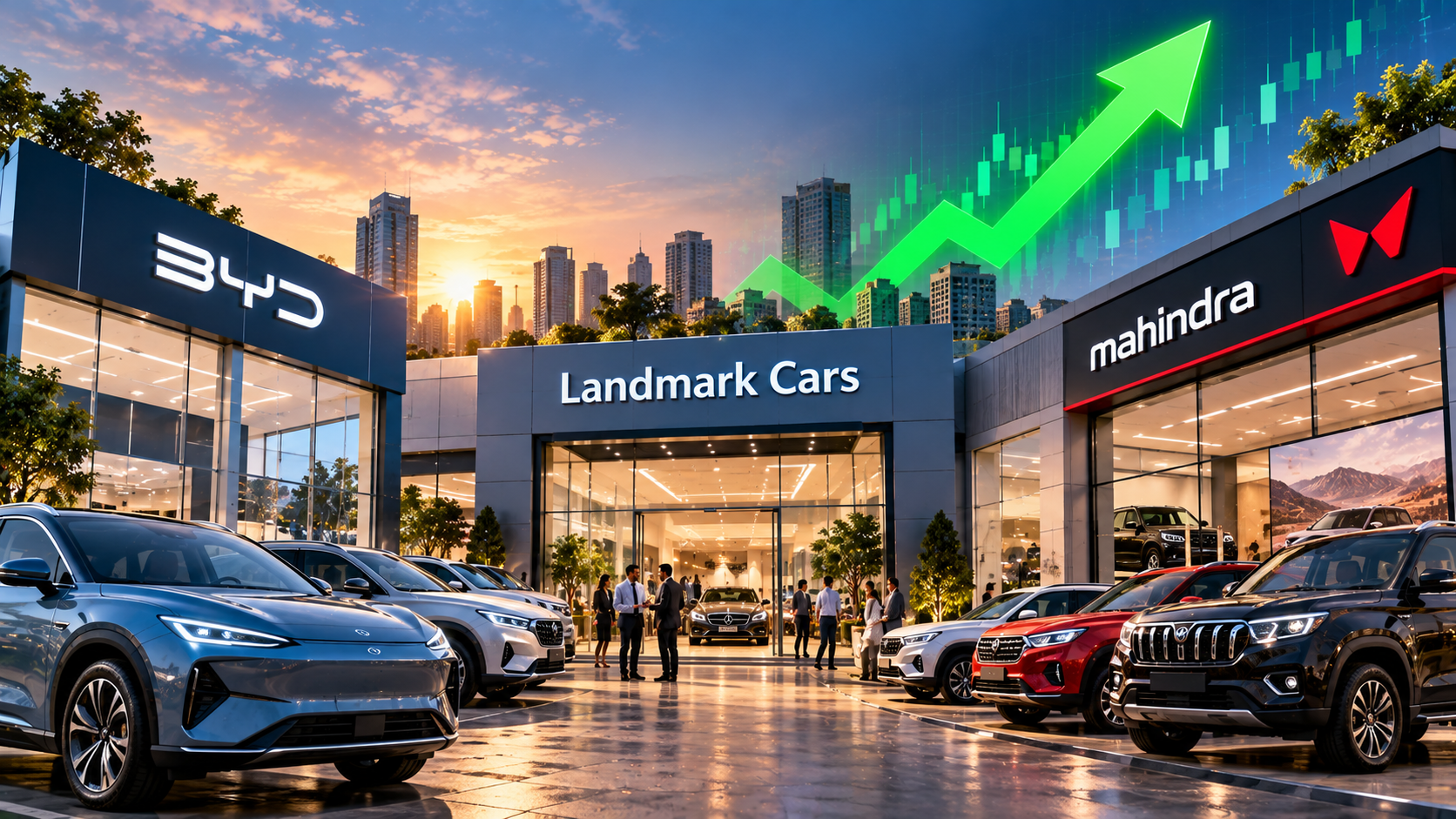
Landmark Cars Stock Jumps Despite Market Sell-Off
Shares of Landmark Cars Ltd surged as much as 12% during Tuesday's trading session, sharply outperforming a weak broader equity market.
The stock climbed to ₹535.80 on the BSE during intraday trade after the company announced the addition of a BYD facility in Noida and a new Mahindra & Mahindra (M&M) showroom at EM Bypass in Kolkata, West Bengal. Heavy trading activity accompanied the move, with millions of shares changing hands across the NSE and BSE.
The sharp rally came even as the broader market remained under pressure, making the stock's relative strength particularly notable.
BYD and M&M Expansion Drives Investor Interest
The immediate trigger for the buying interest was Landmark Cars' announcement that it is expanding its dealership footprint with two new facilities.
The Noida facility strengthens the company's relationship with BYD, for which Landmark Cars is the largest retail and service partner in India. The Kolkata showroom, meanwhile, expands Landmark's presence with M&M in the eastern market.
The company has said the additions are part of its long-term strategy of deepening engagement with existing original equipment manufacturer (OEM) partners rather than simply expanding its network for the sake of outlet numbers.
Following these additions, Landmark Cars will have 11 BYD outlets and 12 M&M outlets, taking its overall network to 143 outlets across India.
EV Business Becomes an Important Growth Driver
One of the most important elements of Landmark Cars' expansion strategy is its increasing exposure to electric vehicles.
The company said its EV portfolio contributed around 30% of new-car sales revenue in Q1 FY27, with BYD and M&M among the leading EV brands within its portfolio.
The development is significant because India's automobile market is gradually moving towards greater electrification, particularly in premium passenger vehicles and SUVs.
For an automotive retailer, having access to a wider range of EV brands can create opportunities across several stages of the customer lifecycle, including vehicle sales, servicing, accessories, financing and insurance.
Multi-Brand Strategy Reduces Dependence on One OEM
Landmark Cars operates a diversified dealership portfolio covering premium, luxury, mass-market and electric-vehicle brands.
Its portfolio includes Mercedes-Benz, Honda, Jeep, Volkswagen, BYD, Renault, Mahindra & Mahindra, Kia, MG Motor and Citroën, along with commercial vehicle retail operations for Ashok Leyland.
This multi-brand structure allows the company to participate in different segments of India's automotive market instead of relying exclusively on one manufacturer.
The strategy also gives Landmark exposure to multiple customer segments, geographic markets and vehicle categories.
After-Sales Business Adds Recurring Revenue
Landmark Cars' business model extends beyond the initial sale of a vehicle.
The company generates revenue from after-sales servicing and repairs, spare parts, accessories, pre-owned vehicles and facilitation of financing and insurance products.
This creates opportunities to maintain relationships with customers after the original vehicle purchase and potentially generate revenue throughout the vehicle ownership cycle.
The company's expansion of showroom and workshop infrastructure can therefore have implications beyond new-car volumes, as a larger vehicle parc can eventually support higher after-sales activity.
Q1 FY27 Financial Performance
Landmark Cars' latest quarterly financial data also provides some context for the market's interest in the company.
For Q1 FY27, revenue stood at approximately ₹1,302.36 crore, representing year-on-year growth of 22.67%. Operating profit increased 17.99% year-on-year to ₹72.01 crore.
Profit before tax rose 93.63% year-on-year to ₹19.15 crore, while net profit increased 97.42% to ₹14.55 crore.
The figures indicate that the company's expansion is occurring alongside significant year-on-year growth in revenue and profitability, although quarterly numbers can be affected by dealership ramp-up costs, vehicle mix, inventory and other operating factors.
Network Expansion Remains Central to the Strategy
Landmark Cars has been steadily expanding its dealership network across multiple brands and geographies.
Company disclosures earlier in 2026 showed a network of 141 outlets across 12 states and 29 cities, including 76 sales showrooms and 65 workshops. The company has continued adding facilities since then.
The strategy is designed to increase geographic reach while strengthening relationships with OEM partners.
For dealership businesses, the success of such expansion ultimately depends on how quickly new locations achieve sufficient sales volumes and profitability.
Pre-Owned Cars Offer Another Growth Avenue
Landmark Cars is also expanding beyond traditional new-car retail.
Earlier this month, the company announced a strategic partnership with OLX India to develop an integrated physical-and-digital platform for pre-owned vehicle transactions.
Under the partnership, Landmark's network of more than 140 retail and service touchpoints will be integrated with OLX India's digital automotive platform. The proposed model combines online vehicle discovery with physical inspection, test drives, financing, registration support and after-sales services.
The move could help Landmark participate more extensively in India's large used-car market while leveraging its existing physical infrastructure.
Premiumisation Supports Long-Term Opportunity
The Indian passenger vehicle market is undergoing structural changes, including rising consumer aspirations, premiumisation and greater formalisation of automotive retail.
Landmark's portfolio gives it exposure to premium and luxury vehicles as well as mass-market and EV categories.
The company's annual-report commentary has highlighted low vehicle penetration, rising aspirations and increasing formalisation as long-term drivers for India's automotive retail industry.
At the same time, dealership expansion requires disciplined capital allocation because new facilities need time to reach mature utilisation levels.
Key Risks Investors Should Monitor
Despite the sharp stock-price reaction, investors should also consider the risks associated with the business model.
The dealership industry remains sensitive to vehicle demand, interest rates, consumer confidence, inventory levels and OEM policies. Rapid network expansion can also increase fixed costs before new outlets reach optimal scale.
Changes in OEM relationships, competition between dealerships and direct-to-consumer initiatives could affect individual retailers.
The EV transition also presents both an opportunity and a challenge. While EVs can expand the addressable market, their after-sales requirements differ from conventional internal-combustion vehicles, potentially changing the economics of dealership servicing over time.
Market Outlook
Landmark Cars' latest expansion reinforces three key themes in its business: multi-brand diversification, increasing EV exposure and deeper OEM partnerships.
The addition of the BYD facility in Noida and M&M showroom in Kolkata expands the company's geographic footprint while increasing its presence in two brands that are important to its EV and passenger-vehicle strategy. The company's reported 30% EV contribution to new-car sales revenue in Q1 FY27 further highlights the growing importance of electric vehicles to its portfolio.
The recent stock rally has occurred against a weak market backdrop, meaning investors are responding to company-specific developments rather than simply broader market strength. However, after a sharp one-day move, the sustainability of the rally will depend on execution at the new outlets, dealership profitability, vehicle volumes, after-sales growth and the performance of its OEM partners.
The expansion of the pre-owned vehicle business through the OLX partnership could provide another avenue for growth, while the company's diversified brand portfolio may help it participate across multiple segments of India's evolving automotive market.