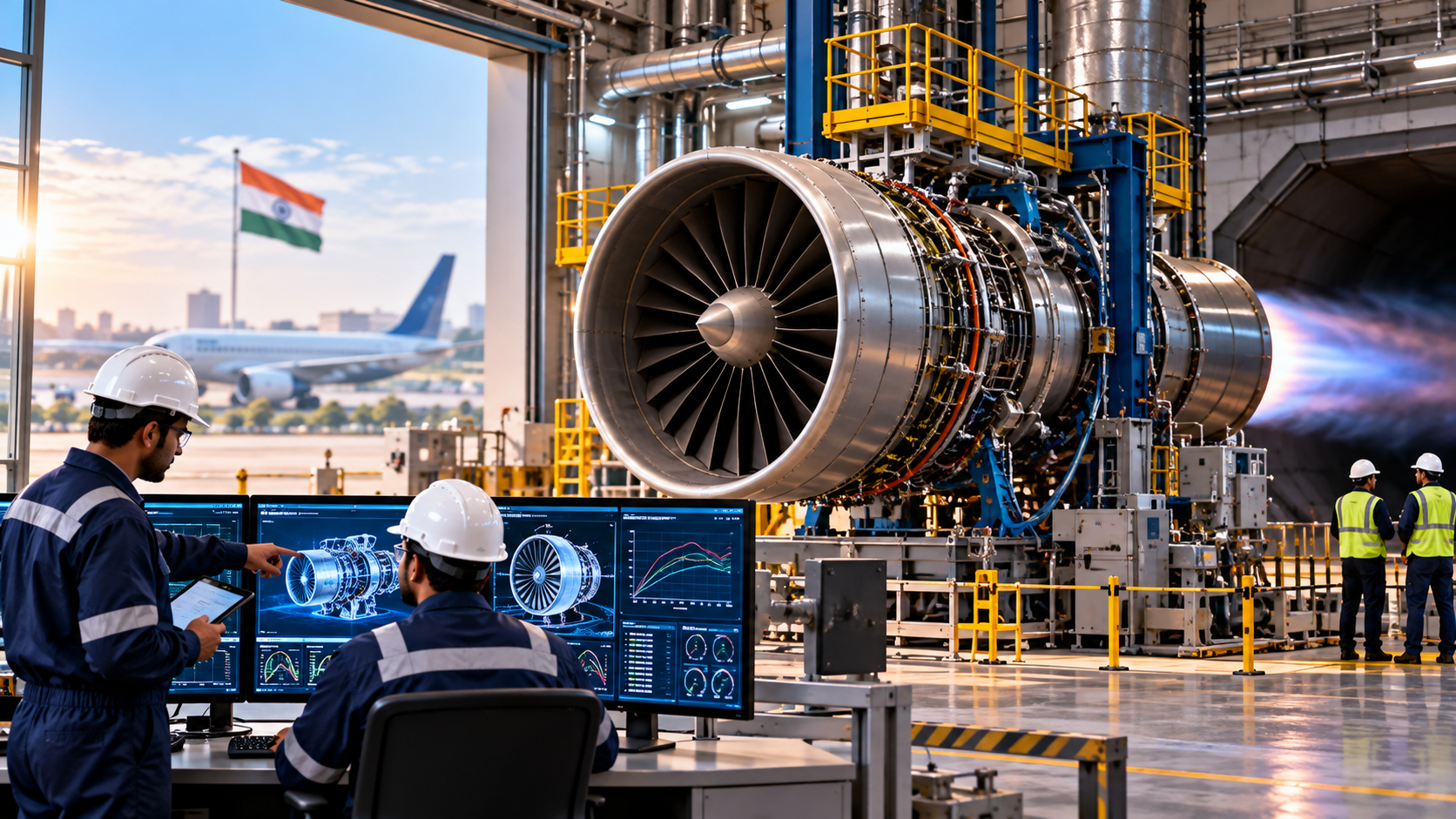
Strategic partnership combines Tata Projects’ infrastructure capabilities with MDS Aero’s global gas-turbine testing expertise to support India’s expanding aerospace and propulsion ecosystem
Tata Projects has entered into a strategic partnership with Canada-based MDS Aero Support Corporation to develop advanced aero-engine testing infrastructure in India, marking a further step toward strengthening the country’s capabilities across aerospace, propulsion and high-end engineering.
The partnership brings together Tata Projects’ experience in executing complex infrastructure projects with MDS Aero’s specialised expertise in the design and development of gas-turbine engine testing facilities.
The companies said the collaboration is aimed at supporting India’s rapidly expanding aerospace and propulsion ecosystem, where demand for advanced testing, validation and engineering infrastructure is expected to grow alongside investments in aircraft manufacturing and defence technologies.
Tata Projects to Lead Major Infrastructure Components
Under the partnership, Tata Projects will be responsible for several critical infrastructure components required for sophisticated aero-engine testing facilities.
Its scope will include civil and structural works, mechanical, electrical and plumbing systems, high-air-pressure systems, HVAC infrastructure, high-temperature exhaust systems and cooling-water systems.
The company will also undertake associated site infrastructure required to support the operation of specialised testing facilities.
Such infrastructure is critical because aero-engine testing involves highly controlled environments and complex systems capable of handling extreme temperatures, pressures, airflow and exhaust conditions.
MDS Aero to Provide Engine-Testing Expertise
MDS Aero Support will contribute its specialised capabilities in the design, engineering, supply, integration and commissioning of advanced gas-turbine engine test facilities.
The Canadian company will also provide lifecycle support for testing systems, giving the partnership an end-to-end capability spanning facility development through operational support.
MDS has experience delivering gas-turbine engine testing projects across international markets. Founded in 1985, the company has executed projects in more than 27 countries and developed turnkey testing capabilities for engine components used in aviation, defence and industrial applications.
India’s Aerospace Ecosystem Enters a New Phase
The partnership comes as India’s aerospace sector expands beyond traditional aircraft maintenance and component manufacturing toward more sophisticated activities involving aircraft production, propulsion systems, testing and advanced technologies.
Rajiv Menon, President and Chief Growth and Strategy Officer at Tata Projects, said India’s aerospace ecosystem is entering a new phase, with growing ambitions across aircraft manufacturing, propulsion, testing and advanced technologies.
He also highlighted the importance of building supporting infrastructure alongside these technological capabilities.
The development of specialised testing infrastructure can be particularly important for aerospace manufacturers because engines and propulsion systems require extensive validation before being deployed in operational aircraft.
Why Aero-Engine Testing Infrastructure Matters
Engine testing is an essential stage in the aerospace development cycle. It allows manufacturers and engineers to assess performance, reliability, efficiency and safety under controlled conditions.
Testing facilities can be used for development and validation of engines and components, as well as for research, troubleshooting and performance optimisation.
Advanced test infrastructure also requires sophisticated systems to manage high temperatures, exhaust gases, cooling requirements, airflow and pressure. This makes the construction of such facilities significantly more specialised than conventional industrial infrastructure.
For India, developing these capabilities domestically could strengthen the broader aerospace supply chain and support companies involved in aircraft engines, components, defence propulsion and related technologies.
Potential Benefits for India’s Aerospace Supply Chain
The partnership could contribute to the development of a stronger domestic ecosystem around aerospace testing and engineering.
As aerospace manufacturing expands, the availability of specialised testing infrastructure can reduce dependence on overseas facilities for certain development and validation requirements. It can also create opportunities for Indian engineering, construction, technology and equipment suppliers to participate in high-value aerospace projects.
The collaboration may therefore have implications beyond the immediate infrastructure projects, particularly if India continues to expand its role in global aerospace manufacturing and defence production.
Canada-India Aerospace and Technology Cooperation
The partnership also highlights the potential for deeper technology and engineering cooperation between India and Canada.
Joe Hajjar, Chief Revenue Officer at MDS Aero Support Corporation, said the companies bring together local execution capabilities and global engine-testing expertise while supporting India’s growing aerospace sector.
The collaboration could provide a platform for combining international technology expertise with Indian project execution and infrastructure capabilities.
Strategic Importance for Defence and Civil Aviation
Aero-engine technology has applications across both civil aviation and defence. Advanced testing facilities can support the development and validation of systems used in commercial aircraft, military platforms and industrial gas turbines.
India’s focus on expanding domestic aerospace and defence manufacturing has increased the importance of specialised engineering infrastructure, including testing and certification capabilities.
The creation of more advanced domestic facilities could support the wider objective of building an integrated aerospace ecosystem rather than focusing solely on final assembly or component production.
Opportunities for Engineering and Infrastructure Companies
The project also reflects the increasing complexity of infrastructure requirements emerging from India’s high-technology manufacturing ambitions.
Traditional construction capabilities are increasingly being combined with specialised mechanical, electrical, environmental-control and industrial systems.
For infrastructure companies, participation in such projects can provide exposure to higher-value engineering and technology-intensive segments. However, execution of aerospace-related infrastructure also requires strict technical specifications, specialised expertise and adherence to demanding safety and quality standards.
What to Watch Ahead
The key developments to watch will be the specific testing facilities to be developed under the partnership, project timelines, investment commitments and the types of engines or propulsion systems that the infrastructure will support.
The scale of future aerospace manufacturing and propulsion programmes in India will also influence demand for specialised testing infrastructure.
If India continues to expand domestic aircraft, defence and propulsion capabilities, demand for advanced testing and validation facilities could become an increasingly important part of the aerospace value chain.
Market Outlook
The Tata Projects-MDS Aero partnership is strategically relevant to India’s broader aerospace, defence and advanced manufacturing ambitions. While the immediate financial impact on Tata Projects is dependent on the scale and execution of future projects, the collaboration provides exposure to a specialised infrastructure segment linked to long-term aerospace development.
For investors, the broader theme to monitor is the expansion of India’s aerospace manufacturing ecosystem and the associated demand for engineering, infrastructure, testing, components and technology services.
The partnership also underlines a broader shift in India’s infrastructure landscape, where opportunities are increasingly emerging from specialised sectors such as aerospace, defence, semiconductors, advanced manufacturing and industrial technology.