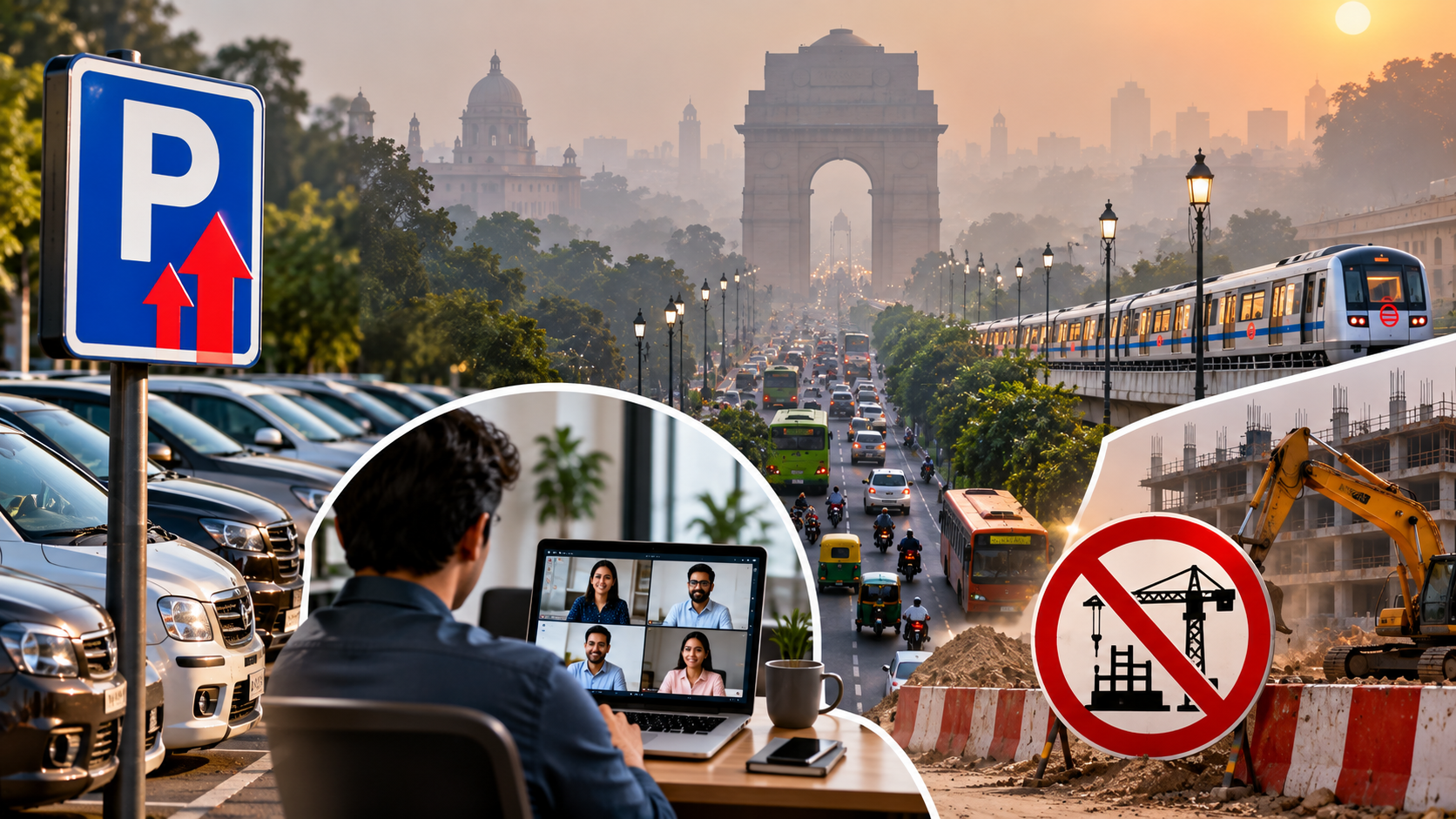
Delhi government announces a fixed annual winter pollution framework covering parking, offices, construction, vehicles and dust control from November 1 to February 28
The Delhi government has announced a comprehensive set of measures to tackle the capital’s recurring winter air-pollution problem, with higher parking charges, staggered office timings, a 50 per cent work-from-home arrangement and tighter restrictions on construction and demolition activities.
The measures are part of Delhi’s consolidated Winter Pollution Action Plan, which was notified earlier this year and is designed to come into force every year from November 1 to February 28. The framework is intended to move pollution-control measures from reactive restrictions to a more predictable annual system.
Parking Charges to Double From November 1
One of the most visible changes for commuters will be the doubling of parking charges at authorised parking facilities between November 1, 2026 and February 28, 2027.
The objective is to discourage unnecessary private-vehicle use during the winter pollution season and encourage commuters to consider public transport, carpooling and ride-sharing.
Parking facilities operated by the Delhi Metro Rail Corporation will remain exempt from the doubling provision. The exemption is intended to preserve the role of Metro-linked parking facilities as part of the city’s public-transport and park-and-ride network.
50% Work From Home for Offices
The winter framework also introduces a major change for office workers. Government and private establishments will operate with 50 per cent physical attendance, with the remaining workforce working from home.
The government has also asked private offices to promote carpooling, ride-sharing and public transport.
For employees, this could mean rotational attendance arrangements, reduced daily commuting and greater dependence on digital collaboration tools during the winter pollution period.
Staggered Office Timings Across Delhi
Government offices will follow different operating schedules as part of the plan.
Municipal Corporation of Delhi offices will operate from 8:30 am to 5 pm, while Delhi government offices will function from 10 am to 6:30 pm during the winter period.
Staggering working hours is aimed at reducing simultaneous movement on Delhi’s roads and potentially easing peak-hour traffic and vehicle emissions.
Essential and emergency services will remain exempt from the restrictions.
Construction and Demolition Restrictions
Construction activity will face some of the strongest restrictions under the plan.
Dust-generating demolition work and outdoor civil construction activities will be prohibited from November 1 to January 31. A stricter prohibition will operate from December 10 to January 20, when construction and demolition activities will be completely stopped, subject to applicable exemptions.
The government has also indicated that construction sites measuring more than 500 square metres will be monitored using the Delhi government's Dust Portal and AI-enabled cameras.
The emphasis on construction dust reflects the administration’s effort to strengthen enforcement rather than rely solely on temporary restrictions during severe pollution episodes.
Dust Portal to Strengthen Monitoring
Delhi’s Dust Portal 2.0 is expected to play a central role in monitoring construction and demolition sites.
The system uses GIS mapping, live 360-degree PTZ cameras, PM10 and PM2.5 sensors and AI-based analytics. It can monitor eligible construction sites and provide authorities with information on pollution levels and compliance.
The system can generate colour-coded alerts and support digital issuance of compliance certificates and enforcement notices. District-level dashboards and hotspot analysis are also intended to help officials identify areas requiring faster intervention.
No PUC, No Fuel Enforcement
Vehicle pollution is another major component of the winter strategy.
The Delhi government plans year-round enforcement of Pollution Under Control Certificate requirements. Fuel stations will be permitted to supply petrol, diesel and CNG only to vehicles carrying a valid PUC certificate.
Verification can be carried out through physical documents as well as digital systems, including automatic number-plate recognition and vehicle databases such as VAHAN.
The government has separately announced an enforcement drive against vehicles with invalid PUC certificates from October 1, 2026.
Restrictions on Older and Non-Compliant Vehicles
The winter framework also restricts the entry and movement of vehicles registered outside Delhi that do not meet BS-VI emission standards from November 1 to January 31.
Electric vehicles, CNG vehicles, emergency services and other specified exempt categories are not covered by the restriction.
The measure adds another layer of vehicle-emission control during the period when Delhi typically faces unfavourable atmospheric conditions and elevated pollution levels.
Why Delhi Is Taking a Fixed Annual Approach
Delhi has traditionally relied heavily on emergency pollution-control measures that are triggered or intensified when air quality deteriorates sharply.
The new framework represents a more structured annual approach, with several measures scheduled in advance irrespective of day-to-day pollution levels. The plan covers transport, construction, office operations, dust management and vehicle compliance.
The government’s approach is aimed at reducing emissions before the winter pollution episode reaches its most severe phase rather than waiting for air quality to deteriorate before implementing restrictions.
Impact on Commuters, Businesses and Real Estate
The measures could have a direct effect on daily commuting patterns and business operations.
Higher parking costs could increase the incentive to use Metro services, buses, carpooling and other shared transport options. The 50 per cent work-from-home requirement could reduce office-related traffic but may also require companies to redesign attendance schedules and workplace operations.
Construction restrictions could affect project timelines, particularly for developments dependent on outdoor civil and demolition work during the restricted period. Developers and contractors may therefore need to plan dust-generating activities and project schedules around the winter restrictions.
Pollution Control and Economic Activity
The challenge for policymakers will be to balance pollution reduction with continuity of economic activity.
Construction, transport, offices and commercial establishments are important parts of Delhi’s economy. Restrictions can reduce certain emission sources, but they can also create operational costs for businesses and workers.
The effectiveness of the framework will therefore depend not only on the rules themselves but also on consistent enforcement, availability of public transport, compliance by construction sites and vehicle owners, and coordination among multiple agencies.
What Delhi Residents Should Know
For residents, the major changes to remember are:
-
Parking charges at authorised facilities will double from November 1, except eligible DMRC parking facilities.
-
Offices will operate with 50 per cent physical attendance, with the remaining workforce working from home.
-
Government offices will follow staggered timings.
-
Dust-generating construction and demolition activity will face restrictions from November.
-
A stricter construction and demolition prohibition is scheduled from December 10 to January 20.
-
Vehicles will need valid PUC certificates for fuel purchases.
-
Enforcement against invalid PUC certificates begins October 1.
-
Certain non-BS-VI vehicles registered outside Delhi will face restrictions during the winter period.
-
Essential and emergency services are exempt from relevant office restrictions.
A More Predictable Winter Pollution Strategy
Delhi’s new framework effectively creates a recurring winter operating calendar for pollution control. Instead of introducing every restriction only after pollution levels deteriorate, several measures will now be scheduled in advance between November and February.
The success of the policy will ultimately depend on implementation and measurable improvement in air quality. Monitoring systems such as the Dust Portal, digital vehicle databases and enforcement mechanisms could provide authorities with better tools to identify violations and respond more quickly.
For residents and businesses, the coming winter season is likely to bring changes in commuting, office attendance, parking costs, construction schedules and vehicle compliance requirements.
Market Outlook
The measures are primarily environmental and administrative in nature, but they could have indirect implications for several economic segments.
Public transport, shared mobility, electric vehicles and digital workplace services could see greater relevance as commuting patterns change. On the other hand, construction and real-estate activity could face temporary operational disruptions during periods when work is restricted.
For investors, the broader implication will depend on the duration and intensity of enforcement and whether similar measures are adopted or strengthened in other major cities. The immediate focus will remain on implementation, compliance and the actual impact of the winter framework on Delhi’s air quality and economic activity.