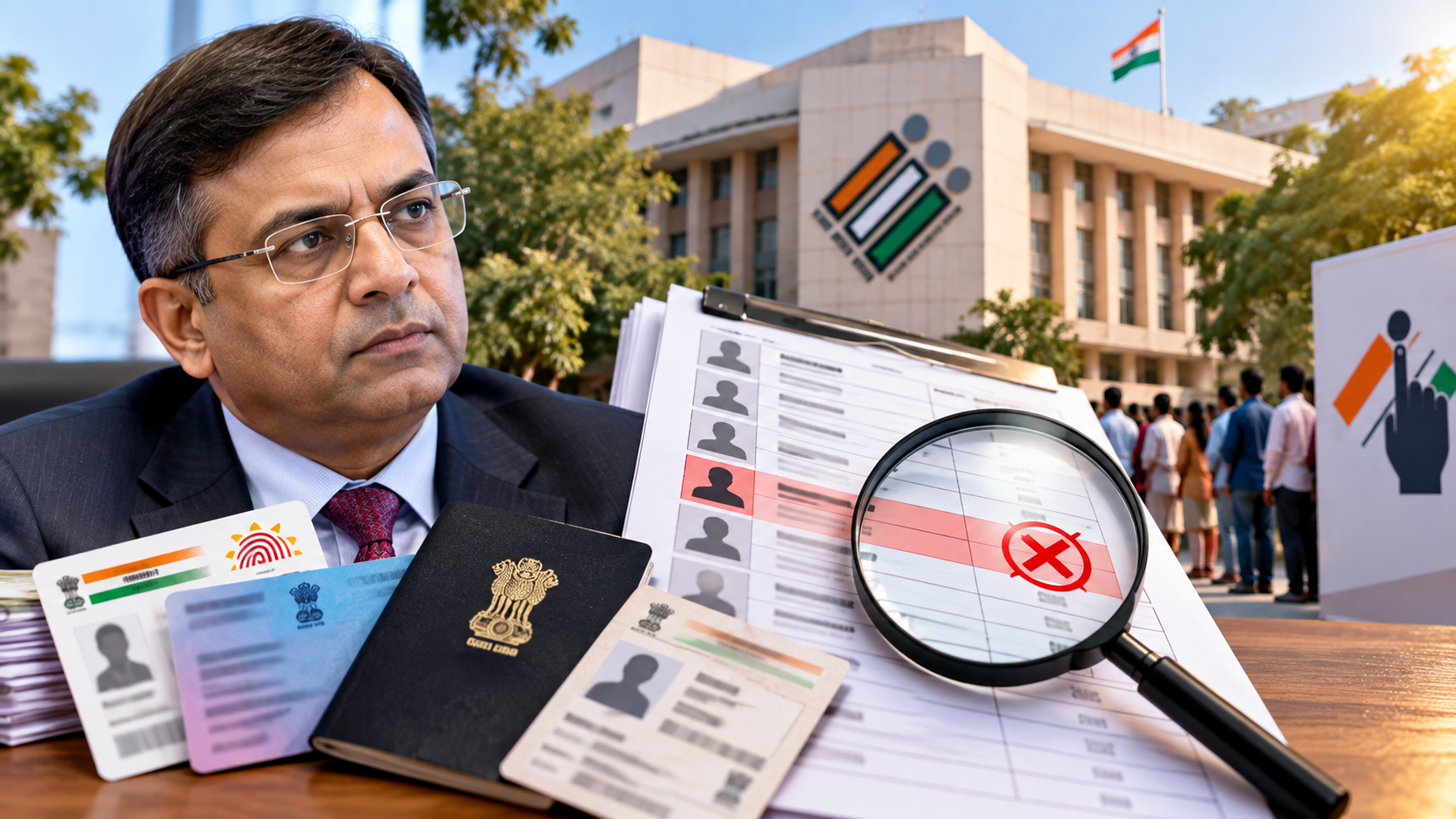
Rajiv Anand says he was asked to appear for a hearing to prevent deletion of his name as the Election Commission's Special Intensive Revision exercise continues
IndusInd Bank Managing Director and CEO Rajiv Anand has said that his name has been marked as “unmapped” in the electoral roll and that he was asked to appear for a hearing to prevent his name from being deleted from the voter list.
Anand raised the issue publicly in posts on X, saying that he had voted in every election since becoming eligible and possessed several government-issued identity documents, including a passport, PAN card, voter ID and Aadhaar.
The development comes amid the Election Commission's ongoing Special Intensive Revision (SIR) of electoral rolls, an exercise aimed at reviewing and updating voter records.
Rajiv Anand questions the need for multiple identity documents
In his social-media posts, Anand questioned why he needed to appear for a hearing when he already possessed multiple identity documents and had a history of voting.
He said his name had been described as “unmapped” and that he had been told to appear before the authorities, failing which his name could be deleted from the electoral roll.
In a separate post, Anand questioned the reliance on multiple documents to establish identity, referring to Aadhaar, PAN, voter ID and passport.
His comments have brought attention to the practical difficulties that can arise when voter records are being reconciled with earlier electoral databases.
What does 'unmapped' mean?
In the context of the SIR exercise, an “unmapped” elector is broadly one whose current electoral-roll details could not be linked or matched to the relevant previous electoral-roll records through the revision process.
Being marked as unmapped does not by itself establish that a person is ineligible to vote or that the person will automatically be removed from the final electoral roll.
The Election Commission has introduced a process for dealing with such discrepancies, including document collection and verification before decisions are taken by the relevant Electoral Registration Officer.
Election Commission changes process for SIR noticees
The Election Commission recently announced measures intended to make the process easier for people who receive notices because their records are classified as unmapped or contain logical discrepancies.
Under the revised procedure, Booth Level Officers (BLOs) will visit the homes of such voters to collect documents, which can then be uploaded to the ECINET system for consideration by the Electoral Registration Officer.
The Election Commission has also said that such voters generally need not be called to the ERO or Assistant Electoral Registration Officer's office for a personal hearing. Hearings can be held in exceptional circumstances, preferably online, when the ERO considers them necessary.
This clarification is particularly relevant to voters who may otherwise face difficulty travelling to an election office simply to establish or verify their existing electoral credentials.
Family members can assist in exceptional hearings
The Election Commission has also provided flexibility regarding representation.
Where a hearing is required, an adult member of the elector's family can be authorised to attend on the voter's behalf, according to the procedure announced by the poll panel.
The Commission has said that facilities for online hearings are also being strengthened.
These measures are intended to reduce the administrative burden on voters while allowing electoral authorities to verify records where discrepancies remain.
SIR is aimed at updating electoral rolls
The Special Intensive Revision is a comprehensive exercise involving verification and updating of electoral-roll records.
The Election Commission's published SIR schedule covers different states and Union territories in phases, with house-to-house verification, draft-roll publication, claims and objections, notice disposal and final-roll publication taking place according to the applicable state or Union territory timetable.
The process is intended to identify discrepancies and ensure that electoral rolls contain eligible voters while addressing cases involving shifted, deceased, duplicate or otherwise incorrectly recorded electors.
Deadlines extended in Delhi and Maharashtra
The Election Commission has also announced extensions to the period for filing claims and objections in Delhi and Maharashtra.
For Delhi, the deadline has been extended to October 30, while in Maharashtra the deadline has been extended to October 12, according to the latest announcement cited in the report.
The extensions provide additional time for voters whose names or details require correction or verification to submit claims and supporting documents.
Why voter-roll verification matters
Electoral rolls are periodically revised because voter information can change due to relocation, death, duplication, changes in address or other administrative circumstances.
Accurate voter records are important for ensuring that eligible voters can exercise their franchise while reducing duplication and other discrepancies.
At the same time, the verification process requires mechanisms through which genuine voters can establish their eligibility and correct errors before final rolls are published.
The Election Commission's latest measures around home visits, document collection and online hearings are intended to provide additional channels for resolving such cases.
Anand's case highlights the importance of record matching
Anand's case has attracted attention because of his position as the head of a major private-sector bank and because he says he possesses several identity documents and has voted in previous elections.
However, possession of identity documents and a person's presence in a previous electoral roll are separate administrative questions from whether their current record has been correctly mapped in the particular revision exercise.
The exact reason Anand's record was classified as “unmapped” and the outcome of any verification process would need to be established through the relevant electoral authorities.
What happens next?
For voters who receive an SIR-related notice, the immediate step is to follow the instructions issued by the relevant electoral authority and provide the documents requested for verification.
The Election Commission has said that BLOs can collect documents from the voter's residence in cases covered by the revised procedure, while personal hearings are expected to be used only in exceptional circumstances.
The final status of any individual voter depends on the verification and decision-making process conducted by the appropriate electoral authorities.
Key Takeaways
-
Rajiv Anand says his electoral-roll record was marked “unmapped.”
-
He says he was asked to appear for a hearing to avoid deletion from the voter list.
-
The development comes during the Election Commission's ongoing SIR exercise.
-
The ECI has introduced home visits and document collection by BLOs for relevant noticees.
-
Personal hearings are now expected to be required only in exceptional cases.
-
An adult family member may represent an elector when authorised, where a hearing is necessary.
-
The claims-and-objections deadline has been extended to October 30 in Delhi and October 12 in Maharashtra.
Market Outlook
The episode has no direct, immediate implication for IndusInd Bank's operating performance or financial fundamentals. Rajiv Anand's comments relate to his individual electoral-roll status rather than the bank's business operations.
For investors tracking IndusInd Bank, the relevant factors remain the bank's financial performance, asset quality, deposit and loan growth, margins, capital position and management execution. The electoral-roll issue is separate from those operating metrics.
More broadly, the developments around SIR are relevant to India's electoral administration because the process involves large-scale verification and updating of voter records. The Election Commission's recent procedural changes will be important in determining how efficiently voters with discrepancies can establish their eligibility and correct their records.