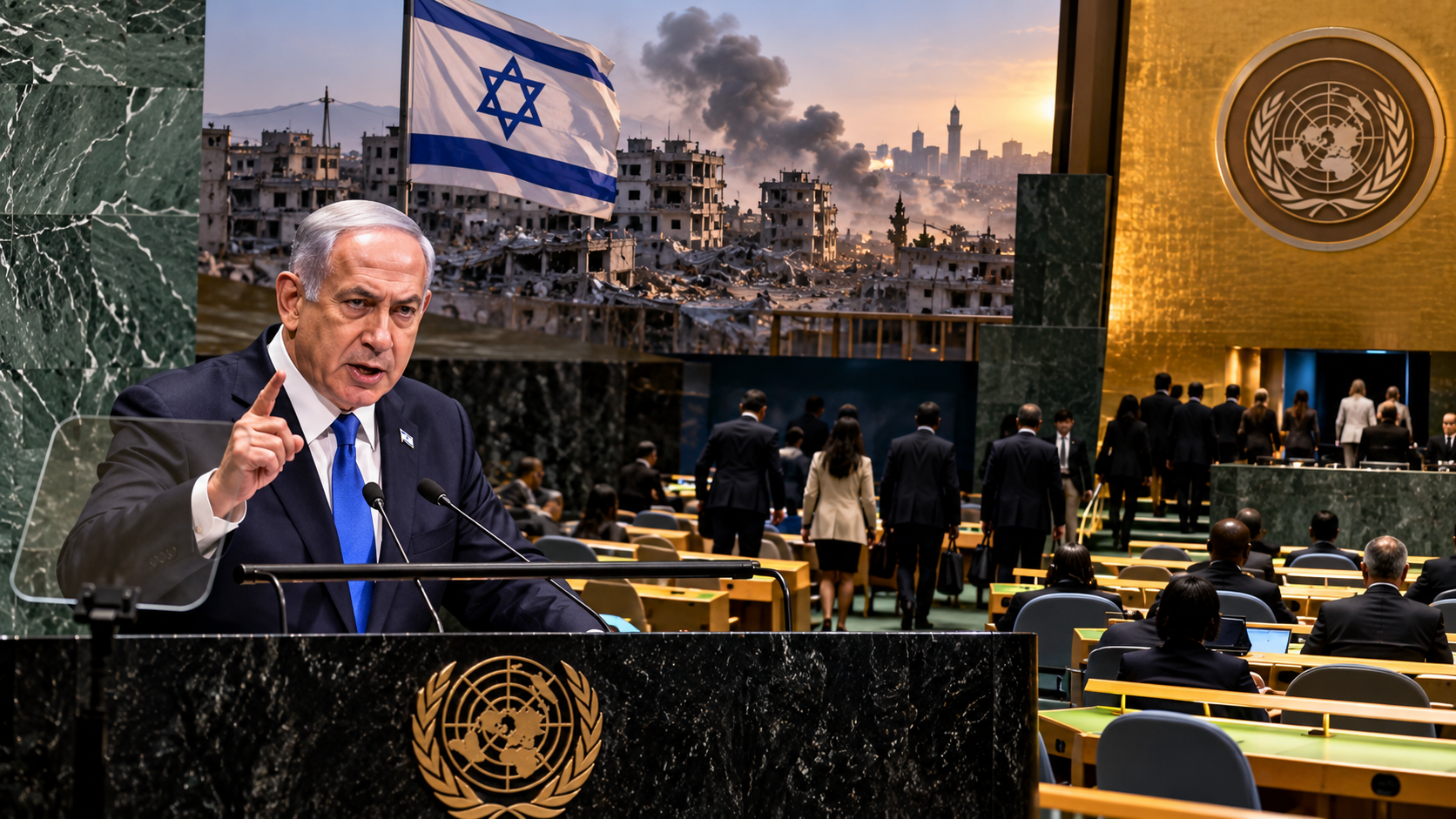
Israeli Prime Minister Benjamin Netanyahu rejected genocide allegations over Gaza, defended Israel’s military actions against Hamas and Iran, praised US President Donald Trump and faced a mass walkout by UN delegates during his address
Israeli Prime Minister Benjamin Netanyahu used his address to the 81st United Nations General Assembly in New York on Thursday to strongly defend Israel’s military campaign in Gaza and its strikes against Iran, while rejecting allegations that Israel has committed genocide in Gaza.
The speech, delivered amid deep international divisions over the Middle East conflicts, was accompanied by a mass walkout of delegates as Netanyahu approached the podium. The walkout followed an appeal by the Palestinian Mission to the United Nations urging member states to leave the chamber during his address.
Netanyahu responded by accusing those who left of hypocrisy and describing them as “moral cowards”. He maintained that Israel was acting in self-defence and said the country would continue its military campaign until what he described as its security objectives were achieved.
The address came against the backdrop of continuing fighting in Gaza, tensions involving Iran and Israel, international debate over Palestinian statehood and growing pressure on governments over their positions on the conflict.
Netanyahu Rejects Gaza Genocide Allegations
A central theme of Netanyahu’s speech was his rejection of allegations that Israel’s military campaign in Gaza amounts to genocide.
Netanyahu described the accusation as false and argued that Israel's military actions followed the Hamas-led attack on Israel on October 7, 2023. According to figures cited in the report, around 1,200 people were killed in the attack and 251 people were taken hostage.
The subsequent Israeli military offensive has caused a very large number of Palestinian deaths and extensive destruction across Gaza. Gaza's Health Ministry, which operates under the Hamas-run government, has reported tens of thousands of Palestinian deaths since the start of the Israeli offensive.
Israel has rejected allegations of genocide and war crimes, saying that its military operations are directed against Hamas and other armed groups and that it seeks to protect its population.
The issue remains one of the most contentious international legal and diplomatic questions surrounding the conflict. The UN Secretary-General, in remarks at the opening of the General Assembly, highlighted the scale of killing and destruction in Gaza and referred to legally binding provisional measures issued by the International Court of Justice in the genocide case.
Mass Walkout Marks Netanyahu’s UN Appearance
The political significance of Netanyahu’s speech was underscored even before he began speaking.
Scores of delegates left the General Assembly chamber as the Israeli prime minister approached the rostrum. The walkout followed the Palestinian Mission’s call for countries to demonstrate their opposition to Israel’s conduct in Gaza.
The empty seats became one of the defining images of the address.
Netanyahu criticised the departing delegates and challenged those who remained in the chamber. His response reflected the wider diplomatic divide that has emerged at the United Nations over Israel's military operations and the future of Gaza.
The walkout also demonstrated the difficulty Israel faces in presenting its position to an international audience where many governments have sharply criticised the humanitarian consequences of the Gaza war.
Israel’s Case for Military Action Against Iran
Netanyahu devoted substantial attention to Israel’s military confrontation with Iran.
He defended Israel’s attacks on Iranian nuclear facilities, describing the decision to launch the strikes as necessary for Israel’s security. He argued that allowing Iran to retain what Israel considers a major nuclear threat would have exposed Israel and its allies to potentially severe consequences.
Netanyahu also predicted that Iran's current political system would eventually face major internal pressure. He attributed what he described as public dissatisfaction to corruption and repression and said that change in Iran was ultimately a matter of time.
His remarks came as the wider Middle East remained unsettled, with the United States, Iran, Israel and regional actors involved in overlapping military and diplomatic confrontations.
The conflict has also become an important factor for global energy markets because continued instability in the Middle East can affect crude oil supplies, shipping routes and risk sentiment across international markets.
Netanyahu Praises Donald Trump
Netanyahu also used the UN platform to praise US President Donald Trump for his support for Israel.
He described Trump as a major partner in confronting threats to Israel and the United States and credited the US administration with backing Israel during the conflict.
The relationship between Washington and Jerusalem has remained an important element of the regional security equation. Trump's own UN appearance earlier in the week also focused heavily on Iran and the broader Middle East conflict.
Netanyahu's comments therefore served not only as a defence of Israel's military policies but also as an expression of the strategic relationship between the two countries.
Netanyahu Says Israel Has Faced Multiple Fronts
Netanyahu presented the conflict as a wider confrontation involving multiple armed groups and regional actors.
He referred to Hamas in Gaza, Hezbollah in Lebanon, the Houthis in Yemen, Iran and Iran-backed militias as threats Israel has faced over the past several years.
He argued that Israel's military actions had weakened several of these adversaries and presented the campaign as a continuing effort to protect the country.
Netanyahu concluded this part of his argument by saying Israel would continue fighting because, in his view, it had no alternative.
His remarks reflected Israel's long-standing argument that military pressure is necessary to prevent further attacks. Critics, however, argue that the scale of the military campaign and its humanitarian consequences cannot be justified solely through security considerations.
Palestinian President Mahmoud Abbas Calls for Action
Netanyahu's speech came shortly after Palestinian President Mahmoud Abbas addressed the General Assembly through a prerecorded video message.
Abbas rejected the possibility of Palestinians being displaced from their homeland and called on the international community to take stronger action over Israel's military operations.
He also questioned why some governments continued to provide weapons to Israel despite the civilian toll in Gaza and the West Bank.
The contrasting speeches from Netanyahu and Abbas illustrated the fundamental political divide surrounding the conflict: Israel's emphasis on security and the October 7 attack versus the Palestinian leadership's emphasis on occupation, civilian protection, displacement and Palestinian self-determination.
The UN Secretary-General has separately reiterated support for a two-state framework and called for Gaza and the West Bank, including East Jerusalem, to remain politically and territorially connected under a legitimate Palestinian government.
West Bank Settlement Issue Remains Contentious
Netanyahu also addressed criticism of Israel's conduct in the West Bank.
He said he opposed settler violence against Palestinians and rejected vigilantism. At the same time, the broader issue of Israeli settlements remains a major point of disagreement between Israel, Palestinians and much of the international community.
Palestinians view the West Bank and East Jerusalem as territories intended for a future Palestinian state. Much of the international community considers Israeli settlements in the occupied West Bank illegal under international law, while Israel disputes that interpretation and maintains that its settlements are legally defensible.
The settlement issue has become increasingly important in international discussions about whether a negotiated two-state solution remains achievable.
Netanyahu Criticises Qatar and Turkey
The Israeli prime minister also criticised several foreign governments during his address.
He accused Qatar of spending significant sums to influence international opinion against Israel and criticised the country for hosting Hamas leaders.
Netanyahu also targeted Turkish President Recep Tayyip Erdogan, accusing him of supporting Hamas and criticising Turkey's treatment of journalists and political opponents.
The comments added another layer to Netanyahu's broader argument that Israel is facing not only armed groups but also an international information and diplomatic campaign against it.
Those governments and Israel's critics have sharply different interpretations of the conflict and of the policies being pursued by the Israeli government.
Clash With New York Mayor Zohran Mamdani
Netanyahu also directly criticised New York City Mayor Zohran Mamdani, who has been a prominent critic of Israel's military campaign in Gaza.
Netanyahu accused Mamdani of contributing to an environment in which Jewish New Yorkers feel unsafe and challenged his political positions on Israel and Hamas.
Mamdani has rejected accusations that criticism of Israel amounts to antisemitism and has publicly advocated for Palestinian rights.
The dispute has also involved the International Criminal Court. Mamdani has previously discussed the ICC arrest warrant issued for Netanyahu and acknowledged that New York City itself does not have authority to enforce such a warrant.
The exchange between the two politicians has become part of the broader US political debate surrounding Israel, Palestine and the Gaza war.
International Legal Pressure Remains a Major Issue
The International Criminal Court and International Court of Justice remain important institutions in the international legal debate surrounding the conflict.
The ICC has issued an arrest warrant for Netanyahu in connection with allegations relating to the Gaza conflict, while Israel has rejected the court's jurisdiction and the allegations against its leadership.
Separately, the ICJ genocide proceedings concern allegations brought against Israel under the Genocide Convention. The court has issued provisional measures in the case, while the underlying proceedings remain distinct from a final determination on whether genocide has been committed.
These legal processes should therefore be distinguished from political statements made by governments or individual politicians.
A UNGA Speech Reflecting a Deep Global Divide
Netanyahu's address highlighted the widening diplomatic divide over the Gaza conflict.
Israel continues to frame its military campaign primarily through the lens of national security, the October 7 attack and the threat posed by Hamas and other armed groups. Palestinian officials and many governments, meanwhile, focus on the scale of civilian casualties, destruction, displacement and the long-term political status of the Palestinian territories.
The mass walkout during Netanyahu's speech demonstrated how sharply divided the international community remains.
The UN Secretary-General has called for an end to fighting, expanded humanitarian access and adherence to international law, while continuing to support a two-state political framework.
Impact Beyond Diplomacy
The continuing Middle East conflicts have consequences beyond international politics.
Markets remain sensitive to developments involving Israel, Iran, the United States and major regional shipping routes. Any escalation that threatens oil production or transportation infrastructure can quickly affect crude prices, inflation expectations, currencies and global equity markets.
Energy-importing economies such as India are particularly exposed to sustained increases in crude prices because higher oil costs can widen import bills and create pressure on inflation and corporate margins.
The geopolitical situation is therefore being monitored not only by governments and diplomats but also by investors, energy companies, shipping firms and central banks.
What Comes Next
The immediate diplomatic challenge remains finding a path towards de-escalation while addressing the humanitarian crisis in Gaza and the wider regional security concerns involving Iran and other armed groups.
For Israel, Netanyahu's speech reinforced the government's position that military pressure remains necessary for national security. For Palestinians and their supporters, the focus remains on civilian protection, humanitarian access, an end to occupation and progress towards Palestinian statehood.
The competing positions remain far apart, and the UN General Assembly speech did not signal a breakthrough between them.
Instead, Netanyahu's address reinforced the central arguments that have defined the international debate over the conflict: Israel's security and right to defend itself, Palestinian civilian rights and statehood, the application of international law, and the role of the United States and other major powers in determining the region's future.
Global Outlook
The Gaza war and the wider confrontation involving Israel and Iran remain important geopolitical risks for global markets. Investors will continue to monitor developments that could affect crude oil supplies, shipping routes and regional stability.
Any movement towards diplomatic negotiations or de-escalation could reduce geopolitical risk premiums, while renewed military escalation could have the opposite effect through higher energy prices and greater uncertainty.
For policymakers and investors, the next phase of the Middle East conflict will therefore remain closely linked to energy markets, inflation expectations and global risk sentiment.