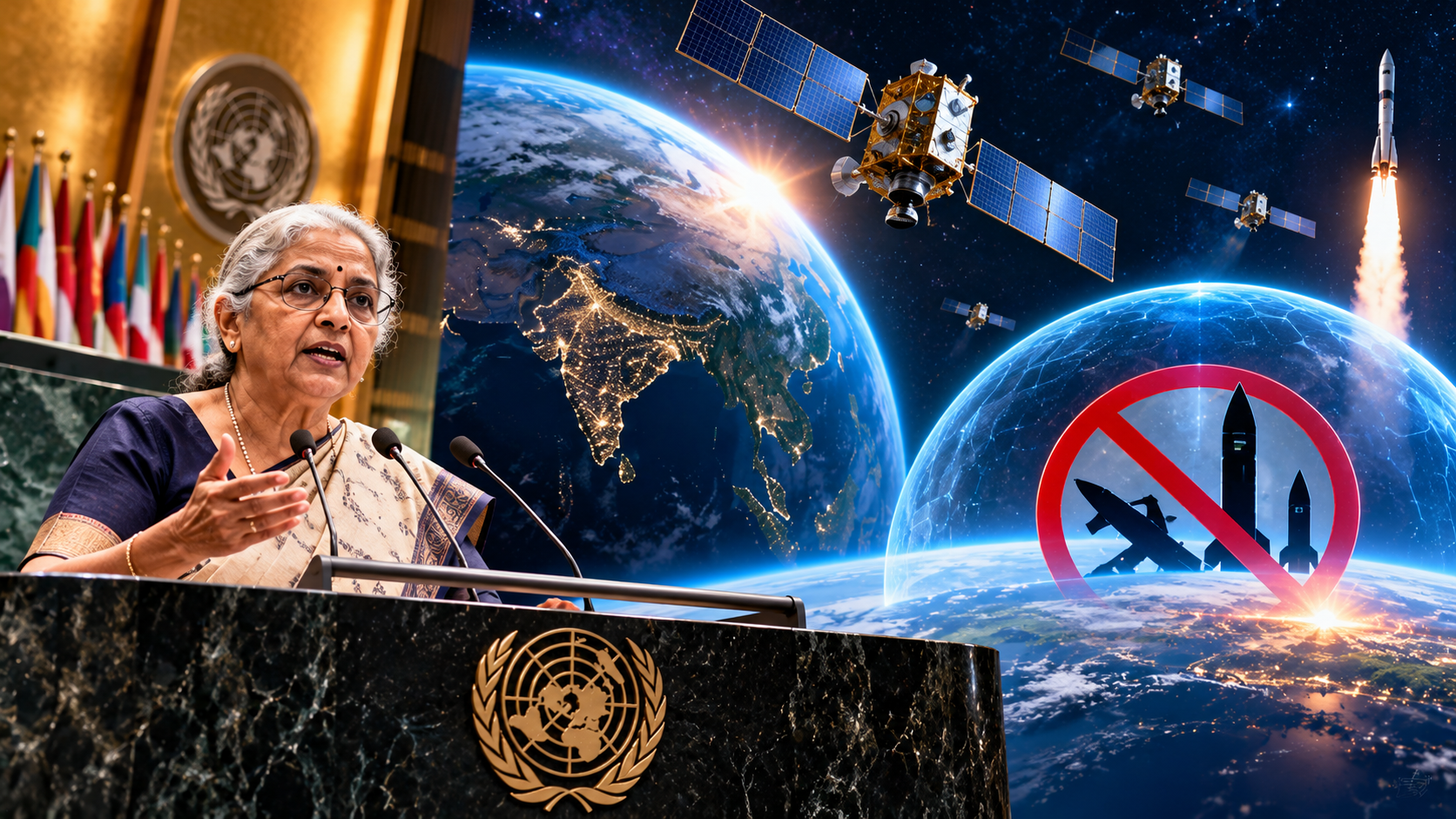
Addressing the UN General Assembly, Rajya Sabha MP Sudha Murty urged countries to keep space peaceful and accessible to all, stressing that voluntary norms must complement—not replace—a universally acceptable and verifiable international agreement.
India Pushes for International Rules on Space Security
India has called for a legally binding international agreement to prevent an arms race in outer space, reiterating that space should remain a domain for peaceful cooperation rather than military confrontation. The proposal was presented by Rajya Sabha MP Sudha Murty while delivering India's statement at the United Nations General Assembly's First Committee, which deals with disarmament and international security.
India's position comes as more countries and private-sector players expand their presence in space, increasing the strategic importance of satellites, launch systems and other space-based infrastructure. These assets support communications, navigation, weather forecasting, disaster management, scientific research and national security, making their protection an international concern.
Murty emphasised that outer space belongs to all humanity and that countries must work together to preserve it for peaceful purposes. India believes a multilateral agreement should prevent an arms race while ensuring that all nations can continue to access and benefit from space technology.
Why India Wants a Legally Binding Agreement
India supports a legally binding instrument on the Prevention of an Arms Race in Outer Space (PAROS). New Delhi wants the agreement to be universally acceptable, verifiable and negotiated multilaterally through the Conference on Disarmament.
A binding framework could establish clearer international obligations and help reduce uncertainty over military activities in space. It could also provide a common foundation for countries to address potential threats to satellites and other space infrastructure.
However, negotiations face differences over how space security should be regulated, which activities should be restricted and how compliance could be verified. Countries also disagree over the relative priority of legally binding treaties and voluntary approaches such as transparency measures and codes of conduct.
India has said it remains open to universal, non-discriminatory, non-binding norms and transparency and confidence-building measures. However, it considers these steps complementary to a binding treaty rather than a substitute for one.
Dual-Use Technologies Complicate Space Governance
A major challenge in regulating space activities is the dual-use nature of many technologies. Equipment and systems developed for peaceful purposes can also have military applications.
Satellites, for example, can provide weather information, navigation and communications while also supporting intelligence gathering and military operations. The same technological capabilities may therefore serve civilian and strategic objectives, making it difficult to distinguish legitimate activities from potentially threatening behaviour.
Murty highlighted the need to address the safety, security and long-term sustainability of outer space together. India also stressed that the international community must consider the risks of misunderstanding, miscalculation and uncertainty over what constitutes the use of force in space.
A fragmented approach that focuses on only selected threats could leave important gaps in international rules. India has called for coordination among the various international forums dealing with space safety, security and sustainability, while cautioning against overlapping mandates and multiple standards addressing the same issues.
Verification Remains a Major Challenge
Even if countries agree on new rules, verifying compliance could prove difficult. Space activities take place across a vast and technically complex environment, while many systems have both civilian and military uses.
Effective verification may require access to relevant information, reliable data-sharing mechanisms and agreed procedures for assessing potentially prohibited activities. Countries would also need to develop sufficient confidence in the methods used to determine whether commitments are being respected.
Differences in national capabilities and security concerns could complicate negotiations. A workable agreement would need to balance transparency with legitimate national security requirements while ensuring that its provisions apply fairly across participating countries.
The challenge is particularly important because uncertainty surrounding the purpose of a space object or activity can increase the risk of misinterpretation and escalation.
India Seeks to Protect Peaceful Research and Technology Sharing
India has also emphasised that any international agreement should not restrict legitimate scientific research or prevent developing countries from benefiting from space technology.
For emerging space programmes, access to scientific knowledge, research collaboration and technological capabilities can support economic development, disaster preparedness, communications and public services. India has argued that new rules should preserve these opportunities while addressing genuine security threats.
This position reflects the broader challenge facing international space governance: preventing dangerous military competition without creating barriers to peaceful exploration, innovation and cooperation.
A balanced framework would need to account for the interests of established space powers as well as countries seeking to develop their capabilities.
India's Space Ambitions Strengthen Its Stake in Global Rules
India's call for stronger international rules comes alongside the expansion of its own space programme. The country achieved a major milestone in 2023 when Chandrayaan-3 successfully landed on the Moon.
India is also advancing its Gaganyaan human-spaceflight programme and pursuing plans for the Bharatiya Antariksha Station, a proposed national space station. These initiatives reflect the growing role of space in India's scientific, technological and strategic priorities.
As the country's capabilities expand, the safety and sustainability of the wider space environment become increasingly important. Disruptions to satellite services or escalating tensions in orbit could affect civilian infrastructure, economic activity and national security.
India has consistently advocated strengthening the international legal framework governing outer space to preserve access for all countries and prevent an arms race.
In September 2026, Prime Minister Narendra Modi also called for a safe, secure, peaceful and sustainable space domain anchored in international law, dialogue and multilateral cooperation during a virtual address to the International Space Summit in Paris.
Global Cooperation Will Determine the Way Forward
The push for a binding agreement comes amid continuing differences among countries over how best to prevent an arms race in outer space. Reaching consensus will require negotiations on the scope of restrictions, verification arrangements, transparency and the relationship between existing international commitments and any new treaty.
Voluntary guidelines can help build confidence and encourage responsible behaviour, but their effectiveness depends substantially on countries' willingness to follow them. A legally binding agreement could provide a stronger foundation, although its practical value would depend on broad participation, clear provisions and credible implementation.
For India, the objective is to develop an international framework that addresses security concerns without undermining peaceful scientific and technological progress.
Outlook
Outer space is becoming increasingly important to global communications, navigation, economic infrastructure and national security. As more countries develop advanced capabilities, the risk of miscalculation and strategic competition is likely to remain a key international concern.
India's proposal for a universally acceptable and verifiable treaty places emphasis on common rules, multilateral negotiations and equal access to peaceful space activities. The next challenge will be translating these principles into an agreement that major space powers and developing nations can support.
The outcome of international negotiations could shape how future space activities are governed and how effectively countries cooperate to prevent conflict beyond Earth.