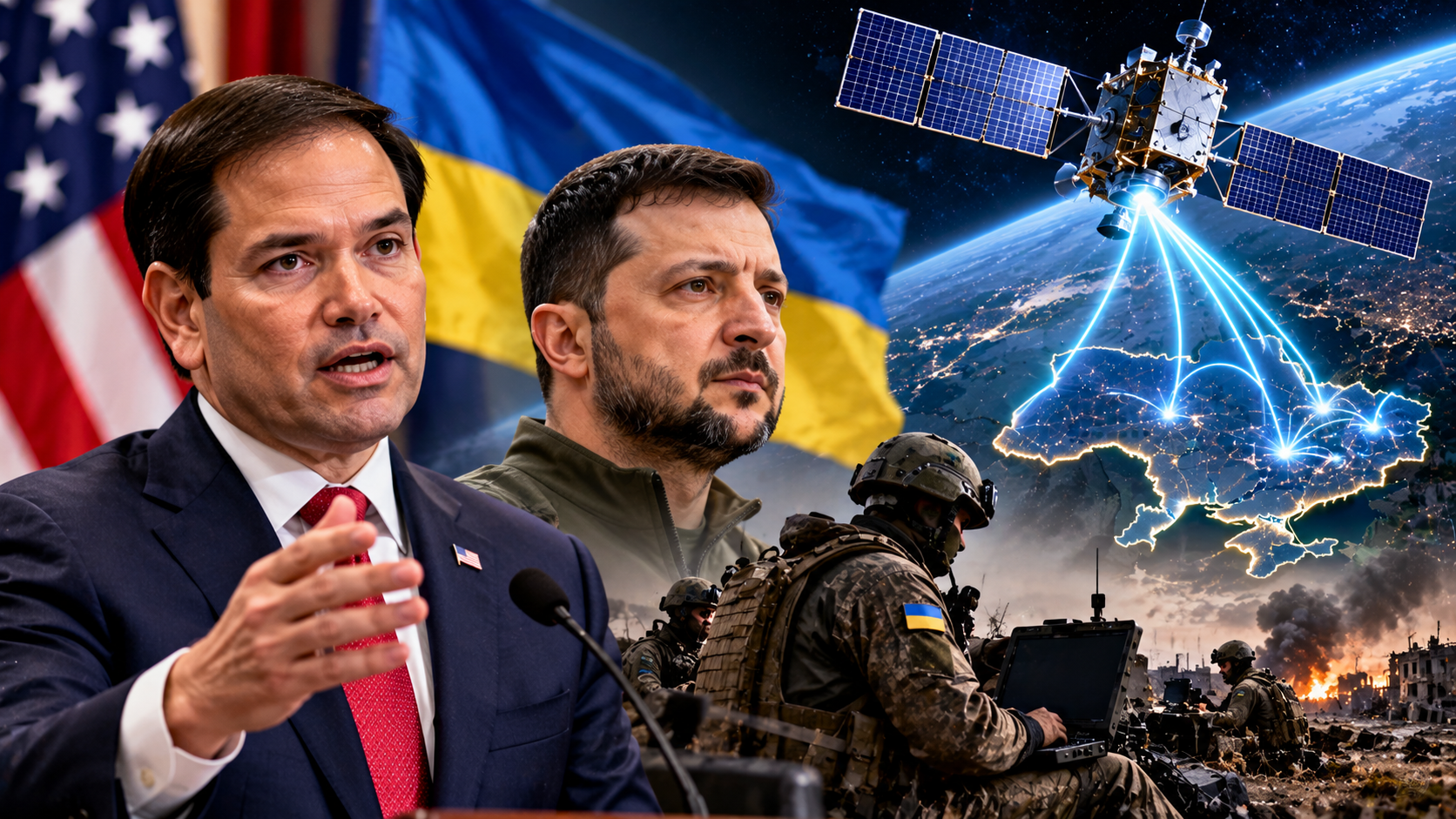
US Secretary of State Marco Rubio defended Washington's backing of Kyiv amid questions over Starlink satellite connectivity, as negotiations involving the United States, Ukraine and Russia focus on territorial disputes and long-term security guarantees.
Rubio Reaffirms Washington's Support for Kyiv
US Secretary of State Marco Rubio has strongly defended the Trump administration's support for Ukraine, arguing that American assistance has been critical to the country's survival as a sovereign state during Russia's full-scale invasion.
Speaking to reporters during a visit to India on Wednesday, October 21, 2026, Rubio said Ukraine would not exist in its current form as an independent country without assistance from the United States, including support provided under President Donald Trump.
His remarks come at a sensitive moment for US-Ukraine relations, with questions surrounding military assistance, intelligence sharing and satellite connectivity adding to the complexity of diplomatic efforts to end the war.
Rubio also indicated that Washington would no longer remain defensive when discussing its contribution to Ukraine's defence. He acknowledged the courage of Ukrainian forces in resisting Russia while stressing that a difficult negotiation was underway to resolve the conflict.
Starlink Controversy Raises Questions Over Military Connectivity
Rubio's comments followed a report alleging that Elon Musk, chief executive of SpaceX, ordered a recent slowdown of the Starlink satellite system used by Ukrainian forces. The service has played an important role in maintaining communications and supporting military operations, including Ukraine's response to Russian aerial attacks.
According to the report, Musk discussed the decision with Trump after the slowdown became publicly known. It also cited a person familiar with the matter who said Musk had spoken with administration officials before the change took effect.
Rubio said he was unaware of any advance knowledge by Trump and rejected suggestions that the US government had directed the action. He also argued that the government could not automatically control decisions made by a private company regarding its products.
The episode highlights the strategic importance of privately operated satellite networks during modern warfare. Reliable connectivity can support communications, intelligence coordination and battlefield operations, making access to commercial space infrastructure an increasingly important element of national security.
It also raises questions about the extent to which military operations should depend on private technology providers, particularly when service decisions can have immediate consequences on the battlefield.
Zelenskyy Seeks Long-Term Security Guarantees
Ukrainian President Volodymyr Zelenskyy has continued to press for sustained US support, emphasising that any settlement must protect Ukraine against another invasion.
Zelenskyy previously accused Trump of attempting to pressure Ukraine into accepting terms favourable to Russia. However, following discussions involving Trump's special envoy Steve Witkoff, the Ukrainian president described recent conversations on intelligence sharing and access to Starlink as constructive.
The discussions indicate that military cooperation and future security arrangements remain central to Kyiv's diplomatic priorities.
For Ukraine, a potential agreement would need to address not only the immediate cessation of hostilities but also the risk of renewed Russian military action. Security guarantees, intelligence cooperation and access to essential defence technology could therefore play an important role in determining whether any settlement is sustainable.
Donbas Remains a Major Obstacle to a Peace Agreement
Negotiations are continuing amid disagreements over the future of Ukraine's eastern Donbas region, which remains one of the most contentious territorial issues in the conflict.
Rubio described the discussions as difficult, saying that creative proposals had been put forward to bridge differences between the two sides. He also acknowledged that reaching an agreement would require compromises.
However, territorial concessions carry significant political, security and humanitarian implications for Ukraine. Any proposed settlement would have to contend with questions of sovereignty, control over territory and the protection of people living in affected regions.
Zelenskyy has indicated that one objective of Witkoff's diplomatic mission is to explore the possibility of a trilateral meeting involving the leaders of the United States, Ukraine and Russia. Such a meeting could address issues that require direct political decisions, including territorial claims.
Russian President Vladimir Putin was also expected to hold talks with Witkoff in St Petersburg on Wednesday, according to information reported from Russian official sources. The outcome of these discussions could influence the direction of subsequent negotiations, although no final agreement was established in the information available at the time.
Diplomatic Efforts Continue Amid Deep Differences
The latest diplomatic contacts suggest that discussions are continuing through multiple channels, including direct engagement with Ukrainian and Russian officials.
Zelenskyy's meetings with European leaders and his discussions with the US envoy underline the role of European partners in the broader diplomatic process. Norway and Finland have also been involved in discussions surrounding the conflict and regional security.
Despite these engagements, substantial differences remain over territory, military arrangements and the conditions required to guarantee Ukraine's future security.
The challenge for negotiators is to develop terms that can be accepted by the parties while reducing the risk of renewed conflict. A ceasefire without credible enforcement or security arrangements could leave the underlying tensions unresolved.
Implications for Defence Technology and Geopolitics
The Starlink controversy illustrates how commercial technology companies have become important participants in global security, even when they are not state actors.
Satellite communications, cloud infrastructure, artificial intelligence and other commercially developed technologies increasingly support military and intelligence operations. Governments may rely on private providers for capabilities that are difficult or expensive to replicate independently.
This creates strategic dependencies. Decisions by private companies concerning service availability, access or operating policies can affect national security, particularly during a conflict.
For governments, the episode reinforces the importance of resilient communications infrastructure, alternative providers and clear contractual arrangements for critical services. For technology companies, it highlights the growing scrutiny surrounding their role in conflicts and the responsibilities associated with supplying essential infrastructure.
Market Outlook
The course of the Russia-Ukraine war remains an important variable for global markets, particularly energy, defence, shipping and European economic activity. Changes in diplomatic prospects can influence crude oil prices, risk sentiment, government spending priorities and demand for defence equipment.
A credible peace framework could reduce some geopolitical risk premiums and improve confidence in affected regions. Conversely, a breakdown in negotiations or renewed escalation could sustain uncertainty, disrupt energy and commodity flows, and increase demand for safe-haven assets.
Investors should monitor developments in the negotiations, any changes in US military and technological support, and the positions taken by Ukraine, Russia and European governments. Until concrete progress emerges, the economic consequences of the conflict are likely to remain sensitive to geopolitical headlines and shifts in diplomatic expectations.