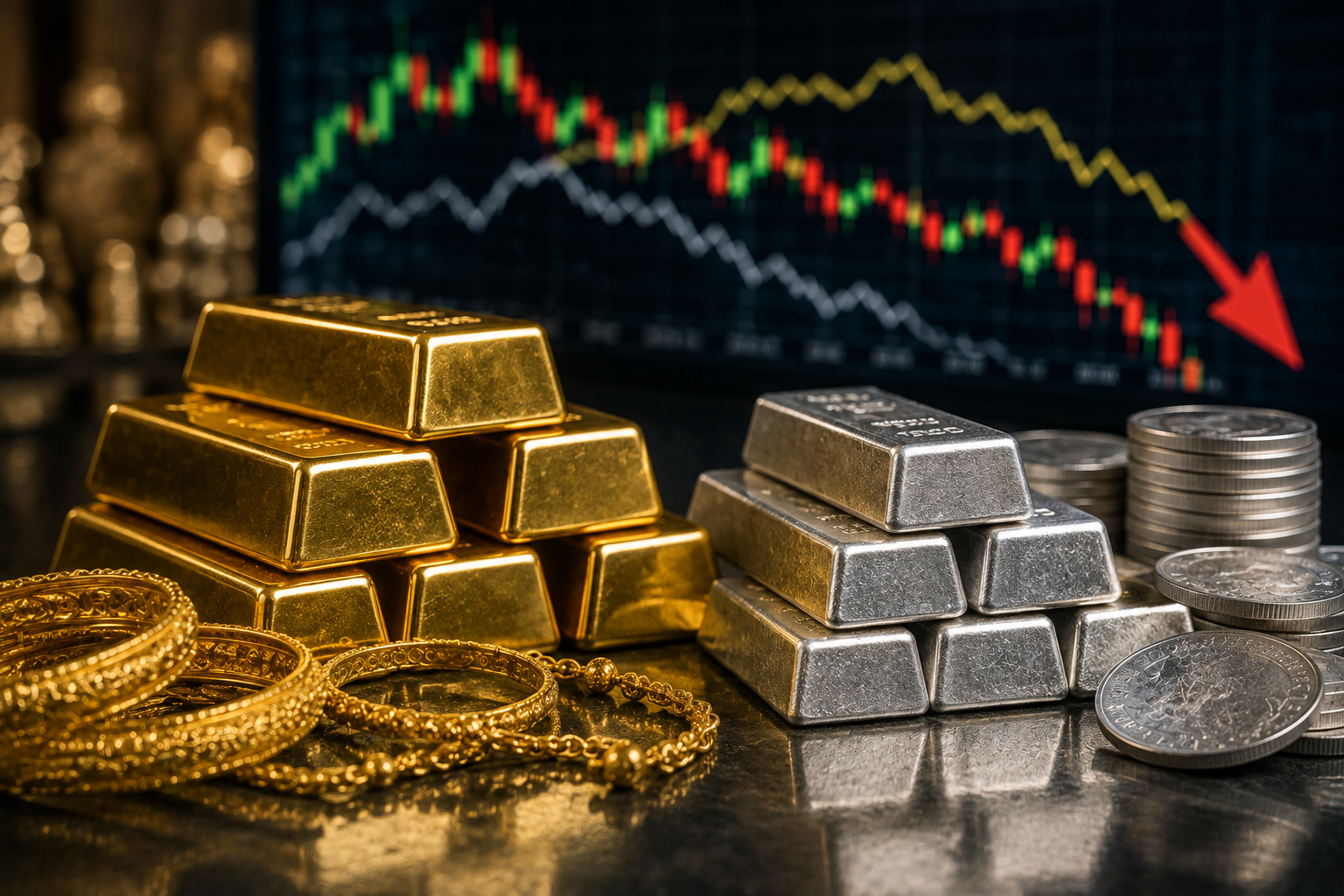
Gold and silver prices slipped in early trade as investors booked profits following the recent sharp rally in precious metals. While gold remained elevated in global markets, silver witnessed a comparatively steeper decline as traders reduced positions at higher levels.
The correction comes after bullion prices had gained momentum amid changing expectations around US monetary policy, movements in government bond yields and heightened demand for safe-haven assets.
Gold Prices Ease on MCX
The benchmark October gold futures contract on the Multi Commodity Exchange (MCX) opened at ₹1,63,015 per 10 gram, down ₹214 from its previous close of ₹1,63,229.
During the trading session, gold moved between an intraday high of ₹1,63,450 and a low of ₹1,62,015 per 10 gram. The contract was trading around ₹1,63,172 at the time of reporting.
The decline follows a strong run-up in gold prices, prompting traders to lock in gains. The precious metal has remained volatile as investors assess the outlook for US interest rates, bond yields and the global economy.
Silver Witnesses Sharper Correction
Silver futures faced stronger selling pressure compared with gold.
The benchmark September silver contract opened at ₹2,42,299 per kg, down ₹1,921 from its previous close of ₹2,44,220.
The contract touched an intraday high of ₹2,43,445 and a low of ₹2,42,299 per kg. At the time of reporting, silver was trading around ₹2,42,601, down ₹1,619.
The sharper movement in silver highlights the metal's higher volatility. Silver is influenced by investment demand as well as industrial consumption, making its price movements sensitive to both financial-market conditions and expectations for global economic activity.
Gold Trades Near $4,680 in International Market
Gold prices also weakened in the international market.
On Comex, gold opened at $4,710.10 per ounce, compared with the previous close of $4,697.80. It subsequently slipped to around $4,680.10 per ounce, down $17.70.
Despite the correction, gold remains at historically elevated levels. The metal had previously touched a yearly high of $5,586.20 per ounce, indicating the extent of the broader rally.
The recent decline therefore appears to be more consistent with profit booking than an immediate change in the long-term trend.
Silver Trades Around $67.80
Comex silver also remained under pressure.
Silver futures opened at $68.96 per ounce, compared with the previous close of $68.59. The contract subsequently declined to around $67.80 per ounce, down $0.79.
Silver had previously touched a yearly high of $121.79 per ounce, leaving the metal vulnerable to sharp corrections as investors reassess positions after substantial gains.
Why Investors Are Booking Profits
The recent rally in precious metals encouraged investors to lock in gains at elevated prices.
Gold had moved to a three-month high after the US Treasury unexpectedly announced higher buybacks of long-term government bonds. The development influenced expectations around the US bond market and contributed to increased interest in precious metals.
After a sharp rally, profit booking is common as traders seek to protect gains. Such corrections can become more pronounced when prices have moved significantly above recent trading ranges.
US Interest Rates Remain Important for Bullion
The direction of US interest rates remains one of the most important factors for gold and silver.
Lower interest-rate expectations generally support gold because the opportunity cost of holding a non-interest-bearing asset falls. Expectations of declining yields can also weaken the US dollar, providing additional support to dollar-denominated bullion.
On the other hand, higher Treasury yields and a stronger dollar can create headwinds for precious metals.
Investors are therefore likely to closely monitor upcoming US economic data and comments from Federal Reserve officials for indications about the future path of monetary policy.
Bond Yields and Dollar Movement in Focus
Movements in US Treasury yields and the dollar could determine whether the current correction remains temporary or develops into a deeper pullback.
A stronger dollar can make gold and silver more expensive for international buyers, potentially reducing demand. Conversely, weakness in the dollar and falling real yields could encourage investors to return to bullion.
This makes the currency and bond markets particularly important for precious-metal traders.
Silver Remains More Volatile Than Gold
Silver's dual role as an investment asset and industrial commodity makes it more sensitive to changes in market expectations.
Demand from electronics, renewable energy, industrial manufacturing and other applications can influence the physical market, while investment flows can drive short-term price movements.
As a result, silver can experience substantially larger percentage moves than gold in both rising and falling markets.
The recent decline therefore needs to be viewed in the context of silver's exceptionally strong price movement over the broader period.
Safe-Haven Demand Continues to Support Bullion
Despite the latest profit booking, gold continues to benefit from its traditional safe-haven characteristics.
Uncertainty surrounding global economic growth, monetary policy, geopolitical developments and financial markets can encourage investors to maintain exposure to precious metals.
Central-bank demand and investment flows also remain important structural factors for gold prices.
However, elevated prices can make the market vulnerable to periodic corrections whenever traders decide to reduce exposure.
What Could Influence Prices Ahead
The next major moves in gold and silver could depend on several factors:
-
US inflation and employment data
-
Federal Reserve interest-rate expectations
-
US Treasury yields
-
Dollar-index movement
-
Global geopolitical developments
-
Central-bank gold purchases
-
ETF and institutional investment flows
-
Industrial demand for silver
-
Commodity-market positioning
-
Profit booking after recent gains
Gold and Silver Outlook
The near-term outlook for precious metals remains volatile, with profit booking likely to continue after the recent rally. Gold's ability to attract buying on declines will be important in determining whether the current weakness remains a short-term correction.
Silver could continue to experience larger price swings because of its combination of investment and industrial demand.
A sustained decline in bond yields and a softer dollar could once again support bullion, while rising yields and renewed dollar strength could extend the correction.
For investors, the current environment favours caution around fresh purchases at elevated levels. Rather than reacting to individual daily moves, attention should remain on global interest-rate expectations, currency movements and the ability of gold and silver to hold important technical support zones.