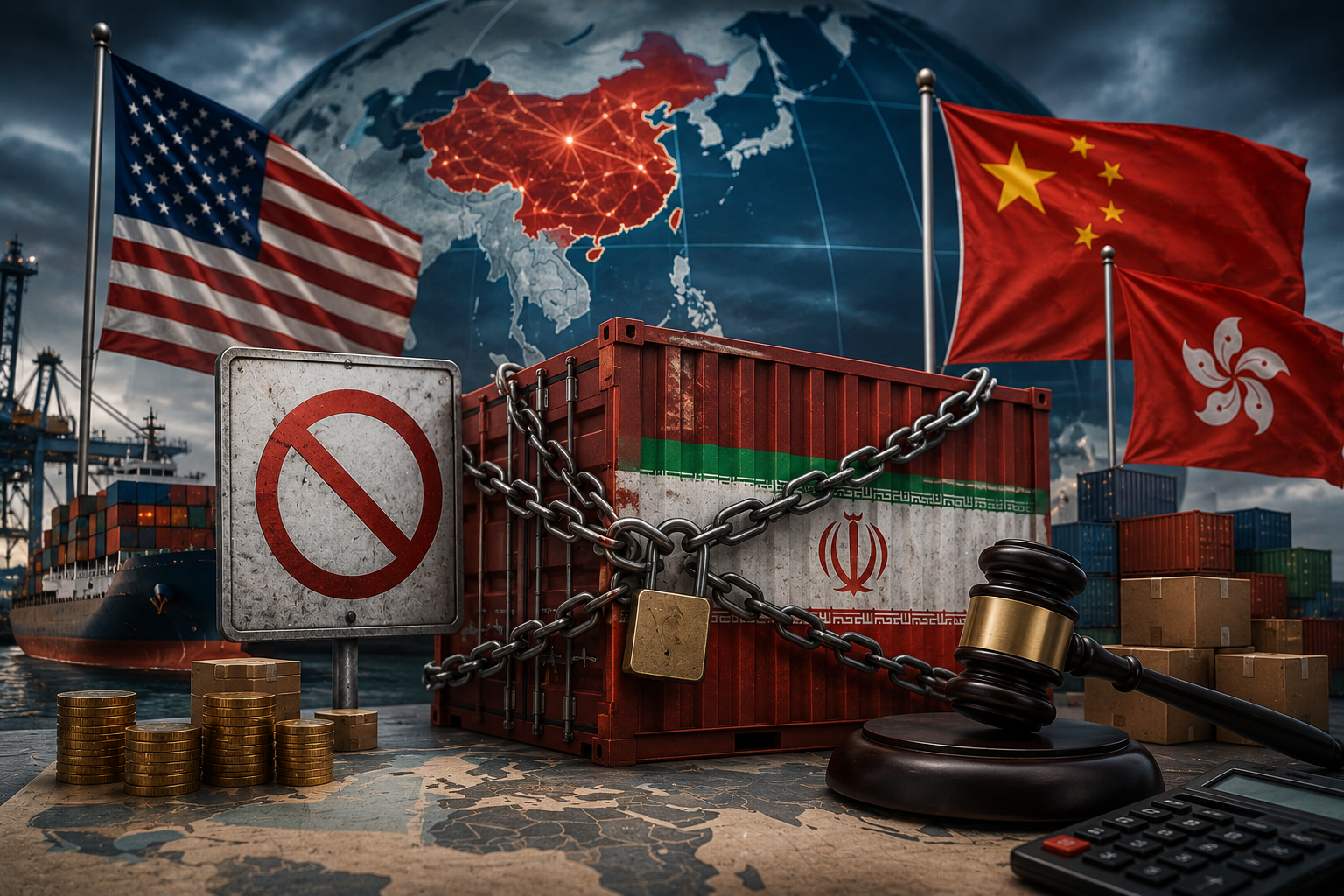
Washington broadens ‘Operation Economic Outcast’ to disrupt Iran-linked technology, logistics and financial networks
The United States has expanded its economic pressure campaign against Iran, targeting dozens of companies and individuals in mainland China and Hong Kong as Washington seeks to disrupt the networks that Tehran allegedly uses to procure technology, move goods and access international financial channels.
The latest measures were announced by the US Treasury Department as part of “Operation Economic Outcast”, a campaign Treasury Secretary Scott Bessent has described as an effort to sever Iran’s remaining financial and commercial lifelines.
While the latest package includes a sizeable number of Chinese and Hong Kong entities, Washington has so far avoided sanctioning major Chinese financial institutions, limiting the immediate risk of a broader disruption to US-China financial relations.
Chinese and Hong Kong Firms Face Growing Scrutiny
The latest sanctions underline Washington’s increasing focus on intermediaries that allegedly help Iran conduct international business.
Rather than targeting only Iranian companies and individuals, the US is pursuing firms in third countries that it says provide procurement, logistics, financing or other services to Iranian networks.
Hong Kong-based companies are particularly significant because the territory serves as an important international trading and financial centre connecting mainland Chinese businesses with global markets.
The latest move follows a pattern previously seen in US sanctions enforcement related to Russia, where Hong Kong-based trading and shipping intermediaries have also faced restrictions.
Technology Procurement Network at the Centre
A major component of the latest action involves an alleged procurement network centred on Hong Kong-based Sweet Ocean Industrial Ltd.
According to the US Treasury Department, the company allegedly acted as an intermediary to acquire laser-optics equipment intended for Iran’s Malek Ashtar University of Technology, which Washington identifies as a defence-linked research institution.
The US also designated three individuals based in China — Li Na, Tian Jianbai and Zhang Limei — alleging that they helped coordinate procurement activities through the network.
Several companies allegedly connected to the supply chain were also targeted, including Shenzhen Sweet Ocean Technology Ltd., RPT Technology Ltd., Tiany Technology Ltd. and MT Trading and Logistics HK Ltd.
Financial Transfers Come Under US Pressure
Washington has also targeted companies it says helped facilitate payments associated with Iranian procurement networks.
The Treasury Department alleged that Hong Kong-based DEC Photonics Ltd repeatedly transferred funds to Shenzhen Sweet Ocean.
Other companies named in the action include Feili Co., Minvur Ltd., Feisu Ltd. and Guska Co.
US authorities alleged that some of these companies operated as front companies or intermediaries supporting Iranian financial networks.
The latest designations demonstrate that Washington is increasingly examining not only the final recipient of a transaction but also the network of businesses involved in financing, sourcing and delivering goods.
Logistics Operators Also Targeted
The sanctions extend to logistics and supply-chain businesses in Shenzhen.
Among the companies named by US authorities are:
-
Shenzhen Huamei Lianyun International Logistics Co.
-
Shenzhen Bositong Logistics Co.
-
Bositong Supply Chain Shenzhen Co.
Washington alleges that these companies had links to Iranian networks.
Logistics operators can become important targets in sanctions enforcement because freight forwarders, shipping companies and supply-chain intermediaries can facilitate international movement of goods even when the final destination or beneficiary is obscured.
Why the US Is Avoiding Major Chinese Banks
The decision not to target major Chinese financial institutions is one of the most important aspects of the latest sanctions package.
Sanctioning a large Chinese bank could have much wider consequences than targeting smaller private companies because major financial institutions are deeply integrated into global dollar-based transactions and international banking networks.
Such a move could also significantly increase tensions between Washington and Beijing.
By targeting smaller companies and intermediaries, the US can attempt to increase the cost of Iran-related business while limiting the immediate risk of destabilising broader financial relationships with China.
Effectiveness of the Strategy Remains Uncertain
The effectiveness of entity-specific sanctions is likely to remain a key issue.
Sanctioned companies can potentially be replaced by new entities, particularly when the businesses involved have limited exposure to the US financial system.
Analysts have previously pointed to the ability of sanctions networks to create substitute companies and intermediaries as a major challenge for enforcement.
This creates a potential cycle in which Washington identifies and sanctions one network while another network emerges to perform similar functions.
Iran's Oil Trade Remains a Major Target
The latest action comes against the backdrop of Washington's continuing campaign against Iran's oil revenues.
Oil remains one of Iran's most important sources of foreign currency, making the petroleum sector a central component of US sanctions policy.
Washington has previously targeted oil brokers, tanker operators, shipping companies, vessel managers and financial intermediaries accused of helping Iranian crude reach international buyers.
The US has also warned companies in third countries that facilitating Iranian oil transactions could expose them to secondary sanctions.
Shipping and Trade Networks Under Pressure
Shipping is another critical part of the US strategy.
Iran has historically relied on complex maritime networks, intermediaries and ownership structures to maintain trade despite sanctions.
By targeting logistics companies and shipping-related businesses outside Iran, Washington is attempting to make those networks more expensive and difficult to operate.
The approach could also increase compliance costs for legitimate companies that handle cargo connected to Middle Eastern trade routes.
China Remains Central to the Iran Sanctions Challenge
The effectiveness of the US campaign ultimately depends partly on China's approach to trade with Iran.
China is an important economic partner for Tehran and remains a significant participant in Iranian energy trade.
This creates a fundamental challenge for Washington: sanctions can restrict specific companies, but completely isolating Iran becomes substantially harder if major economies continue to maintain commercial relationships with the country.
The US therefore faces a delicate balance between increasing pressure on Iran and avoiding measures that could trigger a larger confrontation with Beijing.
Secondary Sanctions Increase Risks for Global Businesses
The latest measures also highlight the growing importance of secondary sanctions.
Unlike traditional sanctions that primarily prohibit US persons and companies from dealing with designated entities, secondary sanctions can create significant risks for foreign companies that continue certain business relationships with sanctioned parties.
For international businesses, this can mean losing access to US markets or financial infrastructure even when the company itself is not based in America.
As a result, banks, logistics companies, technology suppliers and commodity traders are likely to strengthen compliance procedures around Iran-related transactions.
Technology Controls Could Become More Important
The targeting of laser-optics procurement networks points to another dimension of the US strategy: restricting Iran's access to sensitive technology.
The US is increasingly focused on preventing dual-use equipment and advanced technologies from reaching Iranian organisations that Washington believes could support military, missile, nuclear or other strategic programmes.
This could lead to greater scrutiny of exporters and intermediaries dealing in specialised industrial equipment, electronics, optics and other advanced components.
Potential Impact on Global Trade
The expanding sanctions campaign could have consequences beyond Iran and the companies directly targeted.
Businesses involved in international shipping, commodities, technology and financial services may face higher compliance costs as sanctions screening becomes more complex.
Companies could also become more cautious about transactions involving jurisdictions and intermediaries that Washington considers high-risk.
For global markets, the larger concern is whether the US campaign remains focused on individual entities or eventually expands to major Chinese banks and larger state-linked businesses.
US-China Relations Remain a Key Variable
For now, Washington appears to be pursuing a targeted approach by penalising companies allegedly linked to Iran while avoiding direct action against China's largest financial institutions.
However, continued enforcement could test the limits of that strategy.
If US officials conclude that existing measures are insufficient and move towards broader secondary sanctions on Chinese financial institutions, the economic consequences could be significantly larger.
That could affect banking, energy trade, shipping, technology supply chains and commodity markets well beyond Iran.
A Wider Economic Front in the Iran Conflict
The latest sanctions indicate that the economic dimension of the US-Iran confrontation is becoming increasingly extensive.
Washington is seeking to restrict not only Iran's direct access to international markets but also the network of companies, financial institutions, logistics providers and technology suppliers that help Tehran maintain economic links with the outside world.
The inclusion of dozens of Chinese and Hong Kong firms shows that the campaign is increasingly reaching beyond Iran's borders, while the decision to spare major Chinese banks suggests Washington is still attempting to keep the escalation targeted.