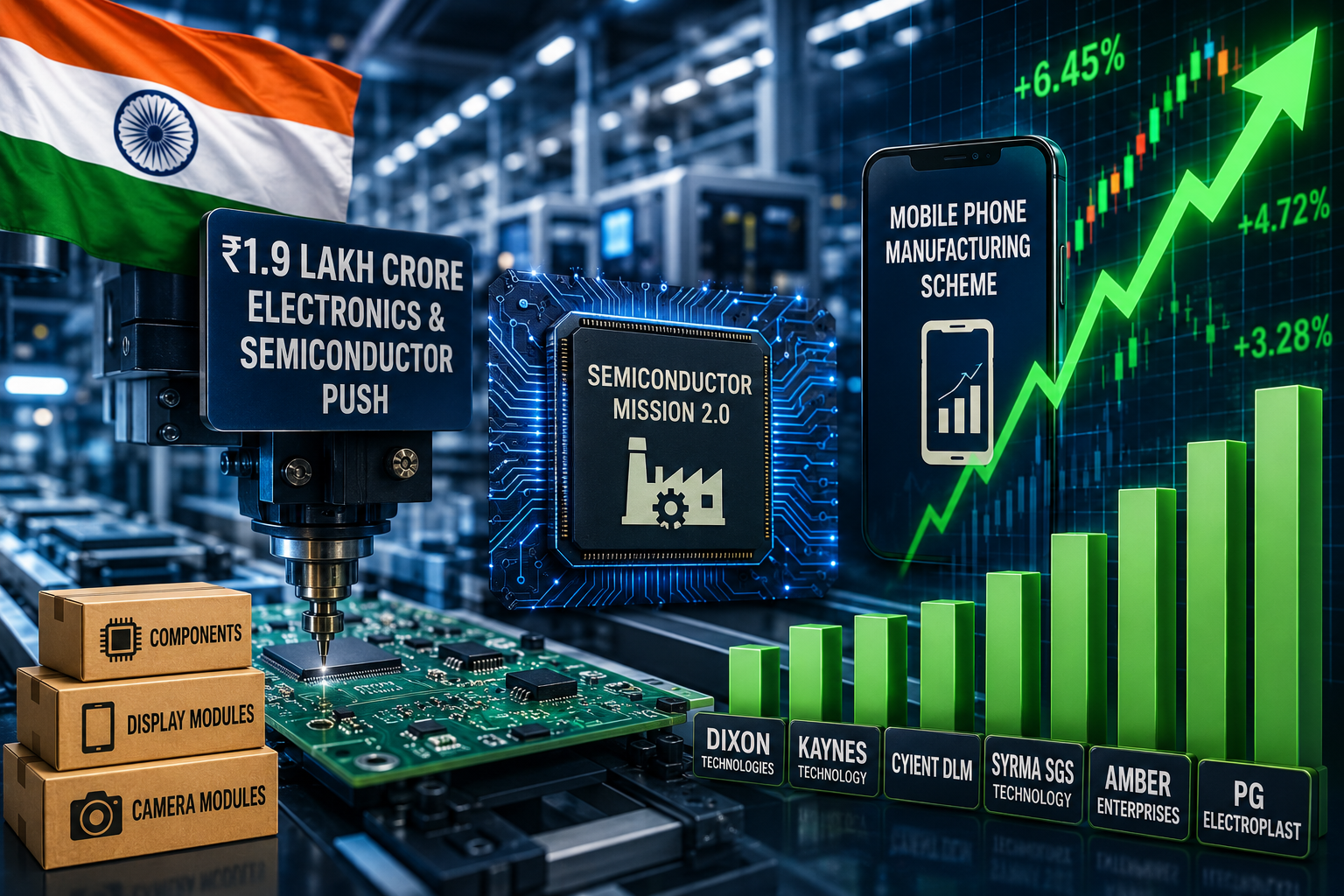
Dixon Technologies, Kaynes Technology, Cyient DLM, Syrma SGS and Other EMS Players Jump Up to 7% as Cabinet Approves Mobile Phone Manufacturing Scheme and ISM 2.0
Electronic Manufacturing Services (EMS) stocks witnessed strong buying interest on Thursday after the Union Cabinet approved two landmark initiatives aimed at accelerating India's electronics manufacturing and semiconductor ecosystem. The government's decision to launch a ₹62,500 crore Mobile Phone Manufacturing Scheme alongside the ₹1.27 lakh crore India Semiconductor Mission (ISM) 2.0 sparked optimism across the sector, driving shares of leading electronics manufacturers sharply higher.
Among the biggest gainers were Dixon Technologies, Kaynes Technology India, and Cyient DLM, which rose between 3% and 7% during intraday trade. Other EMS companies including Syrma SGS Technology, Amber Enterprises, PG Electroplast and Avalon Technologies also traded firmly in the green as investors anticipated stronger order inflows, higher localisation and increased government support for domestic manufacturing.
The policy announcements reinforce India's long-term ambition of becoming a global electronics and semiconductor manufacturing hub while reducing dependence on imported components and strengthening domestic supply chains.
EMS Stocks Outperform the Broader Market
The electronics manufacturing sector emerged as one of the strongest-performing segments in Thursday's trading session.
Top Gainers
| Company | Intraday Gain |
|---|---|
| Dixon Technologies | Up to 7% |
| Kaynes Technology | Around 5% |
| Cyient DLM | Around 3–6% |
| Syrma SGS Technology | 1–2% |
| Amber Enterprises | 1–2% |
| PG Electroplast | 1–2% |
The rally significantly outperformed the benchmark indices, highlighting renewed investor confidence in India's manufacturing story.
Strong Performance Extends Monthly Rally
The latest gains add to an already impressive run in EMS stocks over the past month.
One-Month Stock Performance
-
Dixon Technologies: +20%
-
Cyient DLM: +19%
-
PG Electroplast: +15%
-
Syrma SGS Technology: +10%
-
Kaynes Technology: +8%
The sustained upward momentum reflects growing optimism around government policy support, robust demand for electronics manufacturing and increasing global supply chain diversification.
Cabinet Clears Two Mega Manufacturing Schemes
The sharp rally was triggered by Cabinet approval of two major initiatives designed to strengthen India's electronics manufacturing ecosystem.
1. Mobile Phone Manufacturing Scheme
The government approved a ₹62,500 crore incentive programme as an extension of the existing Smartphone Production Linked Incentive (PLI) scheme.
The new programme aims to:
-
Increase smartphone manufacturing capacity.
-
Promote exports.
-
Encourage local sourcing of components.
-
Deepen domestic value addition.
-
Improve India's competitiveness in global electronics manufacturing.
2. India Semiconductor Mission (ISM) 2.0
The Cabinet also approved India Semiconductor Mission 2.0, with an outlay of approximately ₹1.27 lakh crore.
Unlike the earlier phase, ISM 2.0 focuses on developing an integrated semiconductor ecosystem rather than only supporting chip fabrication facilities.
The mission represents one of the largest industrial policy initiatives undertaken by the government in recent years.
ISM 2.0 Shifts Focus to Complete Ecosystem Development
Industry experts believe ISM 2.0 represents a strategic evolution in India's semiconductor ambitions.
Instead of concentrating solely on fabrication plants, the government now aims to develop every link of the semiconductor value chain.
Priority Areas Under ISM 2.0
-
Semiconductor fabrication
-
Chip design
-
Display manufacturing
-
Semiconductor equipment
-
Packaging and testing
-
Specialty chemicals
-
Industrial gases
-
Precision engineering
-
Research & development
-
Skill development and talent creation
This broader approach is expected to create opportunities for a much wider range of manufacturing companies.
New Incentive Structure Encourages Localisation
The revised policy introduces differentiated financial support across various segments of the semiconductor industry.
Government Incentives
| Segment | Fiscal Support |
|---|---|
| Silicon Fabrication | 40% |
| Display & Compound Semiconductor Fabs | 35% |
| Advanced Packaging | 35% |
| Conventional Packaging | 25% |
| Equipment & Materials | 30% |
| Research & Development | Up to 75% |
The revised framework aims to encourage higher domestic value addition while attracting private investment across the electronics supply chain.
Why EMS Companies Could Benefit Significantly
Electronic Manufacturing Services companies are expected to be among the biggest beneficiaries of the government's latest initiatives.
Higher Domestic Production
Greater localisation of components will increase manufacturing opportunities for domestic EMS firms.
Backward Integration
Companies manufacturing:
-
Display modules
-
Camera modules
-
Enclosures
-
Printed Circuit Boards (PCBs)
-
Semiconductor components
may qualify for additional incentives linked to local sourcing.
Export Expansion
The new smartphone manufacturing programme places greater emphasis on exports, opening new growth avenues for companies supplying global brands.
Margin Improvement
Reduced dependence on imported components may lower production costs and improve profitability over time.
Dixon Technologies Positioned for Long-Term Growth
Brokerages believe Dixon Technologies remains one of the strongest beneficiaries of the new policy framework.
The company has already announced investments in:
-
Display module manufacturing
-
Camera module production
-
Enclosure manufacturing
-
Backward integration initiatives
These investments align closely with the government's objective of increasing domestic value addition.
Analysts believe the company is well positioned to capture opportunities arising from both localisation incentives and export-led manufacturing growth.
Kaynes Technology Gains from Semiconductor Expansion
Kaynes Technology has already established its presence in semiconductor assembly and testing through investments made under the first phase of India's Semiconductor Mission.
ISM 2.0 is expected to further strengthen the company's growth prospects by expanding opportunities in:
-
Outsourced Semiconductor Assembly & Testing (OSAT)
-
Electronics manufacturing
-
Industrial automation
-
Semiconductor ecosystem development
The broader ecosystem approach may create multiple long-term revenue opportunities for the company.
Cyient DLM, Avalon and Other Players Also Stand to Benefit
Several other listed companies are expected to participate in the expanding electronics ecosystem.
These include:
-
Cyient DLM
-
Avalon Technologies
-
Syrma SGS Technology
-
Amber Enterprises
-
PG Electroplast
Avalon Technologies has recently entered semiconductor equipment manufacturing, positioning itself to benefit from increased capital investment in semiconductor infrastructure.
Companies involved in:
-
Industrial gases
-
Precision engineering
-
Specialty chemicals
-
PCB manufacturing
may also experience higher demand under the new policy framework.
Brokerages See Positive Long-Term Impact
Market experts believe ISM 2.0 marks an important transition from incentive-driven manufacturing towards ecosystem creation.
According to analysts, the revised policy could:
-
Improve domestic value addition.
-
Increase localisation.
-
Strengthen export competitiveness.
-
Encourage technology transfer.
-
Reduce dependence on imports.
-
Attract additional foreign investment.
Although near-term financial benefits will depend on implementation timelines, the structural outlook remains favourable.
India Strengthens Position in Global Electronics Supply Chain
Global manufacturers continue to diversify production away from concentrated manufacturing hubs.
India has emerged as one of the preferred destinations due to:
-
Government incentives.
-
Large domestic market.
-
Competitive labour costs.
-
Growing manufacturing capabilities.
-
Expanding infrastructure.
The latest Cabinet decisions reinforce India's ambition to become a major global hub for electronics manufacturing and semiconductor production over the coming decade.
Challenges Remain
Despite the positive outlook, investors should remain mindful of execution-related challenges.
Potential risks include:
-
Delays in project execution.
-
Capital-intensive investments.
-
Global semiconductor demand fluctuations.
-
Competition from other manufacturing economies.
-
Technology transfer challenges.
-
Supply chain disruptions.
The success of ISM 2.0 will depend largely on timely implementation and sustained private-sector participation.
Investment Perspective
The government's latest policy announcements provide a significant long-term growth catalyst for India's electronics manufacturing ecosystem. Companies with established manufacturing capabilities, backward integration strategies and exposure to semiconductor-related businesses are expected to benefit the most as localisation increases and exports expand.
While valuations in some EMS stocks have already appreciated considerably following recent rallies, the structural growth opportunity remains substantial. Investors may continue to monitor execution progress, capacity expansion, customer additions and order inflows before making fresh investment decisions.
Outlook
The approval of the ₹62,500 crore Mobile Phone Manufacturing Scheme and the ₹1.27 lakh crore India Semiconductor Mission 2.0 represents one of the most ambitious industrial policy initiatives undertaken by the Indian government. By expanding its focus beyond fabrication facilities to the broader semiconductor ecosystem—including chip design, equipment, specialty materials, packaging and research—the government is laying the foundation for a globally competitive electronics manufacturing industry.
For listed EMS companies such as Dixon Technologies, Kaynes Technology, Cyient DLM, Syrma SGS Technology, Amber Enterprises and other ecosystem participants, the policy creates multiple long-term growth opportunities through localisation, export expansion and higher domestic value addition. As India continues its journey toward becoming a global electronics manufacturing powerhouse, the sector is expected to remain one of the key beneficiaries of the country's manufacturing-led growth strategy over the coming years.