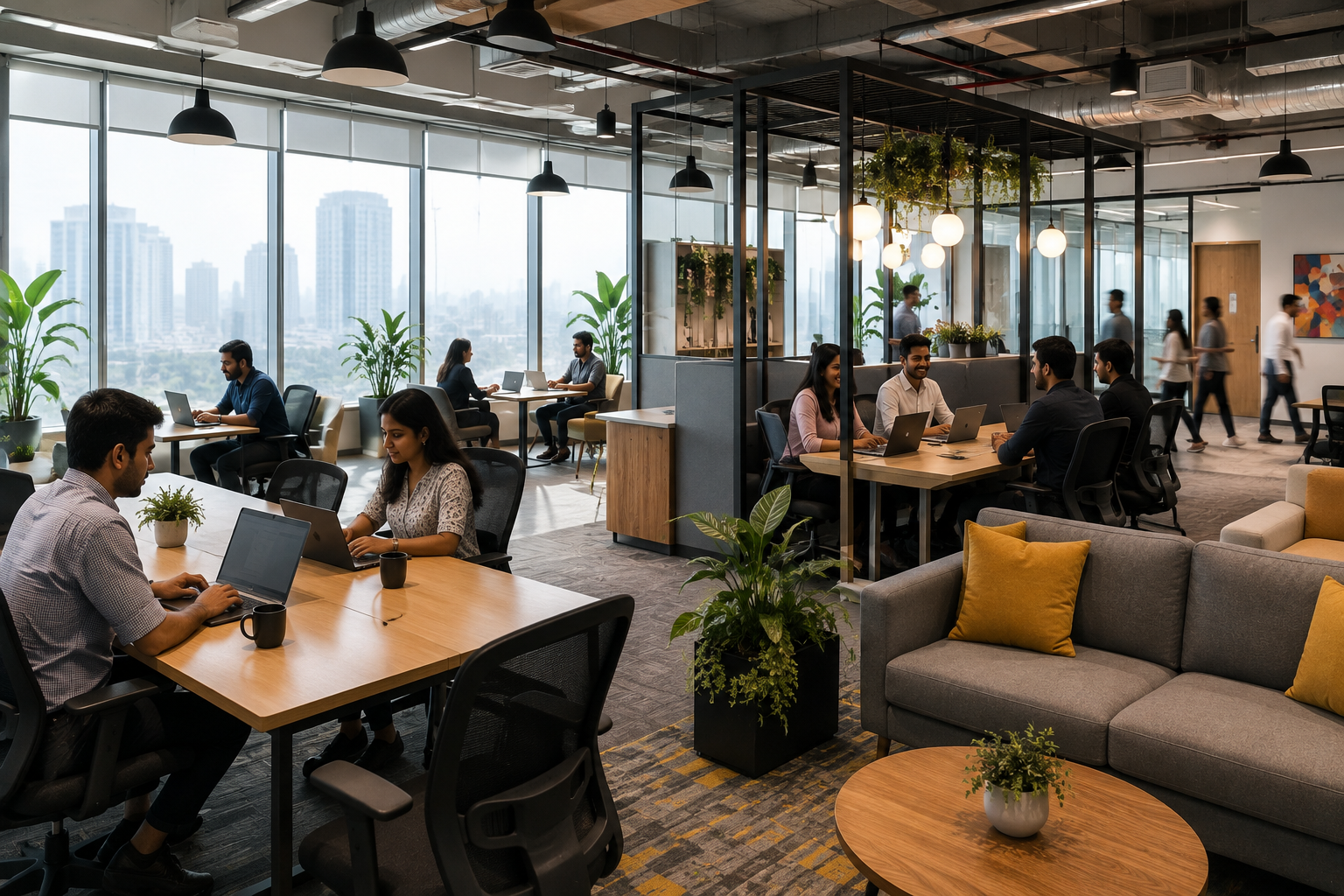
Flexible workspaces are rapidly becoming a mainstream corporate real estate strategy as companies prioritise scalability, cost efficiency and faster expansion
India’s coworking and flexible workspace market witnessed a sharp expansion during the first half of 2026, with operators leasing 1,91,306 seats across the country’s top eight cities between January and June. According to real estate consultant Cushman & Wakefield, seat leasing increased 68 per cent year-on-year, compared with 1,13,623 seats leased during the same period last year.
The strong growth underlines a major shift in corporate workplace strategies. Flexible offices, once primarily associated with startups, freelancers and small businesses, are increasingly being adopted by large enterprises, multinational companies and global capability centres (GCCs).
The expansion is also translating into higher demand for commercial office space, indicating that the flexible workspace industry is becoming an increasingly important component of India’s broader office real estate market.
Flexible Workspace Demand Jumps 68%
Coworking operators leased nearly 1.91 lakh desks during January-June 2026, marking a substantial increase from the 1.14 lakh seats leased in the year-ago period.
The rise comes as businesses seek greater flexibility in managing their office requirements. Rather than committing to large conventional leases for several years, companies can use managed workspaces to increase or reduce their office footprint depending on hiring, projects and business expansion.
This model has become particularly attractive for companies entering new cities or rapidly scaling their workforce.
Bengaluru Leads the Market
Bengaluru remained the largest market for coworking seat leasing during the first half of 2026.
Operators leased 57,487 desks in the city, up from 43,616 desks in the corresponding period last year, representing growth of around 32 per cent.
The city’s strong technology ecosystem continues to provide a large addressable market for flexible office providers. Bengaluru is also one of India’s biggest hubs for GCCs, technology companies and startups, creating sustained demand for ready-to-use office infrastructure.
The continued expansion of technology and global services businesses could keep Bengaluru among the most important markets for flexible workspace operators.
Hyderabad Emerges as a High-Growth Market
Hyderabad recorded an even sharper increase in demand.
Coworking operators leased 40,451 desks during January-June 2026, compared with 14,936 desks in the same period last year. This represents a more-than-two-fold increase in seat leasing.
The city’s expanding technology ecosystem, growing GCC presence and increasing corporate office requirements are supporting demand for flexible workspace solutions.
Hyderabad’s relatively strong commercial development pipeline could provide additional opportunities for operators to expand their presence in the coming quarters.
Mumbai Records Strong Expansion
Mumbai also recorded significant growth in coworking demand.
Operators leased 25,820 desks during the first six months of 2026, compared with 11,226 desks in the year-ago period.
The rise is notable given the city’s traditionally high commercial real estate costs. Flexible workspace providers allow businesses to access established business locations without making the same level of upfront commitment associated with setting up a conventional office.
For financial services, consulting, technology and professional services companies, this flexibility can be particularly useful when establishing new teams or expanding existing operations.
Office Leasing by Operators Rises 55%
The increase in seat leasing has been accompanied by substantial growth in the amount of office space being taken up by flexible workspace providers.
Coworking operators leased approximately 8.4 million square feet of office space during January-June 2026, up 55 per cent from 5.4 million square feet during the same period last year.
This indicates that the growth is not limited to individual memberships. Operators are expanding their physical networks and taking larger commercial spaces to cater to enterprise clients.
For commercial landlords, this creates an additional source of demand for large office properties.
GCC Expansion Supports Flexible Office Demand
One of the major structural drivers behind the market is the continued expansion of global capability centres in India.
Multinational companies are increasingly establishing teams focused on technology, research and development, analytics, finance, engineering and other specialised functions.
Flexible workspace operators can provide these companies with ready-to-occupy infrastructure, allowing them to begin operations faster while maintaining the ability to scale their office footprint.
Cities with strong GCC ecosystems are therefore likely to remain key markets for the sector.
Corporates Look Beyond Traditional Offices
The changing nature of work is also influencing corporate real estate decisions.
Companies are increasingly using flexible offices for:
-
New-city expansion
-
Project-based teams
-
Satellite offices
-
Hybrid working arrangements
-
Temporary workforce requirements
-
Rapidly growing business units
-
GCC and technology teams
This diversified use case is helping flexible workspace providers expand beyond the traditional coworking model.
Enterprise Clients Become Increasingly Important
The growth in corporate leasing suggests that enterprise customers are becoming a critical part of the flexible workspace business.
Large companies generally require larger floor areas, professional infrastructure, security, technology support and customisation. This can provide operators with higher-value contracts and potentially improve revenue visibility.
However, enterprise clients can also demand greater service standards and customised facilities, making operational efficiency increasingly important for workspace providers.
Rising Demand Creates New Opportunities for Landlords
The expansion of coworking companies could have wider implications for commercial real estate owners.
Flexible workspace operators can act as large-scale tenants, taking significant portions of office buildings and converting them into managed workplaces. As demand grows, landlords may increasingly consider partnerships with flex operators as part of their leasing strategies.
The trend could be particularly beneficial in markets where office demand is being supported by technology companies, GCCs and professional services firms.
Growth Does Not Come Without Challenges
Despite the strong increase in demand, the sector faces several challenges.
Operators need to maintain healthy occupancy while managing rent, fit-out costs, employee expenses, maintenance and technology investments. Rapid expansion can also increase capital requirements.
Higher competition could put pressure on pricing, particularly in markets where several operators are expanding simultaneously.
Therefore, the next phase of the industry could be less about simply adding seats and more about achieving sustainable occupancy, improving utilisation and attracting long-term enterprise customers.
Scale and Occupancy Could Define the Next Phase
As the flexible workspace industry matures, scale could become an important competitive advantage. Larger operators may have greater bargaining power with landlords, broader geographic networks and the ability to serve companies across multiple cities.
At the same time, occupancy and pricing discipline will remain crucial. Operators that expand too aggressively without maintaining utilisation could face pressure on profitability.
The ability to combine network expansion with efficient capital deployment could therefore determine which companies emerge as long-term leaders in the sector.
India's Office Market Enters a New Phase
The latest numbers point towards a broader transformation in how businesses approach office space.
Rather than viewing flexible offices simply as an alternative to conventional workplaces, corporates are increasingly incorporating them into their long-term real estate strategies.
With 1.91 lakh seats leased in just six months, the scale of adoption demonstrates that flexible workspace is becoming a meaningful component of India's commercial property ecosystem.
Market Outlook
India’s flexible workspace sector is likely to remain in focus as GCC expansion, corporate hiring, hybrid work models and demand for scalable office infrastructure continue to support leasing activity. Strong growth in Bengaluru, Hyderabad and Mumbai highlights the sector’s expansion potential, while rising office-space absorption by operators could further support commercial real estate demand. Going ahead, occupancy rates, rental costs, enterprise client growth, expansion pace and profitability will be the key factors determining whether the current leasing boom develops into a sustainable long-term growth cycle.