Market Regulator Maintains Fast Complaint Resolution Timeline as Pending Cases Decline; Digital Grievance Redressal System Continues to Enhance Transparency and Investor Confidence
The Securities and Exchange Board of India (SEBI) continues to strengthen investor protection through its technology-driven grievance redressal mechanism, SCORES 2.0 (SEBI Complaints Redress System). According to the regulator's latest monthly update, more than 5,000 investor complaints were successfully resolved during June 2026, demonstrating SEBI's continued focus on improving transparency, accountability and efficiency within India's capital markets.
During the month, SEBI received 5,035 fresh complaints while disposing of 5,037 grievances, resulting in a marginal reduction in pending complaints. The latest figures reflect the regulator's ability to keep pace with increasing investor participation in the securities market while maintaining an efficient complaint resolution process.
As India's equity markets continue to witness growing retail participation, an effective grievance redressal system has become increasingly important in building investor trust and strengthening confidence in regulated financial markets.
Complaint Disposal Continues to Outpace Fresh Registrations
SEBI's monthly data indicates that complaint resolution remained highly efficient throughout June.
SCORES Performance – June 2026
| Particulars | Number |
|---|---|
| Fresh Complaints Received | 5,035 |
| Complaints Resolved | 5,037 |
| Pending Complaints (May-End) | 5,537 |
| Pending Complaints (June-End) | 5,524 |
Although the reduction in pending complaints was modest, the regulator successfully resolved slightly more complaints than it received during the month, preventing any significant increase in backlog.
This consistent disposal rate reflects the growing maturity of SEBI's digital complaint management framework.
What Is SCORES 2.0?
The SEBI Complaints Redress System (SCORES) is an online platform developed to provide investors with a simple, transparent and time-bound mechanism for resolving grievances against entities regulated by SEBI.
The platform enables investors to lodge complaints against:
-
Listed companies
-
Stock brokers
-
Depository participants
-
Mutual funds
-
Portfolio managers
-
Merchant bankers
-
Registrars and transfer agents
-
Other SEBI-registered intermediaries
SCORES serves as a centralised digital portal where investors can track the status of complaints from registration to final resolution.
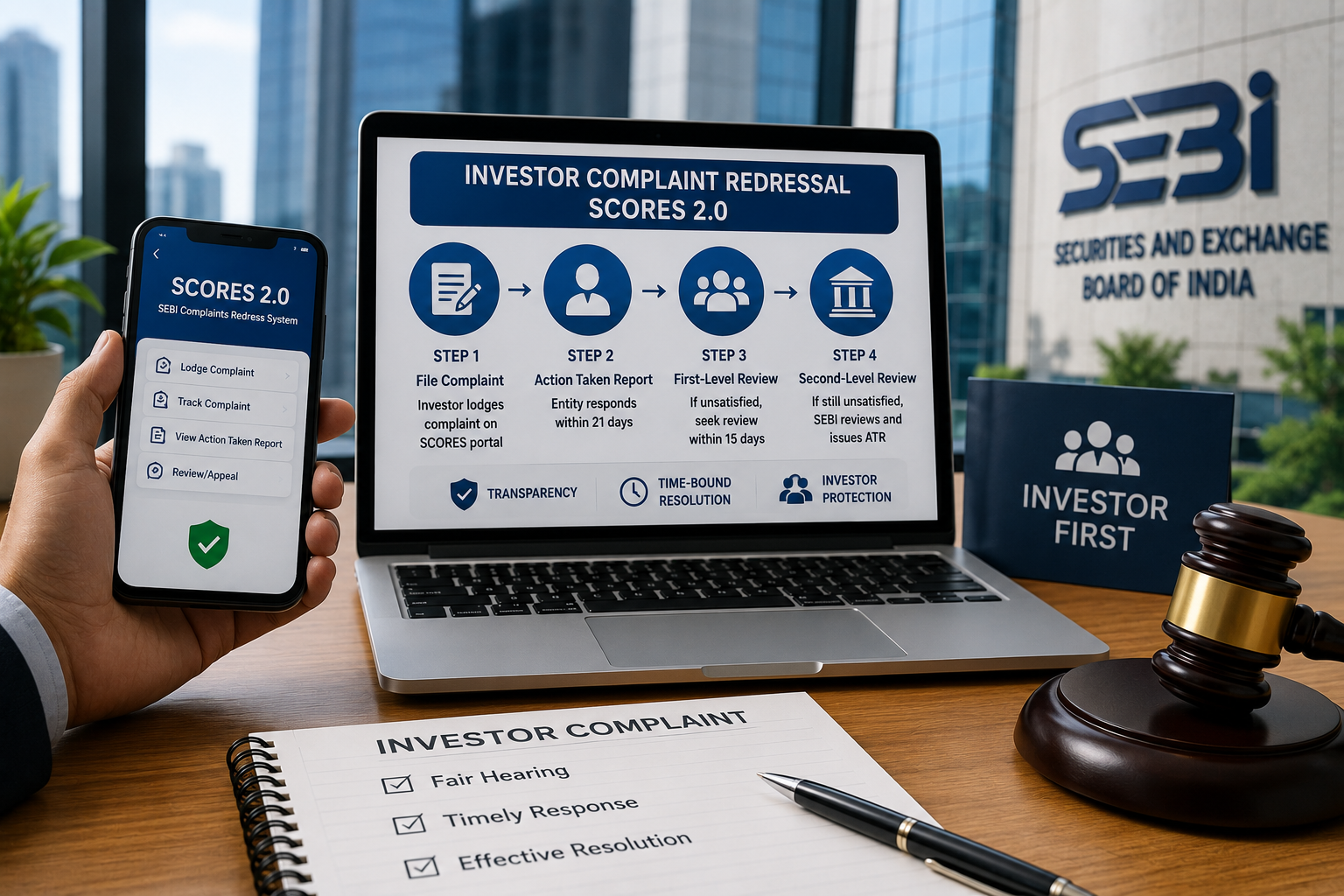
How the SCORES 2.0 Process Works
The upgraded SCORES 2.0 framework follows a structured, multi-level grievance resolution mechanism.
Step 1: Filing the Complaint
Investors submit complaints electronically through the SCORES portal.
The complaint is automatically forwarded to the concerned regulated entity.
Step 2: Action Taken Report (ATR)
The company or intermediary must respond within 21 days by submitting an Action Taken Report (ATR) directly to the investor.
Step 3: First-Level Review
If the investor remains dissatisfied, a review request can be filed within 15 days.
The complaint is then examined by a designated body, which independently reviews the response and issues another Action Taken Report.
Step 4: Second-Level Review
Where the grievance remains unresolved, investors can seek a second-level review within another 15 days.
At this stage, SEBI itself examines the matter and issues its own Action Taken Report.
This structured review mechanism ensures fairness, transparency and multiple opportunities for investors to seek satisfactory resolution.
Fast Resolution Timeline Reflects Operational Efficiency
SEBI's latest report highlights encouraging improvements in response times.
Average Timelines During June
-
Average time for entities to submit ATR: 4 days
-
Average first-level review resolution: 8 days
These timelines remain significantly shorter than the maximum period permitted under the regulatory framework.
Faster complaint handling not only improves investor satisfaction but also enhances overall market confidence.
Only a Few Cases Remain Pending Beyond Three Months
Despite the large volume of complaints handled every month, only 17 complaints remained pending for more than three months as of June-end.
The pending cases involved entities such as:
-
Aditya Birla Money Ltd.
-
Finolex Industries.
-
HBL Power Systems.
According to SEBI, these cases generally involve more complex issues that require additional investigation or extended interaction between investors and regulated entities.
Why Some Complaints Continue to Appear as Pending
SEBI clarified that a complaint may remain listed as pending even after the concerned company has submitted its Action Taken Report.
This occurs because investors are provided an opportunity to review the response before the complaint is finally closed.
Pending status may continue when:
-
Investors seek a first-level review.
-
Investors request a second-level review.
-
Additional information is required.
-
The matter is under Online Dispute Resolution (ODR).
Therefore, pending complaints do not necessarily indicate inaction by regulated entities.
Online Dispute Resolution (ODR) Adds Another Layer of Protection
In addition to SCORES, SEBI has strengthened investor protection through the Online Dispute Resolution (ODR) mechanism.
The ODR framework allows disputes to be resolved digitally through:
-
Mediation
-
Conciliation
-
Arbitration
When an investor opts for ODR, the complaint is treated as disposed of under SCORES while dispute resolution continues separately.
The initiative aims to reduce litigation costs, improve accessibility and accelerate dispute settlement.
Investor Grievance Redressal Plays a Critical Role
A robust grievance redressal system is fundamental to maintaining confidence in financial markets.
Efficient complaint resolution:
-
Protects retail investors.
-
Improves corporate accountability.
-
Enhances regulatory transparency.
-
Strengthens market integrity.
-
Encourages greater retail participation.
As the number of first-time investors in Indian capital markets continues to grow, timely grievance resolution becomes increasingly important.
SEBI's Broader Investor Protection Initiatives
The regulator has introduced several reforms aimed at improving market governance and investor confidence.
Recent initiatives include:
Stronger Corporate Governance
Enhanced disclosure and compliance standards for listed companies.
Conflict of Interest Framework
Tighter code of conduct for SEBI board members and regulated entities.
Digital Regulatory Ecosystem
Expansion of technology-driven compliance and monitoring systems.
Faster Complaint Handling
Continuous upgrades to SCORES for quicker grievance resolution.
Investor Awareness
Educational initiatives promoting informed investing and financial literacy.
These measures collectively contribute to building a more transparent and trustworthy capital market environment.
What Investors Should Do Before Filing a Complaint
Financial experts recommend that investors first attempt to resolve issues directly with the concerned company or intermediary.
If the issue remains unresolved, investors should:
-
Preserve transaction records.
-
Keep contract notes and account statements.
-
Maintain email correspondence.
-
Clearly describe the grievance.
-
Upload supporting documents while filing the complaint.
Providing complete information can significantly reduce resolution time.
How Technology Is Transforming Market Regulation
SEBI's digital transformation reflects a broader shift towards technology-enabled financial regulation.
Modern digital grievance systems provide:
-
Real-time complaint tracking.
-
Faster communication.
-
Improved transparency.
-
Better accountability.
-
Reduced paperwork.
-
Greater accessibility for retail investors.
Technology has become an integral part of ensuring efficient regulatory oversight in India's rapidly expanding financial markets.
The Growing Importance of Investor Confidence
India's capital markets have witnessed unprecedented growth over the past few years, driven by rising retail participation, increased mutual fund investments and expanding digital trading platforms.
As millions of new investors enter the market, regulatory efficiency becomes critical.
A strong grievance redressal mechanism reassures investors that:
-
Their concerns will be addressed.
-
Companies remain accountable.
-
Regulatory oversight is effective.
-
Market integrity is protected.
Such confidence plays a vital role in supporting long-term market development.
Outlook
SEBI's June 2026 grievance redressal data highlights the regulator's continued commitment to strengthening investor protection through faster complaint resolution and technology-driven regulatory reforms. The ability to resolve more complaints than those received during the month, while maintaining an average response time of just a few days, demonstrates the growing effectiveness of the SCORES 2.0 platform.
As India's securities market continues to attract record levels of retail participation, efficient grievance redressal will remain one of the key pillars supporting investor confidence. Going forward, further enhancements to digital complaint management, wider adoption of Online Dispute Resolution (ODR) and continued regulatory reforms are expected to make India's capital markets more transparent, efficient and investor-friendly, reinforcing the country's position as one of the world's fastest-growing investment destinations.