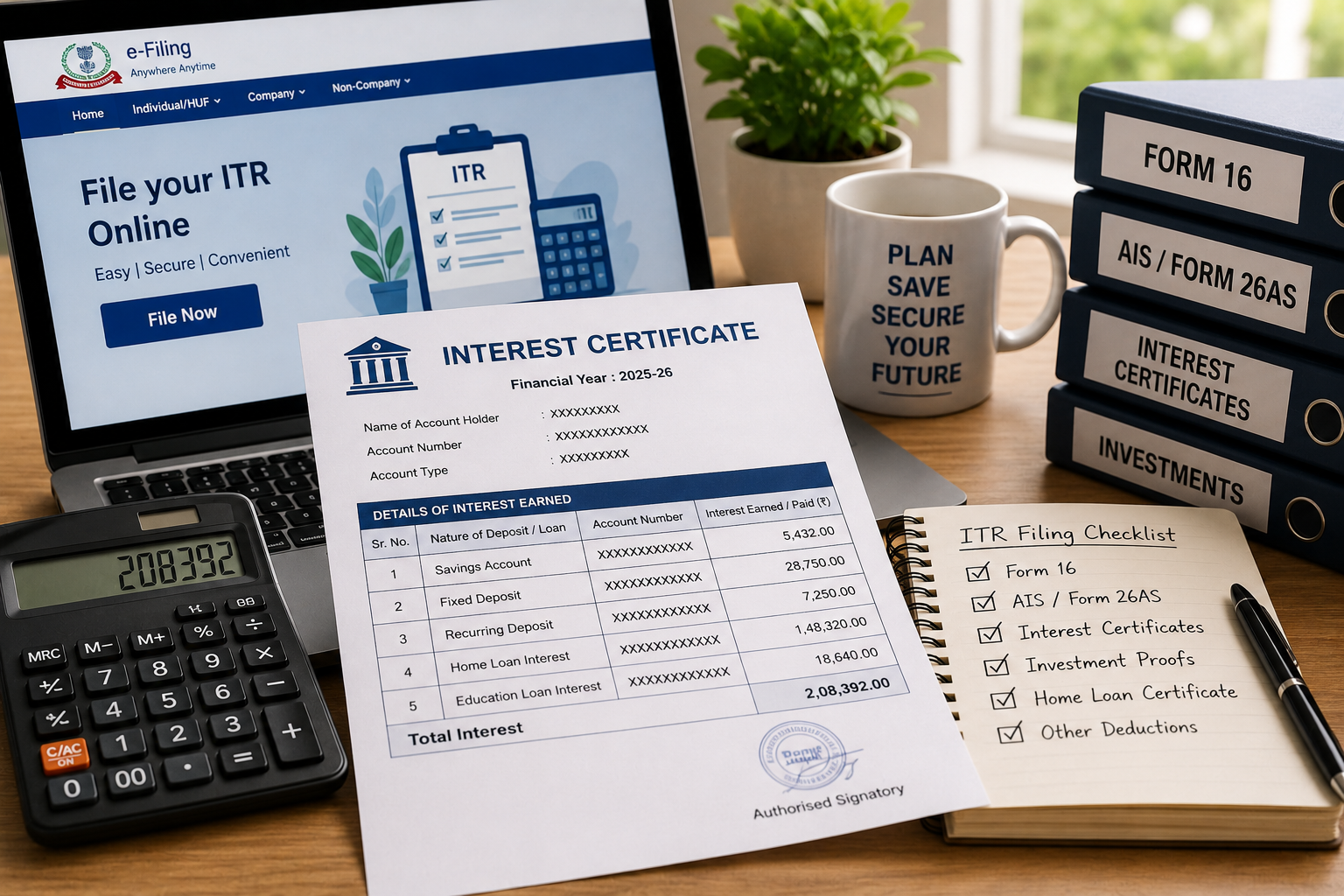
A Complete Guide to Downloading Interest Certificates, Reporting Interest Income Correctly and Avoiding Tax Notices During ITR Filing
With the Income Tax Return (ITR) filing season in full swing, millions of taxpayers are collecting financial documents required to file their returns accurately. While most individuals focus on Form 16, Annual Information Statement (AIS) and Form 26AS, one important document often receives less attention—the bank interest certificate.
Although it may appear to be a routine banking document, an interest certificate plays a vital role in accurately reporting income earned from savings accounts, fixed deposits (FDs), recurring deposits (RDs) and even in claiming deductions on eligible loan interest such as home loans and education loans.
Tax experts advise taxpayers not to rely solely on AIS or Form 26AS while filing their returns. Instead, they recommend collecting interest certificates from every bank and financial institution where deposits are held to ensure complete disclosure of interest income and minimise the possibility of receiving notices from the Income Tax Department.
What Is a Bank Interest Certificate?
A bank interest certificate is an official statement issued by a bank or financial institution summarising the interest credited or paid during a particular financial year.
Depending on the type of account, the certificate may include:
-
Savings account interest
-
Fixed Deposit (FD) interest
-
Recurring Deposit (RD) interest
-
Home loan interest paid
-
Education loan interest paid
-
Other eligible deposit or loan interest
The document serves as authentic proof of interest transactions and assists taxpayers in preparing an accurate income tax return.
Why Is the Interest Certificate Important for ITR Filing?
Interest earned from bank deposits is taxable under the Income Tax Act unless specifically exempt.
Incorrect reporting of this income can lead to:
-
Tax demand notices
-
Mismatch with Income Tax Department records
-
Delayed refunds
-
Revised return filings
-
Additional interest or penalties in certain cases
An interest certificate helps taxpayers report the exact amount credited by each bank during the financial year.
It also supports deduction claims where loan interest qualifies under applicable provisions of the Income Tax Act.
Why You Shouldn't Depend Only on AIS or Form 26AS
Many taxpayers believe that downloading the Annual Information Statement (AIS) is sufficient for filing their return.
However, financial experts recommend using the bank-issued interest certificate as an additional verification tool.
Unlike AIS, interest certificates provide:
-
Account-wise interest details.
-
Separate break-up of savings and deposit interest.
-
Loan interest certificates where applicable.
-
Bank-specific transaction records.
-
Easier reconciliation with personal financial records.
Cross-checking these documents significantly reduces the possibility of reporting errors.
Who Should Download Interest Certificates?
Every taxpayer earning interest income should collect interest certificates before filing an ITR.
This becomes particularly important for individuals who maintain:
-
Multiple savings bank accounts.
-
Fixed deposits across different banks.
-
Recurring deposits with several institutions.
-
Joint bank accounts.
-
Home loans.
-
Education loans.
-
Senior Citizen Savings Scheme accounts.
The more diversified your banking relationships are, the more important it becomes to collect certificates from every institution.
How to Download Interest Certificate Online
Today, almost every bank offers digital access to interest certificates through internet banking and mobile banking applications.
The general process remains similar across banks.
General Steps
-
Log in to Internet Banking.
-
Open the Accounts or Deposits section.
-
Select Interest Certificate.
-
Choose the relevant account.
-
Select the financial year.
-
Download the certificate in PDF format.
The entire process generally takes only a few minutes.
How to Download Interest Certificates from Major Banks
State Bank of India (SBI)
-
Login to Internet Banking.
-
Select e-Services.
-
Click My Certificates.
-
Choose Interest Certificate.
-
Select financial year.
-
Download PDF.
HDFC Bank
-
Login to NetBanking.
-
Open Accounts.
-
Select Download Interest Certificate.
-
Choose account and financial year.
-
Download the certificate.
ICICI Bank
-
Login to Internet Banking.
-
Navigate to Payments & Transfer.
-
Open Tax Centre.
-
Select Interest Certificate.
-
Generate the PDF.
Axis Bank
-
Login to Net Banking.
-
Select Deposits.
-
Click Interest Certificate.
-
Download immediately or receive through registered email.
Bank of Baroda
-
Login to Internet Banking.
-
Select Accounts or Request Services.
-
Choose Interest Certificate.
-
Generate the report.
Canara Bank
-
Login to Net Banking.
-
Open Deposits.
-
Select Interest Certificate.
-
Download PDF.
Punjab National Bank (PNB)
-
Login to Internet Banking.
-
Select Manage Accounts.
-
Open Deposit Accounts.
-
Generate Interest Certificate.
Kotak Mahindra Bank
-
Login to Net Banking.
-
Open Service Requests.
-
Select Tax Services.
-
Download Interest Certificate.
Union Bank of India
-
Login to Internet Banking.
-
Select Accounts.
-
Open Interest Certificate.
-
Download PDF.
Indian Bank
-
Login to Internet Banking.
-
Open Deposit Services.
-
Select Interest Certificate.
-
Download report.
India Post Internet Banking
-
Login.
-
Open Accounts.
-
Select Interest Certificate.
-
Choose financial year.
-
Download PDF.
If the Certificate Isn't Available Online
Customers who cannot locate the certificate online can still obtain it through:
-
Mobile Banking App
-
Customer Care
-
Email request
-
Visiting the nearest branch
Most banks issue digital certificates almost immediately.
Common Mistakes Taxpayers Make
Many taxpayers unintentionally under-report interest income because they:
-
Forget old savings accounts.
-
Ignore recurring deposit interest.
-
Report only TDS instead of total interest.
-
Miss interest earned from joint accounts.
-
Forget deposits held with cooperative banks.
-
Depend entirely on Form 26AS.
These errors often result in mismatches with Income Tax Department records.
Documents You Should Verify Before Filing ITR
Before clicking the final "Submit" button, taxpayers should cross-check:
✔ Form 16
✔ Annual Information Statement (AIS)
✔ Form 26AS
✔ Interest Certificates from all banks
✔ Capital gains statements
✔ Dividend income
✔ Home loan interest certificate
✔ Investment proofs
✔ Tax-saving deduction documents
Preparing these documents beforehand helps avoid last-minute confusion.
Why Interest Certificates Matter More Today
The Income Tax Department has significantly strengthened its technology-driven compliance systems.
Banks, mutual funds, employers, brokers and financial institutions regularly share financial information with tax authorities.
Advanced data analytics now compare:
-
Bank interest
-
Dividend income
-
Capital gains
-
Salary income
-
TDS details
-
Investment disclosures
Even minor mismatches can trigger automated verification notices.
Interest certificates therefore serve as one of the simplest tools to ensure complete and accurate reporting.
Benefits of Proper Documentation
Maintaining complete interest records offers several advantages:
Faster Return Processing
Accurate returns reduce processing delays.
Lower Risk of Notices
Proper reporting minimises mismatch-related tax communications.
Easier Tax Planning
Interest certificates provide a clear picture of annual interest income.
Better Financial Record Keeping
The documents remain useful while applying for loans, visas and financial planning.
The Bottom Line
Although downloading an interest certificate takes only a few minutes, it can significantly improve the accuracy of your Income Tax Return. As taxpayers increasingly maintain multiple bank accounts, fixed deposits and recurring deposits across different financial institutions, relying solely on AIS or Form 26AS may not always be sufficient.
Collecting interest certificates from every bank, reconciling them with your financial records and verifying the figures against the Income Tax Department's information can help ensure smooth tax filing, faster refunds and lower compliance risks.
With the tax filing deadline approaching, investing a little extra time in proper documentation today can save taxpayers from unnecessary notices, revised returns and avoidable disputes tomorrow.