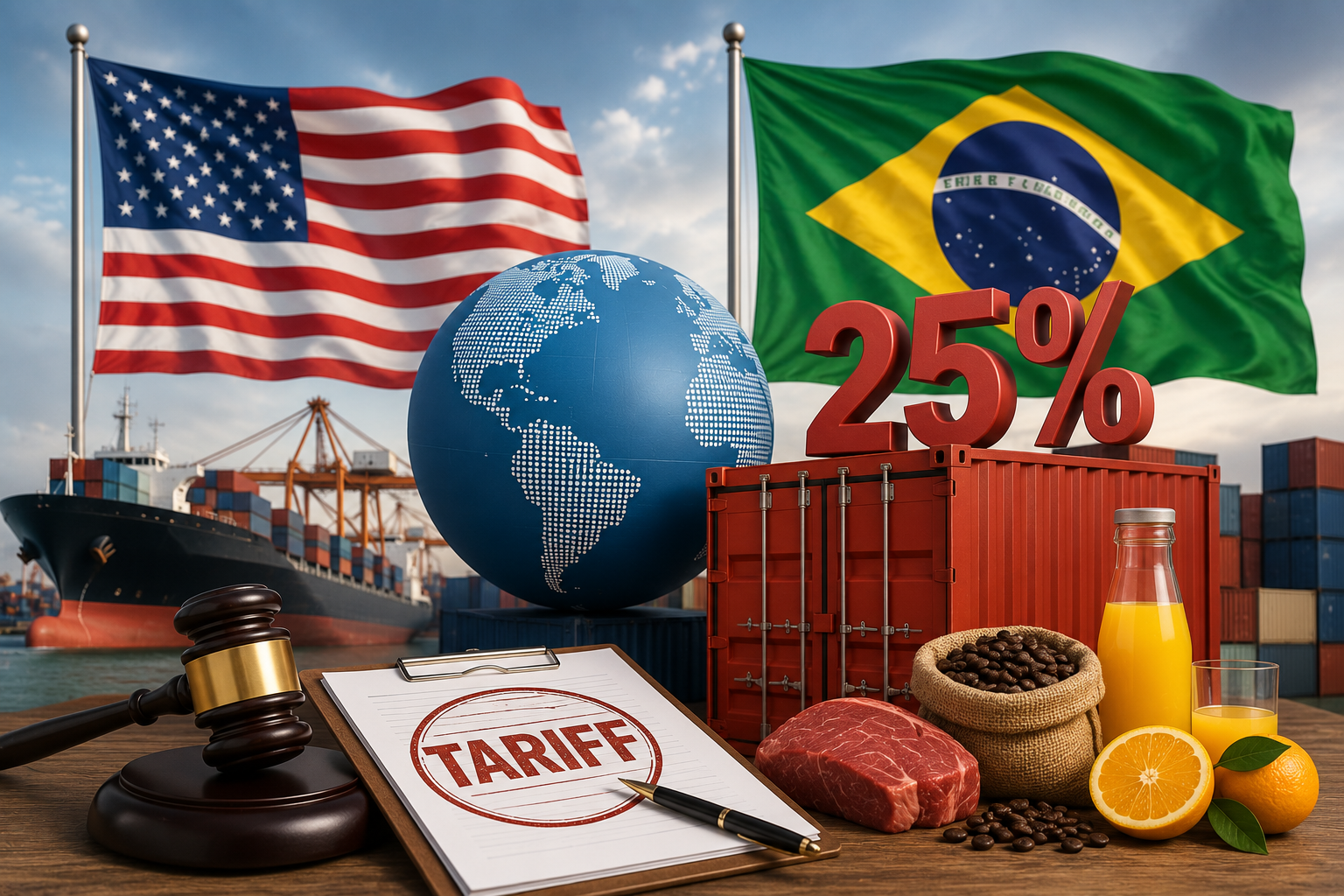
Washington Cites Unfair Trade Practices Under Section 301 Investigation, While Exempting Coffee, Beef, Orange Juice and Aerospace Components to Protect Supply Chains
The United States has announced a fresh round of trade measures against Brazil, imposing a 25% tariff on selected Brazilian imports after concluding that the South American nation engages in several trade practices that unfairly disadvantage American businesses. The new tariffs are scheduled to come into effect on July 22, marking another significant development in the evolving global trade landscape.
The decision follows a year-long investigation conducted by the Office of the United States Trade Representative (USTR) under Section 301 of the US Trade Act of 1974, a legal framework that allows Washington to impose retaliatory trade measures against countries deemed to maintain discriminatory or unreasonable trade policies.
While the tariffs target a range of Brazilian products, the US administration has excluded several strategically important commodities—including coffee, beef and orange juice—to minimise disruptions to domestic supply chains and limit inflationary pressures on American consumers.
The move underscores the growing use of trade policy as an instrument of economic and geopolitical strategy, even between countries that maintain relatively balanced trade relationships.
What Prompted the New Tariffs?
According to the USTR's investigation, Brazil was found to have adopted multiple trade and regulatory practices considered unfair from the perspective of US businesses.
The investigation cited concerns including:
-
Weak enforcement of anti-corruption regulations.
-
Tariff and non-tariff barriers affecting American exporters.
-
Regulatory practices viewed as discriminatory.
-
Trade policies that allegedly restrict fair market access.
-
Administrative procedures considered inconsistent with international trade norms.
US Trade Representative Jamieson Greer stated that negotiations with Brazilian authorities had continued for more than a year but failed to produce meaningful progress.
According to the US administration, the tariff action aims to restore competitive conditions for American manufacturers and exporters while encouraging reforms in Brazil's trade framework.
Tariffs Apply from July 22
The 25% duties will become effective on July 22, impacting selected Brazilian imports entering the United States.
Unlike broad-based tariff measures, the current action focuses on specific product categories identified during the Section 301 investigation.
The targeted approach reflects Washington's effort to balance trade enforcement with broader economic considerations.
Several Critical Imports Exempted
Recognising the importance of Brazilian supplies in certain sectors, the US government has exempted a number of products from the tariff.
Key Exemptions Include:
-
Coffee
-
Beef
-
Oranges
-
Orange juice
-
Selected crude oil and energy products
-
Aerospace components and aviation parts
These exemptions are intended to:
-
Prevent supply chain disruptions.
-
Avoid shortages in key consumer products.
-
Protect industries dependent on imported raw materials.
-
Reduce upward pressure on domestic inflation.
Brazil remains one of the world's largest exporters of coffee, orange juice and several agricultural commodities, making uninterrupted trade particularly important for American consumers and food manufacturers.
Trade Decision Comes Despite Positive US Trade Balance
One of the more unusual aspects of the latest tariff announcement is that the United States has consistently maintained a goods trade surplus with Brazil.
Unlike previous tariff actions aimed at reducing trade deficits, the current measures are primarily focused on addressing structural trade concerns rather than correcting an imbalance in bilateral trade volumes.
Analysts suggest the move reflects Washington's increasing emphasis on:
-
Market access.
-
Regulatory transparency.
-
Fair competition.
-
Governance standards.
This signals a broader evolution in US trade policy beyond conventional deficit-based trade disputes.
Political Dimension Adds Complexity
The tariff decision has also generated political reactions in Brazil.
Brazilian President Luiz Inácio Lula da Silva has previously criticised the proposed tariffs, arguing that political considerations have influenced Washington's position.
Earlier statements from Brazilian officials suggested that domestic political developments—including interactions between US policymakers and Brazilian opposition leaders—had contributed to deteriorating bilateral trade relations.
Meanwhile, senior US officials defended the decision, maintaining that repeated negotiations had failed to resolve longstanding concerns regarding Brazil's trade practices.
The political backdrop has added another layer of complexity to already sensitive economic relations between the two countries.
Why Section 301 Matters
The latest action has been taken under Section 301 of the Trade Act of 1974, a legal mechanism frequently used by the United States to investigate and respond to foreign trade practices considered unfair.
Section 301 allows the US government to:
-
Investigate foreign trade barriers.
-
Conduct formal consultations.
-
Impose tariffs or other retaliatory measures.
-
Seek negotiated settlements.
The provision has previously been used in several high-profile trade disputes involving China, the European Union and other major trading partners.
Its use against Brazil demonstrates Washington's willingness to employ established trade enforcement tools even against countries with relatively balanced trade relationships.
Difference from Previous Tariff Measures
The latest tariffs differ significantly from earlier trade actions imposed under the International Emergency Economic Powers Act (IEEPA).
Earlier this year, the US Supreme Court ruled that several tariffs implemented under IEEPA exceeded presidential authority.
By relying instead on Section 301—which has a longer legal history in trade enforcement—the current administration has adopted a more established statutory framework.
This distinction is expected to strengthen the legal basis for the new tariff measures.
Potential Impact on Brazil's Economy
Although major agricultural exports have been excluded, several Brazilian manufacturing industries may still experience increased pressure.
Potential consequences include:
Reduced Export Competitiveness
Higher tariffs could make Brazilian goods less price competitive in the US market.
Lower Manufacturing Demand
Export-oriented industries affected by the tariffs may experience reduced production if US buyers seek alternative suppliers.
Investment Uncertainty
Businesses considering expansion plans may delay investments until greater clarity emerges regarding future trade relations.
Supply Chain Adjustments
Companies with integrated cross-border operations may reassess sourcing strategies to minimise tariff-related costs.
Impact on American Businesses and Consumers
The exemptions granted to major agricultural and industrial products should help limit immediate disruption for US consumers.
However, companies importing tariff-affected goods could face:
-
Higher procurement costs.
-
Pressure on profit margins.
-
Supply chain adjustments.
-
Increased sourcing diversification.
Manufacturers dependent on Brazilian industrial inputs may also need to explore alternative suppliers if tariff costs become significant.
Global Trade Implications
The announcement reflects a broader global trend toward more assertive trade policies as governments increasingly use tariffs to address economic, strategic and regulatory concerns.
International trade has become closely linked with:
-
Industrial policy.
-
Supply chain resilience.
-
National security.
-
Technology competitiveness.
-
Geopolitical considerations.
As a result, businesses operating across international markets are placing greater emphasis on supply chain diversification and geopolitical risk management.
What Investors Should Watch
Market participants will now closely monitor several developments:
-
Any retaliatory measures announced by Brazil.
-
Further diplomatic negotiations between both governments.
-
Impact on bilateral trade volumes.
-
Commodity price movements.
-
Effects on sectors dependent on Brazilian imports.
-
Responses from multinational companies operating in both countries.
Investors will also watch whether the tariffs remain limited to the current list of products or expand further if negotiations fail.
Outlook: Trade Relations Enter a New Phase
The United States' decision to impose a 25% tariff on selected Brazilian imports marks a significant shift in bilateral trade relations, highlighting Washington's increasingly assertive approach toward addressing what it considers unfair trade practices. While exemptions for critical agricultural products and aerospace components reduce the immediate economic impact, the measures introduce fresh uncertainty into one of the Western Hemisphere's important trading relationships.
Going forward, the direction of US-Brazil trade will largely depend on diplomatic engagement and the willingness of both governments to address outstanding regulatory concerns. For businesses and investors, the focus will remain on potential supply chain adjustments, policy responses and the broader implications for global trade at a time when protectionist measures are becoming an increasingly prominent feature of the international economic landscape.