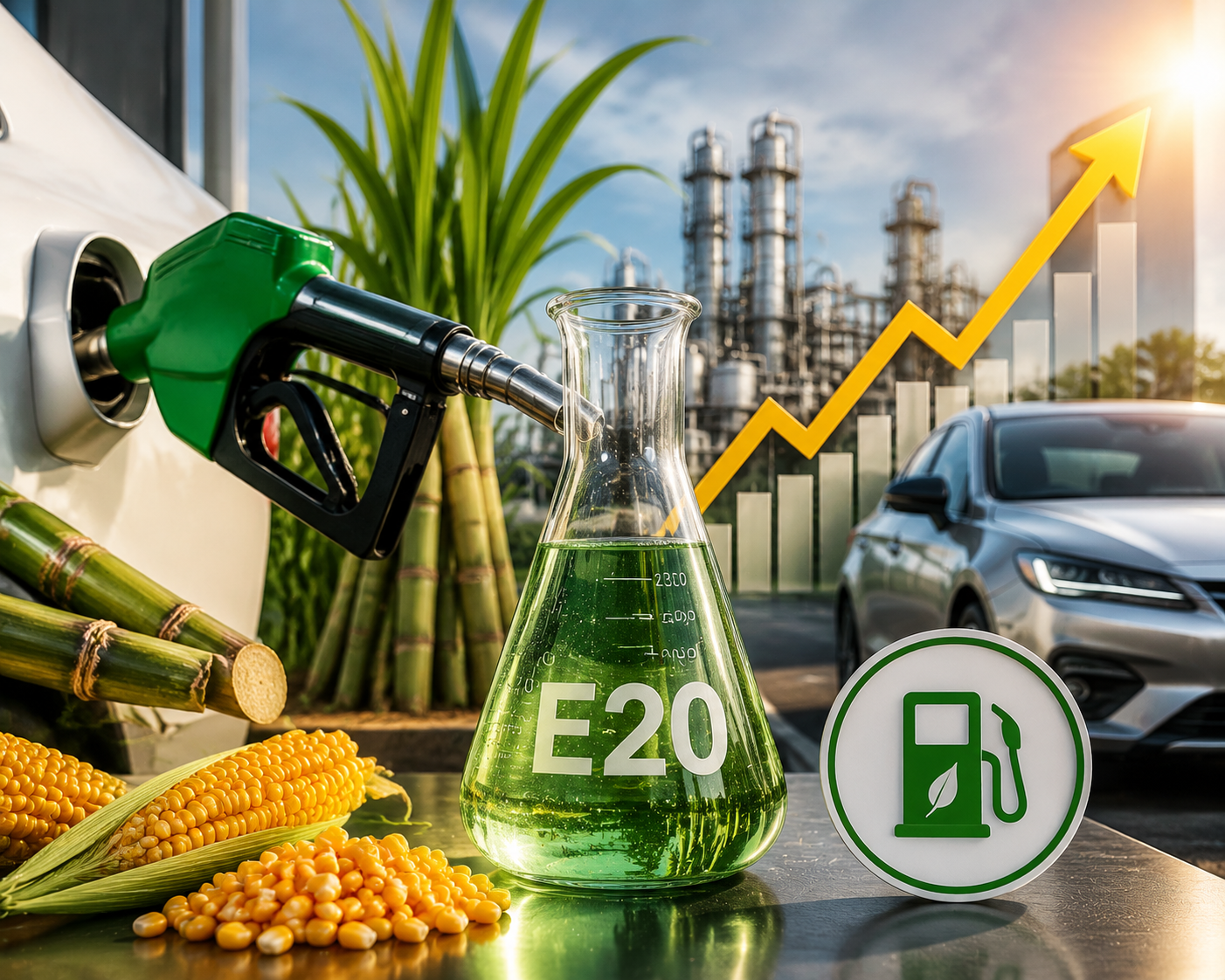
Fuel Efficiency, Tax Benefits and Complete Price Breakdown Remain Key Concerns as India Advances Ethanol Blending Programme
India’s transition towards ethanol-blended petrol has entered a crucial phase, with the government defending the pricing of E20 fuel while consumers and experts continue to seek greater clarity on its actual economic impact.
The government recently released detailed fact sheets addressing concerns around E20 petrol, stating that ethanol is no longer cheaper than petrol because of a significant rise in ethanol procurement prices.
However, experts argue that consumers still lack a complete understanding of the final price structure, including:
-
Actual cost of ethanol blended into petrol
-
Refining and blending expenses
-
Tax contribution from each component
-
Impact on vehicle running costs
While E20 is expected to support India’s energy security and reduce dependence on imported crude oil, transparency around pricing and consumer benefits remains a key issue.
India’s E20 Transition: A Major Fuel Policy Shift
E20 petrol refers to fuel containing:
20% ethanol and 80% petrol
The programme is part of India’s broader strategy to:
-
Reduce crude oil import dependence
-
Promote renewable fuel adoption
-
Support agricultural income
-
Lower carbon emissions
The government has accelerated ethanol blending targets over recent years, making E20 availability increasingly common across fuel stations.
Why Is There Debate Around E20 Petrol Prices?
When ethanol blending was introduced, one of the key expectations was that ethanol could help reduce fuel costs.
However, ethanol prices have increased significantly over recent years, changing the economics of blended fuel.
The government has argued that higher procurement costs have reduced the possibility of cheaper E20 petrol.
At the same time, consumers are questioning why fuel prices remain similar despite ethanol being blended into petrol.
Government’s Explanation: Ethanol Procurement Costs Have Increased
The price of ethanol depends largely on the raw material used for production.
Major sources include:
-
Sugarcane derivatives
-
Maize
-
Rice and foodgrains
-
Other agricultural feedstocks
The government determines procurement prices based on these sources.
Ethanol Prices Witness Significant Increase
Since the introduction of the ethanol blending roadmap, procurement prices have increased.
C-Heavy Molasses-Based Ethanol
The procurement price increased from:
₹46.66 per litre (ESY 2021-22)
to:
₹57.97 per litre (ESY 2024-25)
Maize-Based Ethanol
The price increased from:
₹52.92 per litre
to:
₹71.86 per litre
during the same period.
Production Cost Is More Than Procurement Price
Industry experts highlight that ethanol pricing cannot be evaluated only through procurement rates.
The final cost also depends on:
-
Raw material availability
-
Energy consumption
-
Plant efficiency
-
Transportation expenses
-
Financing costs
-
Compliance requirements
Feedstock remains the largest cost component, accounting for approximately:
60-75% of ethanol production cost
What Consumers Pay for One Litre of Petrol
The retail petrol price includes multiple components.
A litre of fuel price consists of:
1. Crude Oil and Refining Cost
This includes:
-
Imported crude oil cost
-
Refining expenses
-
Oil marketing company margins
2. Ethanol Procurement and Blending Cost
For E20 petrol, additional costs include:
-
Ethanol purchase price
-
Transportation
-
Storage
-
Blending operations
3. Government Taxes
Fuel prices include:
-
Central excise duty
-
Additional cess
-
State VAT
4. Dealer Commission
Fuel retailers receive commissions for selling petrol to consumers.
Why Consumers Want a Detailed E20 Price Breakup
Experts believe the government should publish a separate price calculation for E20 petrol.
Currently, publicly available data generally provides a combined petrol price structure.
Consumers do not get clear information about:
-
Cost of petrol component
-
Cost of ethanol component
-
Blending expenses
-
Tax contribution
-
Retail margin
Transparency Could Improve Consumer Confidence
A detailed E20 price structure would help answer important questions:
-
Is E20 cheaper or more expensive than normal petrol?
-
How much does ethanol contribute to fuel cost?
-
Are tax benefits reaching consumers?
-
Who absorbs additional costs?
Experts believe greater transparency will improve acceptance of ethanol blending.
Does E20 Petrol Increase Running Cost for Vehicle Owners?
Fuel affordability depends not only on the price per litre but also on mileage.
The government has acknowledged that some vehicles may experience:
3-5% lower fuel efficiency
after shifting to E20 petrol.
Mileage Impact Example
Assume:
-
Petrol price: ₹102.12 per litre
-
Vehicle mileage: 20 km/litre
Current fuel cost:
₹5.11 per kilometre
If mileage falls by 3-5%:
Mileage reduces to approximately:
-
19.4 km/litre
-
19 km/litre
Fuel cost rises to around:
₹5.26-₹5.37 per kilometre
This indicates that even if petrol prices remain unchanged, the effective running cost may increase.
Vehicle Technology Plays a Major Role
The impact of E20 depends on:
-
Engine design
-
Vehicle manufacturing year
-
Fuel system calibration
-
Driving conditions
Newer vehicles designed for E20 compatibility may experience lower efficiency impact compared with older models.
Are Consumers Receiving Any Tax Advantage?
Ethanol blending receives certain tax benefits.
Ethanol supplied to oil marketing companies for blending attracts:
5% GST
However, petrol remains outside the GST system and continues to attract:
-
Central excise duty
-
State VAT
E20 Has Tax Advantage Compared With Pure Petrol
The current tax structure provides some benefits for ethanol-blended fuel.
E20 avoids certain additional charges applicable to unblended petrol.
However, this advantage is not separately visible on consumers’ fuel bills.
Should Tax Benefits Be Passed to Consumers?
The earlier ethanol roadmap suggested considering tax relief if ethanol prices increased significantly.
Experts believe consumer incentives could help improve acceptance.
Possible measures include:
-
Lower retail taxes
-
Transparent pricing
-
Mileage-linked benefits
However, experts caution that excessive subsidies could create pressure on:
-
Government finances
-
Oil marketing companies
Why India Is Promoting Ethanol Blending
Despite pricing concerns, ethanol blending provides several strategic benefits.
1. Reduced Dependence on Imported Crude Oil
India imports a major portion of its crude oil requirement.
Higher ethanol usage can reduce exposure to global oil price volatility.
2. Boost to Agriculture Sector
Ethanol production creates additional demand for:
-
Sugarcane
-
Maize
-
Agricultural waste
This can provide additional income opportunities for farmers.
3. Environmental Benefits
Ethanol blending can contribute to:
-
Lower emissions
-
Reduced fossil fuel consumption
-
Cleaner transportation
Challenges Ahead for E20 Adoption
The ethanol transition faces several challenges.
Consumer Awareness Gap
Many vehicle owners remain uncertain about:
-
Mileage impact
-
Vehicle compatibility
-
Long-term effects
Pricing Transparency Issue
The absence of a detailed cost breakup remains the biggest concern.
Infrastructure Requirements
Successful implementation requires:
-
Stable ethanol supply chains
-
Storage facilities
-
Efficient blending infrastructure
What Experts Recommend
Industry experts believe the government should publish:
-
Complete E20 price formula
-
Component-wise cost details
-
Tax contribution breakdown
-
Consumer impact analysis
Such disclosures would help create trust among motorists.
Smart Investment Energy Sector Outlook
India’s ethanol blending programme represents a major transformation in the country’s energy landscape.
The initiative creates opportunities across multiple sectors, including:
-
Agriculture
-
Biofuel production
-
Logistics
-
Renewable energy
-
Fuel infrastructure
However, long-term success will depend on balancing national energy goals with consumer affordability.