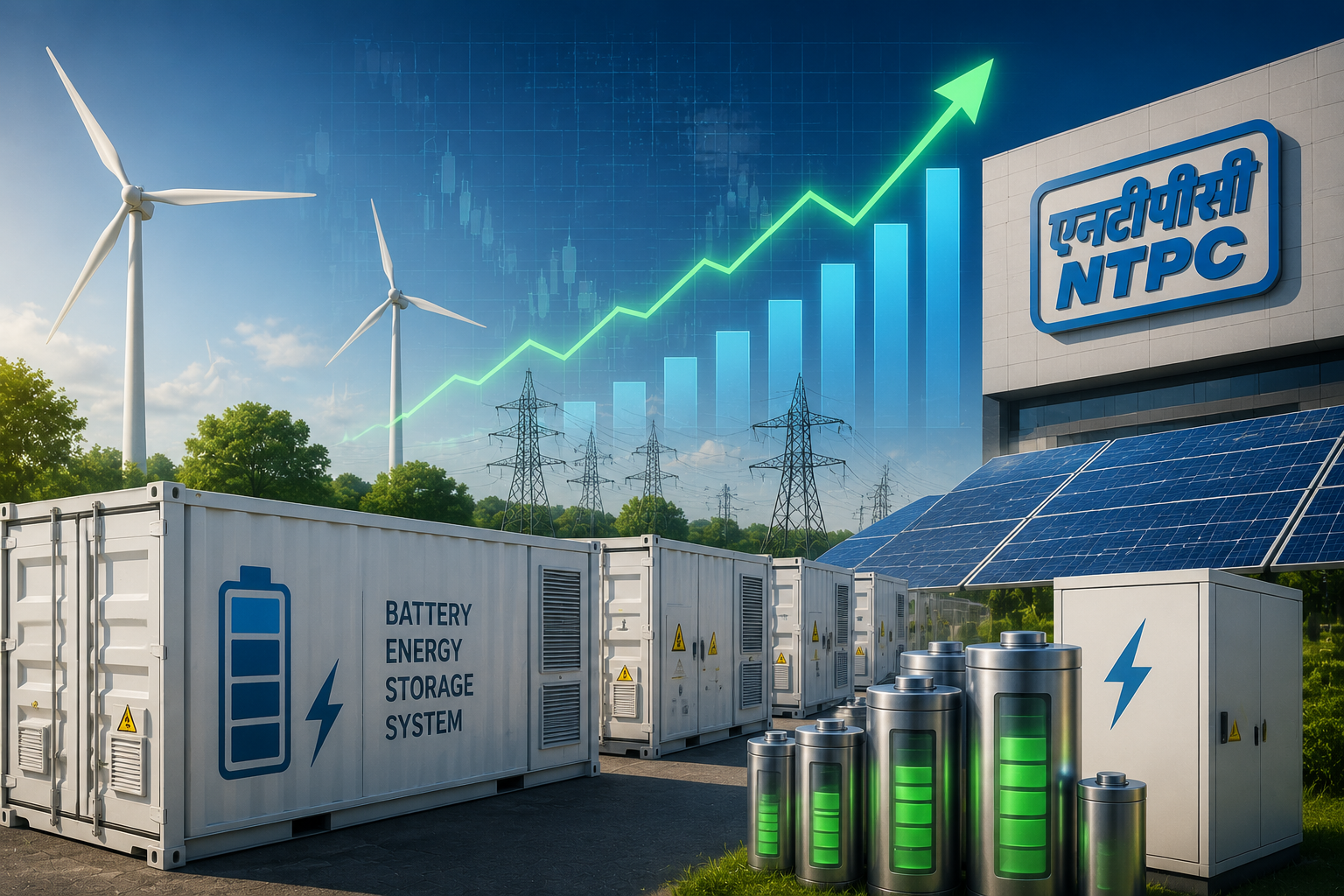
Ambit Capital Turns Selective on Power Sector; NTPC Emerges as Preferred Pick With 16% Upside Potential Amid Battery Storage Uncertainty
India’s ambitious battery energy storage system (BESS) journey is entering a crucial transition phase as rising battery costs, aggressive bidding strategies and execution delays force developers and utilities to reassess project economics.
Brokerage firm Ambit Capital believes the sector is moving into a “reset phase”, where initial optimism around large-scale battery storage deployment is being replaced by a more cautious approach focused on profitability, execution capability and long-term sustainability.
While energy storage remains a key requirement for India’s renewable energy expansion, Ambit believes several utility companies may face limited upside due to increasing project risks.
The brokerage has retained a selective approach in the power sector and identified NTPC Ltd as its preferred choice, assigning a Buy rating with a target price of ₹410, indicating around 16% upside from recent levels.
BESS Revolution Faces Reality Check After Rapid Expansion Expectations
India has positioned battery storage as a critical pillar of its clean energy transition.
With rapid growth in:
-
Solar power capacity
-
Wind energy installations
-
Renewable energy integration
the demand for energy storage solutions has increased significantly.
BESS technology helps solve one of renewable energy’s biggest challenges:
Intermittency of Solar and Wind Power
Battery storage enables electricity generated during high-production periods to be stored and supplied during peak demand hours.
However, Ambit believes the industry’s initial growth expectations were based on assumptions that are now being challenged.
Why Ambit Sees a Reset Phase in BESS Market
According to Ambit Capital, the sector is facing multiple challenges that could impact profitability.
Major concerns include:
1. Rising Battery Costs
Increasing battery prices have reduced project viability.
2. Aggressive Tender Bidding
Several developers offered highly competitive tariffs without fully accounting for lifecycle costs.
3. Project Execution Delays
Supply chain issues and infrastructure requirements are slowing implementation.
4. Battery Performance Uncertainty
Long-term battery degradation and replacement costs remain key concerns.
Battery Prices Rise, Procurement Activity Slows
One of the biggest challenges for the sector is the increase in BESS costs.
Ambit highlighted that battery storage prices have increased to around:
$80 per kWh
The increase represents a rise of nearly:
$15 per kWh compared with previous levels
Higher costs have resulted in:
-
Delayed procurement decisions
-
Reassessment of project economics
-
Pressure on expected returns
Developers who secured projects at aggressive tariffs may face profitability challenges if costs remain elevated.
India May Miss FY27 BESS Installation Target
The Central Electricity Authority (CEA) had set ambitious targets for battery storage deployment.
However, current industry expectations indicate that FY27 installation targets may fall short.
Expected FY27 Capacity
-
Incremental installation: Around 5 GWh
-
Total cumulative capacity: Around 13–15 GWh
This compares with the CEA’s target of:
23 GWh
The gap highlights the challenges involved in converting policy targets into operational capacity.
Aggressive Bidding Creates Pressure on Project Returns
Ambit pointed out that many developers aggressively participated in BESS tenders without fully considering the complexity of storage economics.
Unlike traditional renewable projects, battery storage profitability depends on several additional factors.
Battery Degradation Risk
Battery efficiency declines over time.
Developers must account for:
-
Reduced storage capacity
-
Replacement requirements
-
Maintenance costs
Failure to consider degradation can significantly impact project returns.
Lifecycle Management Challenges
Long-term BESS projects require careful planning around:
-
Battery replacement cycles
-
Technology upgrades
-
Operational costs
Auxiliary Consumption Impact
Battery systems consume energy during operation.
This additional consumption affects:
-
Efficiency
-
Revenue generation
-
Overall economics
CEA Considering Stricter Rules for Future BESS Projects
To improve project quality and reduce risks, the Central Electricity Authority is considering stronger technical qualification requirements.
Future tenders may include:
-
Higher technical standards
-
Better financial evaluation
-
Improved project feasibility checks
The move could reduce unrealistic bidding and encourage participation from financially stronger players.
Government Evaluates Additional 40 GWh Viability Gap Funding Support
To accelerate battery storage adoption, the government is considering additional support through:
Viability Gap Funding (VGF)
The proposed support could cover:
40 GWh of additional BESS capacity
The government is also considering stronger domestic manufacturing requirements.
Expected domestic content requirements:
40–50%
The objective is to:
-
Promote local battery manufacturing
-
Reduce import dependence
-
Create a domestic energy storage ecosystem
FDRE Projects Could Become the Main Growth Engine
A large portion of upcoming BESS demand is expected from:
Firm and Dispatchable Renewable Energy (FDRE) projects
These projects combine:
-
Renewable generation
-
Battery storage
-
Guaranteed power delivery
Most FDRE projects are expected to become operational around:
FY28
Why FDRE Economics Are Better Than Standalone BESS
FDRE projects have certain advantages because battery systems can share infrastructure with renewable assets.
Benefits include:
-
Lower capital costs
-
Shared transmission infrastructure
-
Better asset utilisation
Standalone battery projects face higher costs because they require separate infrastructure.
Merchant Arbitrage Model Faces Questions
Battery storage projects can generate revenue by buying electricity during cheaper periods and selling during high-demand periods.
This model is called:
Merchant Arbitrage
However, Ambit believes the sustainability of this model remains uncertain.
The industry has requested removal of the:
₹10/kWh exchange price cap
to improve profitability.
Some projects have achieved revenue levels near:
₹20/kWh
under specific grid procurement mechanisms.
However, Ambit believes long-term returns will likely depend on multiple revenue streams rather than pure arbitrage.
NTPC Emerges as Ambit’s Preferred Power Stock
Amid sector challenges, Ambit remains positive only on selected companies.
The brokerage’s top pick:
NTPC Ltd
Recommendation
Buy
Target Price
₹410
Potential Upside
Around 16%
Why Ambit Likes NTPC
NTPC benefits from:
Strong Operating Scale
The company remains India’s largest power producer.
Energy Transition Opportunity
NTPC is expanding into:
-
Renewable energy
-
Storage solutions
-
Green hydrogen initiatives
Execution Capability
The company has a strong track record of implementing large infrastructure projects.
Ambit Warns NTPC Must Continue Winning Orders
Despite its positive view, Ambit highlighted a key risk.
The brokerage believes NTPC needs to continue securing new projects and orders.
Failure to maintain growth momentum could create valuation concerns.
Ambit’s View on Other Energy Companies
The brokerage remains selective across the power and renewable energy space.
Positive View
Suzlon Energy
Target Price: ₹61
Emmvee Photovoltaic Power
Target Price: ₹345
Saatvik Green Energy
Target Price: ₹520
Cautious View
Ambit has assigned Sell ratings on:
-
Tata Power — Target ₹410
-
JSW Energy — Target ₹525
-
Torrent Power — Target ₹1,255
-
Power Grid Corporation — Target ₹290
-
NTPC Green Energy — Target ₹85
The brokerage believes valuations already reflect significant future growth expectations.
Battery Manufacturing Push Faces Execution Delays
India’s domestic battery manufacturing ambitions under the Production Linked Incentive (PLI) scheme have also faced challenges.
Several companies have experienced delays in scaling operations.
Key PLI Challenges
Technology Transfer Issues
Battery manufacturing requires advanced technology capabilities.
Manufacturing Learning Curve
Achieving large-scale production with consistent quality remains challenging.
Demand Uncertainty
Lower-than-expected demand has affected commercial expansion plans.
Long-Term Outlook for India’s Energy Storage Sector
Despite short-term challenges, the long-term opportunity remains strong.
India’s renewable energy growth requires reliable storage solutions.
BESS will become increasingly important for:
-
Grid stability
-
Renewable integration
-
Peak power management
-
Energy security
Key Investment Themes in BESS Sector
Positive Drivers
✅ Renewable energy expansion
✅ Government policy support
✅ Rising electricity demand
✅ Need for grid flexibility
✅ Domestic manufacturing push
Risks Investors Should Monitor
1. Cost Inflation
Higher battery prices can reduce returns.
2. Project Execution
Delays can impact profitability.
3. Competitive Bidding
Aggressive tariffs may hurt margins.
4. Technology Changes
Rapid innovation may affect existing assets.