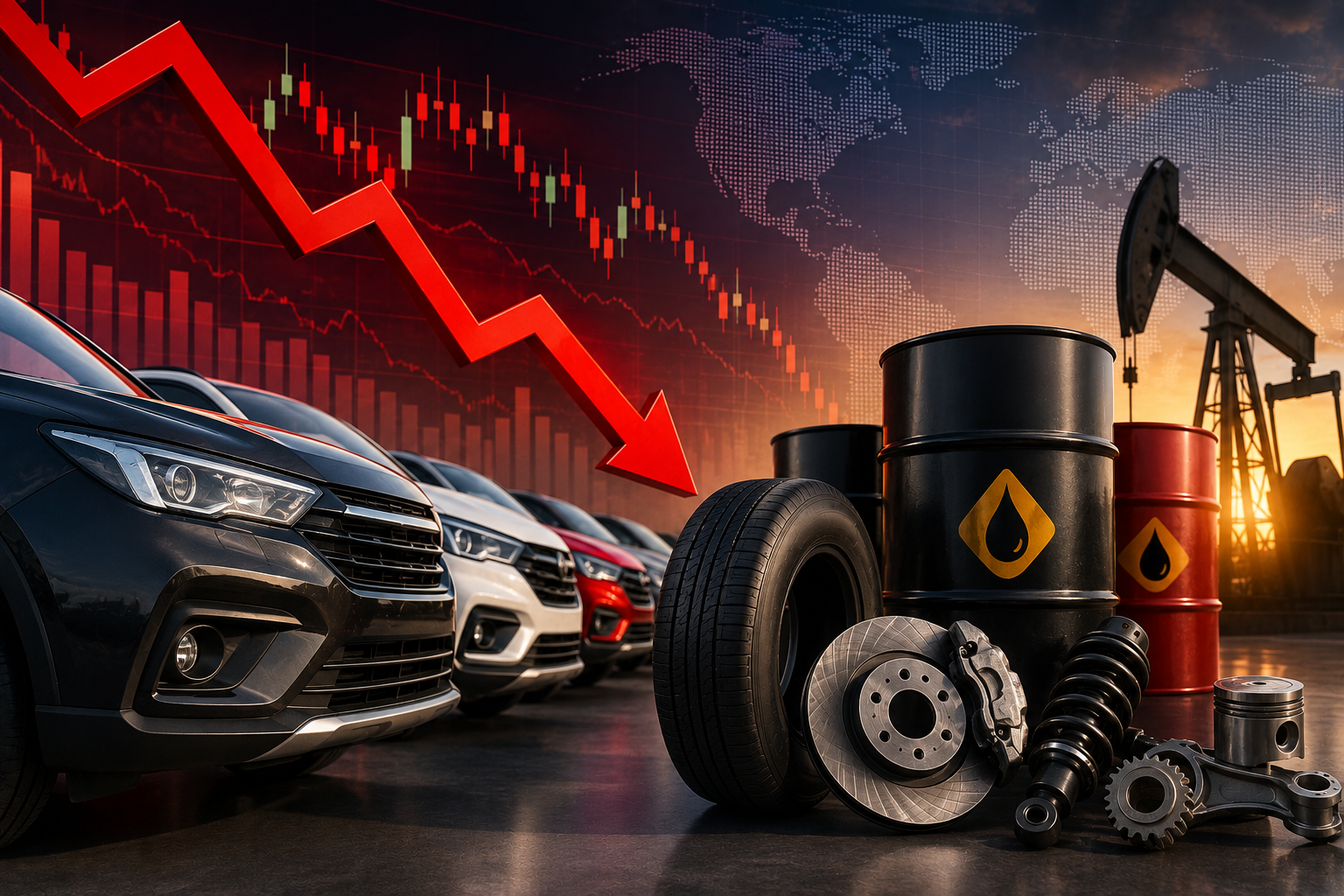
Auto Stocks Witness Broad-Based Selling Amid Rising Fuel Prices and Global Uncertainty, But Industry Fundamentals Continue to Remain Strong
Indian automobile stocks came under heavy selling pressure on Tuesday as the Nifty Auto Index slipped nearly 2%, making it one of the worst-performing sectoral indices of the day. The decline was largely triggered by a sharp spike in Brent crude oil prices to around $85 per barrel, coupled with escalating geopolitical tensions in West Asia and a broad risk-off sentiment across global financial markets.
Major automobile manufacturers and ancillary companies, including Ashok Leyland, Tube Investments of India, TVS Motor, Mahindra & Mahindra, and Tata Motors, witnessed significant declines as investors booked profits after the sector's strong rally over the past year.
Despite the near-term weakness, analysts remain optimistic about the sector's long-term prospects, citing resilient domestic demand, improving rural consumption, government infrastructure spending and the continued expansion of India's electric vehicle ecosystem.
Auto Sector Faces Sharp Selling Pressure
The automobile sector witnessed widespread selling across passenger vehicles, commercial vehicles, two-wheelers and auto ancillary companies.
Major Losers During the Session
-
Ashok Leyland declined more than 3%.
-
Tube Investments of India fell over 3%.
-
TVS Motor lost more than 1.5%.
-
Mahindra & Mahindra traded lower.
-
Tata Motors Passenger Vehicles also came under pressure.
The decline reflected broad-based weakness rather than company-specific concerns, indicating that macroeconomic factors were driving investor sentiment.
Crude Oil Emerges as the Primary Trigger
The biggest catalyst behind the correction has been the sudden surge in global crude oil prices.
Brent crude climbed close to $85 per barrel after renewed geopolitical tensions in the Middle East raised fears of potential supply disruptions through the Strait of Hormuz, a strategic maritime route that handles nearly 20% of global crude oil shipments.
Higher oil prices immediately increase concerns regarding:
-
Manufacturing costs
-
Transportation expenses
-
Inflation
-
Consumer demand
-
Corporate profitability
These concerns typically weigh on automobile stocks due to their sensitivity to economic cycles.
How Higher Oil Prices Affect Automobile Companies
The automobile industry is indirectly exposed to crude oil prices through multiple cost channels.
Rising Input Costs
Higher crude prices increase the cost of:
-
Synthetic rubber
-
Plastic components
-
Chemicals
-
Lubricants
-
Paint materials
-
Packaging
These inputs are essential for vehicle manufacturing and component production.
Logistics Expenses
Transportation costs also rise due to higher diesel prices, increasing expenses across the supply chain.
Auto manufacturers may either absorb these costs, impacting profitability, or pass them on to consumers through higher vehicle prices.
Auto Ancillary Companies Also Under Pressure
The correction was not limited to vehicle manufacturers.
Auto component companies also witnessed selling as investors anticipated pressure on margins due to:
-
Higher freight expenses
-
Increased raw material prices
-
Elevated logistics costs
-
Export-related uncertainties
However, companies with diversified export markets and specialised technology-driven products are expected to remain relatively resilient over the long term.
Profit Booking After Strong Outperformance
Apart from crude oil, analysts believe profit booking also contributed significantly to the decline.
The Nifty Auto Index has generated impressive returns over recent years, making it one of the strongest-performing sectoral indices.
Following a sustained rally, many investors chose to reduce exposure amid increasing geopolitical uncertainty and rising commodity prices.
Such corrections are generally considered healthy within long-term bull markets.
Global Risk-Off Sentiment Adds to Market Weakness
International markets have become increasingly cautious following renewed geopolitical tensions.
Investors globally are reassessing exposure to cyclical sectors amid concerns over:
-
Inflation
-
Energy prices
-
Interest rates
-
Currency volatility
-
Global economic growth
Automobile companies, being economically sensitive businesses, often experience higher volatility during such periods.
Domestic Demand Continues to Support Growth
Despite the current correction, India's automobile demand remains fundamentally healthy.
Key growth drivers include:
-
Rising household incomes
-
Strong consumer spending
-
Expanding middle class
-
Urbanisation
-
Easy vehicle financing
-
Infrastructure development
These structural factors continue to provide long-term support for vehicle sales across multiple categories.
Rural Recovery Benefits Two-Wheeler Segment
The two-wheeler industry is expected to remain one of the strongest beneficiaries of improving rural demand.
Factors supporting rural automobile sales include:
-
Better monsoon conditions
-
Improved agricultural income
-
Government rural spending
-
Higher farm mechanisation
-
Increased financing availability
Leading motorcycle manufacturers are therefore expected to continue benefiting from rural consumption growth.
Passenger Vehicle Segment Remains Resilient
Passenger vehicle manufacturers continue witnessing healthy demand driven by:
-
Premiumisation
-
New product launches
-
SUV demand
-
Urban consumption
-
Improved financing availability
Companies with diversified product portfolios and strong brand positioning remain well placed for sustained growth.
Commercial Vehicles Supported by Infrastructure Spending
Government investment in roads, highways, logistics parks and industrial infrastructure continues supporting commercial vehicle demand.
Segments expected to benefit include:
-
Heavy commercial vehicles
-
Light commercial vehicles
-
Construction equipment
-
Logistics fleets
The ongoing infrastructure cycle remains a major long-term growth driver for commercial vehicle manufacturers.
Electric Vehicle Ecosystem Continues to Expand
India's EV ecosystem remains one of the most promising long-term investment themes.
Growth is supported by:
-
Government incentives
-
Charging infrastructure expansion
-
Falling battery costs
-
Environmental awareness
-
Technological advancements
While valuation concerns exist in certain EV-related companies, industry growth prospects remain strong over the next decade.
Key Risks Investors Should Watch
Although long-term fundamentals remain favourable, investors should monitor several macroeconomic variables.
Major Risk Factors
-
Crude oil prices
-
Inflation
-
Interest rates
-
Global geopolitical developments
-
Rupee movement
-
Consumer confidence
-
Corporate earnings
Sustained increases in oil prices could temporarily impact demand and profitability across the sector.
Where Analysts See Opportunities
Market experts recommend using the current correction to gradually accumulate fundamentally strong businesses rather than exiting the sector.
Preferred investment characteristics include:
-
Strong balance sheets
-
Consistent cash generation
-
Market leadership
-
Export diversification
-
Technology-driven products
-
Sustainable earnings growth
Staggered investments remain the preferred strategy until market volatility subsides.
Investment Perspective
The recent decline in automobile stocks appears to be driven primarily by macroeconomic concerns rather than deterioration in sector fundamentals. Rising crude oil prices have increased short-term uncertainty, but India's long-term automobile growth story remains supported by rising incomes, expanding infrastructure, rural demand recovery and continued technological transformation.
Investors with a long-term investment horizon may view the correction as an opportunity to selectively accumulate quality automobile manufacturers and auto ancillary companies with strong competitive advantages. Businesses demonstrating pricing power, operational efficiency and healthy balance sheets are likely to outperform once commodity prices stabilise and market sentiment improves.
Outlook
The Nifty Auto Index has entered a phase of consolidation after delivering strong returns over recent years. While elevated crude oil prices and geopolitical uncertainties may continue to influence sentiment in the near term, the structural drivers supporting India's automobile industry remain firmly intact.
As domestic demand continues to improve and infrastructure investment accelerates, the sector is expected to remain one of the key beneficiaries of India's long-term economic growth. Investors should closely monitor oil prices, monthly vehicle sales, corporate earnings and macroeconomic developments, while using periods of market volatility to build exposure to fundamentally strong companies capable of delivering sustainable long-term growth.