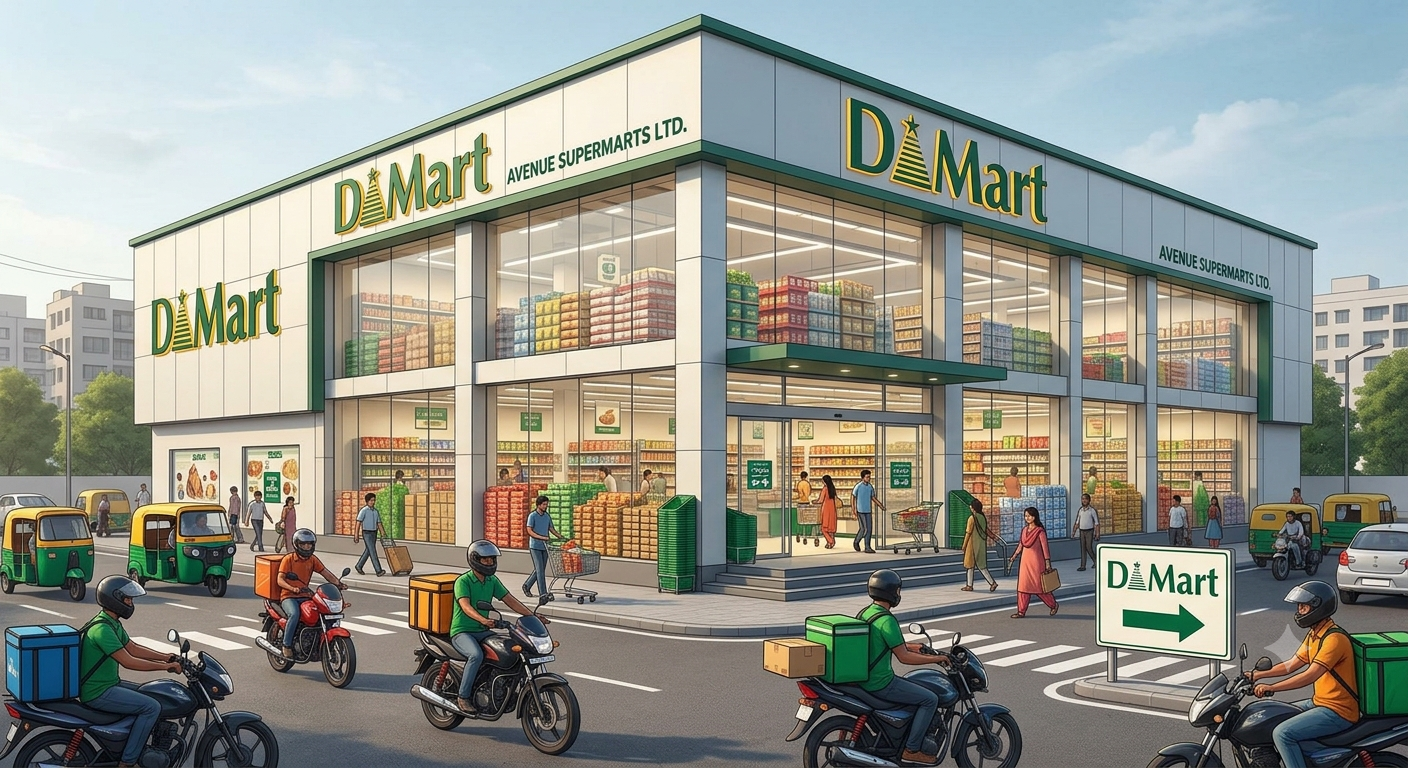
Despite Double-Digit Revenue and Profit Growth, Weak Same-Store Sales and Slower Store Expansion Weigh on Investor Sentiment; Brokerages Remain Divided
Shares of Avenue Supermarts Ltd., the operator of the popular DMart retail chain backed by billionaire investor Radhakishan Damani, came under sharp selling pressure on Monday after the company announced its financial results for the first quarter of FY27. The stock declined more than 4% during intraday trading, touching a low of ₹3,910, as investors focused on slowing same-store sales growth and increasing competition from India's rapidly expanding quick commerce segment.
While the retailer continued to post healthy double-digit growth in revenue and net profit, the market reaction highlighted concerns that the pace of growth in metro cities is beginning to moderate. Analysts believe that the rapid expansion of 10-minute grocery delivery platforms is starting to impact customer footfalls at traditional supermarkets, particularly in urban markets.
Nevertheless, most brokerages remain constructive on DMart's long-term prospects, pointing to its strong balance sheet, disciplined business model and expansion strategy focused on India's underpenetrated organised retail market.
Stock Falls Despite Healthy Financial Performance
The earnings announcement triggered profit booking in the stock, which has been trading at premium valuations compared to other retail companies.
Share Price Snapshot
| Particulars | Value |
|---|---|
| Previous Close | ₹4,083.05 |
| Opening Price | ₹3,950.00 |
| Intraday Low | ₹3,910.00 |
| Current Price | ₹3,995.00 |
| Intraday Decline | Over 4% |
The weakness also coincided with broader market pressure as geopolitical tensions in West Asia weighed on investor sentiment across sectors.
However, analysts suggest that the sharp correction was driven more by concerns over future growth than disappointment in the reported financial numbers.
Q1 FY27 Results Remain Strong
DMart continued to deliver healthy operational performance during the June quarter despite increasing competition in the retail landscape.
Financial Performance
| Particular | Q1 FY27 | YoY Growth |
|---|---|---|
| Revenue | ₹18,794.53 Crore | 14.8% |
| Net Profit | ₹860 Crore | 11.3% |
| EBITDA | ₹1,499 Crore | Strong Growth |
| EBITDA Margin | 8.0% | Up from 7.9% |
Revenue growth remained supported by higher sales volumes, new store additions and stable consumer demand across most product categories.
Operating margins also improved marginally despite inflationary pressures and rising competition.
Like-for-Like Sales Growth Slows Sharply
The biggest concern emerging from the quarterly results was the slowdown in Like-for-Like (LFL) Sales Growth, one of the most closely tracked performance indicators in retail.
LFL Sales Growth
| Quarter | Growth |
|---|---|
| Q4 FY26 | 10.8% |
| Q1 FY27 | 5.5% |
The sharp moderation suggests that existing stores generated significantly lower incremental sales compared to the previous quarter.
Management indicated that mature stores located in major metropolitan cities experienced largely flat revenue growth, while stores in non-metro markets continued to perform well.
The trend indicates that customer demand remains healthy in smaller cities, whereas competition is becoming increasingly intense in urban markets.
Quick Commerce Emerges as the Biggest Competitive Threat
One of the key themes discussed by analysts after the earnings announcement was the growing impact of Quick Commerce (QC).
Companies offering grocery deliveries within 10 to 20 minutes have rapidly expanded across major cities by:
-
Opening dark stores.
-
Increasing delivery coverage.
-
Offering attractive discounts.
-
Expanding product selection.
-
Improving customer convenience.
As consumer shopping behaviour evolves, many urban customers are increasingly choosing instant delivery over visiting physical supermarkets.
This shift has started affecting sales growth at established retail chains, particularly in metro locations.
Although DMart continues to enjoy a significant pricing advantage through its everyday low-cost strategy, the changing competitive landscape remains a key challenge.
Store Expansion Moderates After Strong FY26
Store additions continue to be the primary long-term growth engine for DMart.
However, following aggressive expansion during the final quarter of FY26, the company opened only three new stores during Q1 FY27.
Brokerages expect the pace of expansion to accelerate again over the coming quarters, with approximately 75 new stores annually projected during FY27 and FY28.
The company's strategy increasingly focuses on expanding into Tier-II and Tier-III cities, where organised retail penetration remains relatively low and competition from quick commerce is less intense.
Metro Cities Slow, Smaller Cities Shine
Management commentary highlighted a significant difference between urban and non-urban markets.
Metro Markets
-
Mature stores witnessed almost flat revenue growth.
-
Higher competitive intensity.
-
Greater impact from quick commerce.
-
More cautious consumer spending.
Tier-II & Tier-III Markets
-
Healthy customer footfalls.
-
Better sales growth.
-
Lower competitive pressure.
-
Strong expansion opportunities.
This trend reinforces DMart's long-term strategy of expanding beyond India's largest metropolitan areas.
Brokerages Remain Divided on the Stock
The quarterly results prompted mixed reactions from brokerage firms.
Motilal Oswal: Buy
Target Price: ₹4,800
Motilal Oswal continues to remain optimistic, citing:
-
Strong value retail positioning.
-
Efficient store economics.
-
Expansion into smaller cities.
-
Long-term organised retail opportunity.
The brokerage expects:
-
Revenue CAGR of 18%
-
EBITDA CAGR of 19%
-
Profit CAGR of 16% over FY26–FY29.
According to the brokerage, DMart's low-cost operating model will help it remain competitive despite rising quick commerce competition.
PL Capital: Hold
Target Price: ₹4,103
PL Capital has maintained a more cautious outlook.
The brokerage highlighted:
-
Slowing same-store sales.
-
Increasing competition from quick commerce.
-
Pressure on mature metro stores.
-
Limited margin expansion.
-
Premium valuation.
While acknowledging the company's operational strength, PL Capital believes near-term growth visibility remains limited.
Why DMart Still Commands Premium Valuations
Despite the recent correction, DMart continues to trade at one of the highest valuation multiples within India's retail sector.
Investors continue assigning a premium because of:
-
Strong brand recognition.
-
Consistent execution.
-
Debt-free balance sheet.
-
Efficient inventory management.
-
Superior return ratios.
-
Disciplined capital allocation.
-
Long-term expansion opportunity.
However, premium valuations also make the stock more sensitive to even small disappointments in quarterly performance.
India's Organised Retail Opportunity Remains Huge
India's grocery market remains overwhelmingly dominated by traditional neighbourhood stores.
Organised retail accounts for only a relatively small share of total grocery sales.
Key structural growth drivers include:
-
Rising disposable income.
-
Urbanisation.
-
Growth in modern retail.
-
Formalisation of the economy.
-
Changing consumer preferences.
-
Increasing demand for branded products.
These long-term trends continue to support DMart's multi-year expansion strategy.
Key Risks Investors Should Watch
Investors should continue monitoring several important factors.
Major Risks
-
Rapid expansion of quick commerce.
-
Slower metro demand.
-
Rising operating costs.
-
Delays in store expansion.
-
Margin pressure.
-
Weak consumer sentiment.
-
Elevated valuation.
Future quarterly performance will largely depend on how successfully DMart adapts to the changing retail landscape while maintaining its industry-leading cost structure.
What Lies Ahead for DMart?
The company's long-term growth will likely be driven by:
-
Continued store expansion.
-
Increasing penetration in smaller cities.
-
Supply chain optimisation.
-
Private label expansion.
-
Digital integration.
-
Strong customer loyalty.
-
Operational efficiency.
While quick commerce presents a genuine challenge, analysts believe India's retail market is sufficiently large for multiple business models to coexist.
DMart's value-focused approach may continue to appeal to price-conscious consumers, particularly outside metro markets.