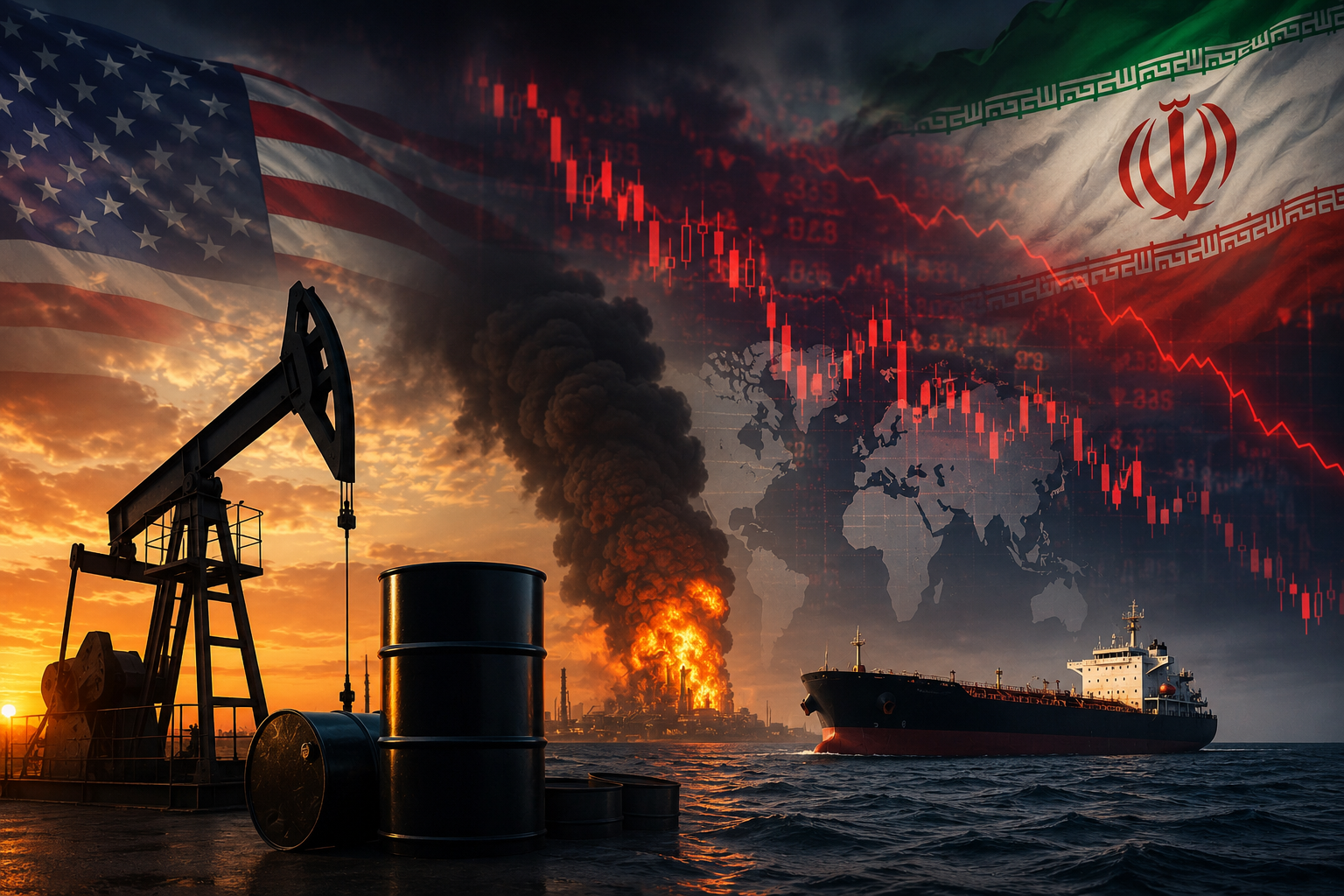
Fresh Airstrikes, Surging Crude Prices and Inflation Fears Trigger Risk-Off Sentiment Across Global Financial Markets
Global financial markets opened the week under pressure as crude oil prices surged nearly 4% following renewed military action between the United States and Iran. The escalation has reignited concerns over the security of global energy supplies, pushing investors away from riskier assets and sending most Asian equity markets lower.
The latest developments have once again shifted market focus toward the Strait of Hormuz, one of the world's most critical oil transit routes, with traders assessing the potential impact on energy prices, inflation and global economic growth.
Crude Oil Rallies as Middle East Tensions Escalate
Oil prices witnessed their biggest single-day gain in weeks after reports of fresh US airstrikes on Iranian targets and retaliatory military action by Iran.
Brent crude, the international benchmark, climbed 3.9% to nearly $79 per barrel, while US West Texas Intermediate (WTI) crude advanced 4% to above $74 per barrel.
The rally comes after oil prices had briefly stabilized in recent sessions as shipping activity resumed through the Strait of Hormuz. However, renewed attacks on commercial vessels and military installations have once again raised concerns about possible disruptions to global oil supplies.
Any prolonged instability in the region could significantly tighten energy markets, particularly if exports from major oil-producing nations are affected.
Strait of Hormuz Remains the Biggest Concern
The Strait of Hormuz handles nearly one-fifth of the world's seaborne crude oil trade, making it one of the most strategically important waterways for global energy markets.
Recent attacks on commercial shipping have increased concerns among traders that transportation costs and insurance premiums could rise sharply. Even without a complete disruption of supplies, heightened security risks are sufficient to push oil prices higher as markets price in geopolitical uncertainty.
Countries heavily dependent on imported crude, including India, Japan and several European nations, remain particularly vulnerable to prolonged disruptions in the region.
Asian Stock Markets Trade Lower
Asian equities reflected the growing risk aversion among investors.
Japan's Nikkei 225 declined more than 1%, while South Korea's Kospi recorded steeper losses amid broad-based selling in technology and semiconductor stocks. Australian equities also traded in negative territory, while Chinese markets remained under pressure.
Investors reduced exposure to cyclical sectors as concerns mounted over higher energy costs and slowing global growth.
Market analysts believe volatility could remain elevated until there is greater clarity regarding the geopolitical situation.
US Futures Point to Weak Start
US stock futures also indicated a cautious opening on Wall Street.
Futures linked to the S&P 500, Dow Jones Industrial Average and Nasdaq Composite all traded lower as investors evaluated the economic implications of rising crude oil prices.
Although US equities ended the previous trading session on a positive note, fresh geopolitical risks have shifted attention toward inflation, interest rates and global economic stability.
Inflation Concerns Return to the Forefront
The sharp rise in oil prices has revived fears that inflation could remain elevated for longer than previously expected.
Higher crude prices increase transportation, manufacturing and logistics costs, eventually feeding into consumer inflation. This could complicate the policy outlook for central banks, particularly the US Federal Reserve, which has been closely monitoring inflation before making further interest-rate decisions.
If energy prices continue climbing, expectations for future rate cuts could be delayed, affecting global liquidity and investor sentiment.
AI Stocks Continue to Support Wall Street
Despite broader market concerns, artificial intelligence-related companies continue to attract investor interest.
Technology giants involved in semiconductor manufacturing, cloud computing and AI infrastructure remain among the strongest performers in US markets. Strong demand for advanced chips and data centre investments continues to support long-term optimism in the technology sector.
However, analysts caution that elevated valuations leave little room for disappointment, making upcoming corporate earnings particularly important.
Earnings Season to Test Market Optimism
Investors are now turning their attention to the upcoming US corporate earnings season, with several major banks and multinational companies scheduled to announce quarterly results.
Strong earnings could provide reassurance that corporate America remains resilient despite geopolitical uncertainty and higher borrowing costs. Conversely, weaker-than-expected results may increase market volatility and trigger further profit booking across global equities.
Management commentary on consumer demand, investment plans and inflation will also be closely monitored.
Impact on Indian Markets
For Indian investors, rising crude oil prices remain the biggest near-term concern.
A sustained increase in oil prices could widen India's import bill, put pressure on the rupee and increase inflation, potentially affecting sectors such as aviation, paints, chemicals, logistics and consumer goods.
On the other hand, upstream energy companies and select oil exploration firms may benefit from stronger crude prices.
Foreign institutional investor (FII) flows, currency movements and domestic inflation data are expected to remain key drivers of Indian equity markets in the coming weeks.
Outlook: Geopolitical Headlines Likely to Drive Markets
Financial markets are expected to remain highly sensitive to developments in West Asia. Any further escalation between the United States and Iran, or disruption to shipping through the Strait of Hormuz, could lead to another sharp spike in crude oil prices and renewed volatility across global equities.
While the global economy continues to be supported by resilient corporate earnings and ongoing investment in technology, geopolitical uncertainty has once again emerged as the dominant market risk. Investors are likely to remain cautious, focusing on quality businesses, diversified portfolios and disciplined risk management until the geopolitical environment becomes more stable.