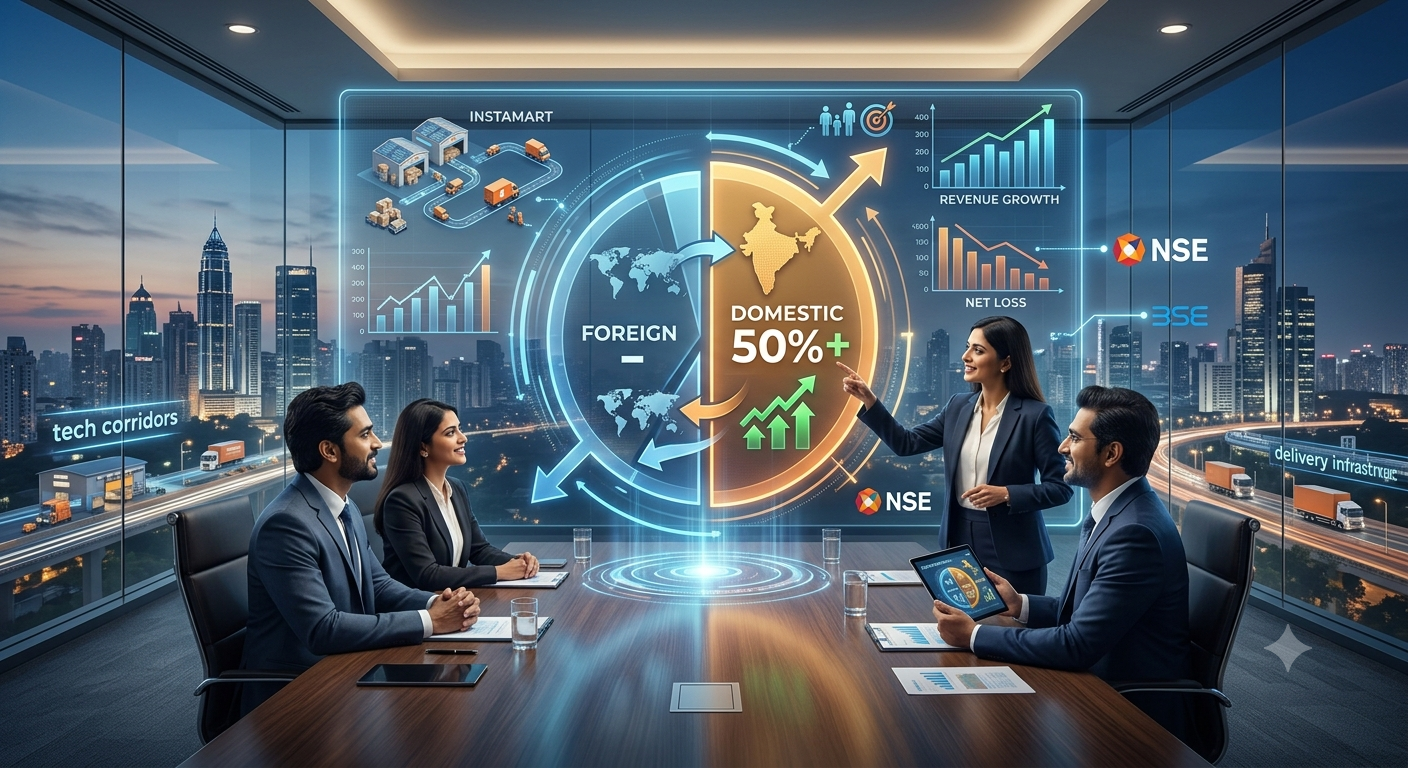
Food delivery and quick commerce major Swiggy has officially transitioned into a majority Indian-owned entity after its domestic ownership crossed the crucial 50% milestone. According to a regulatory stock exchange filing on Tuesday, this ownership shift positions Swiggy to qualify as an Indian-owned company. However, the firm remains one step away from achieving the full legal status of an "Indian-Owned and Controlled Company" (IOCC).
As of July 6, 2026, the aggregate foreign investment in Swiggy—encompassing Foreign Portfolio Investment (FPI), Foreign Direct Investment (FDI), and other indirect foreign routes—dropped to approximately 49.76% of the company's fully diluted paid-up equity share capital. Consequently, domestic holding climbed to 50.24%.
The market reacted positively to the development, with Swiggy’s shares trading up by 5.85% at ₹262.91 on the bourses during the Tuesday session.
The Road to IOCC Status and the Constitutional Hurdles Ahead
While crossing the domestic ownership milestone marks a major structural pivot, Swiggy clarified to the exchanges that this change does not automatically alter its formal control status, management structure, daily business operations, or voting rights.
The Special Resolution Bottleneck
In May 2026, Swiggy's shareholders failed to pass a special resolution aimed at formally classifying the firm as an IOCC. The proposal garnered 72.36% voting support from shareholders, narrowly missing the strict 75% supermajority mandated to amend the company’s Articles of Association (AoA). Securing this regulatory amendment remains the final technical hurdle before the firm can claim full IOCC compliance.
Why IOCC Status is a Game-Changer for Instamart
The corporate pursuit of IOCC status is deeply tied to the financial viability and unit economics of Swiggy's quick commerce vertical, Instamart.
Unlocking the Inventory-Led Model
Under current Indian foreign direct investment (FDI) regulations, e-commerce marketplaces with heavy foreign funding must operate strictly under a marketplace model, barring them from holding their own stock. Attaining IOCC status would unlock the regulatory clearance for Instamart to adopt a lucrative inventory-led model.
Enhancing Operational and Supply Chain Efficiency
Directly owning its inventory will grant Instamart end-to-end control over product procurement, warehousing efficiency, and its localized supply chain networks, directly optimizing profit margins.
The Blinkit Precedent
Swiggy’s chief rival Eternal (the parent company of Zomato and Blinkit) previously capped its foreign ownership at 49.5% after domestic investors gained majority control. This structural shift allowed Blinkit to successfully transition from a pure marketplace model to an inventory-led structure. The move exponentially boosted its top-line performance, enabling Eternal to post a massive ₹17,292 crore in revenue for the March quarter of FY26 by recognizing full sales value rather than just merchant commissions.
Financial Health: Soaring Revenue and Narrowing Losses
The ownership milestone comes on the back of rapidly improving financial metrics for the Bengaluru-headquartered platform, highlighting stronger fundamental footing:
Exponential Top-line Growth
On a consolidated basis, Swiggy reported a stellar jump in revenue from operations, scaling up to ₹23,053 crore in FY26 compared to ₹15,227 crore recorded in FY25.
Sequential Margin Improvement
The company's continuous emphasis on operational scaling and rationalized cost structures helped narrow its net loss down to ₹800 crore in the fourth quarter of FY26. This marks a notable improvement from a net loss of ₹1,081 crore in the corresponding quarter of the previous fiscal year and a sequential reduction from the ₹1,065 crore net loss recorded in the preceding quarter.