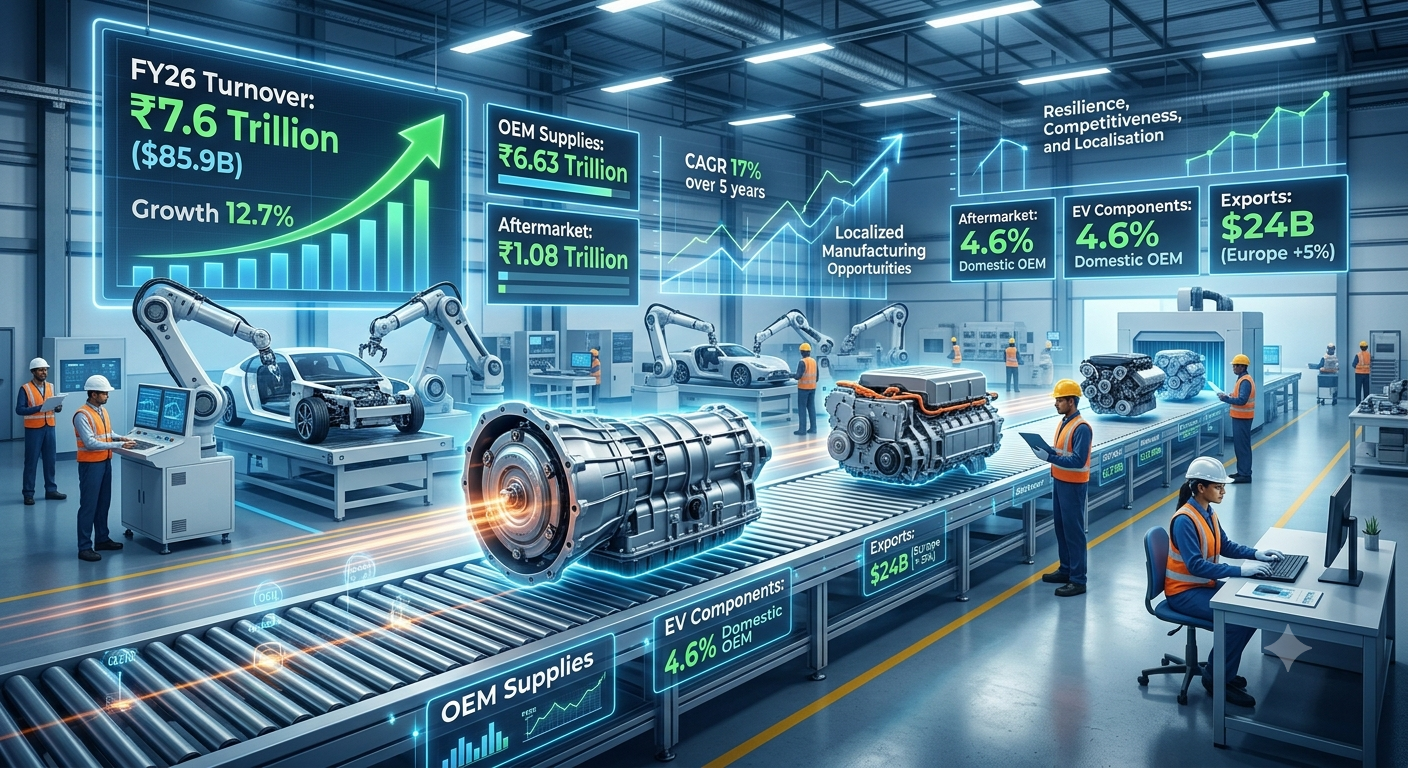
India's automotive component sector achieved a historic milestone in the financial year 2025–26, recording an overall turnover of ₹7.60 trillion ($85.9 billion). According to data released by the Automotive Component Manufacturers Association of India (ACMA), the industry registered a robust growth rate of 12.7% in rupee terms compared to the previous fiscal year.
The landmark performance reflects the sector's rapid expansion; over the past five years, the industry has more than doubled in size, compounding at a stellar annual growth rate (CAGR) of 17%. This trajectory underscores India’s strengthening position as a highly resilient and globally competitive automotive manufacturing base.
Key Performance Vectors: OEM Supplies and Aftermarket Expansion
The growth during the fiscal year was primarily anchored by intense demand within the domestic ecosystem alongside expanding vehicle production.
OEM Segment Leads the Surge
Components supplied directly to original equipment manufacturers (OEMs) grew by a significant 16.3%, reaching ₹6.63 trillion ($75 billion). This surge was directly supported by heightened manufacturing volumes across passenger and commercial vehicle lines.
Aftermarket Steady Progress
The domestic aftermarket segment grew by 9% to scale ₹1.08 trillion ($12.3 billion). This segment's expansion is being continuously driven by India's expanding vehicle parc and the steady formalization of the automotive repair and service ecosystem.
The EV Transition
Highlighting the ongoing transition toward cleaner mobility, components tailored for electric vehicles (EVs) accounted for 4.6% of total domestic OEM supplies, excluding lithium-ion batteries.
Global Trade Dynamics: Export Resilience and Strategic Imports
Despite an increasingly uncertain and volatile international trade environment, India's integration into global automotive supply chains continued to deepen.
Europe Outpaces as Top Export Destination
Total exports from the sector grew by 5% to hit $24 billion (₹2.12 trillion). Regionally, Europe emerged as the strongest growth driver for Indian-made components. Product-wise, engine components alongside drive transmission and steering systems remained the most heavily demanded categories, collectively commanding more than half of the country's total component export basket.
Technology-Driven Imports Highlight Localisation Openings
In tandem with rising domestic complexities, imports moved up 13% to reach $25.4 billion (₹2.24 trillion). This increase was predominantly driven by a growing internal demand for advanced technological systems and specialized engineering components. China, Japan, and Germany maintained their status as the top leading sourcing hubs for the Indian market.
According to Vinnie Mehta, Director General of ACMA, while the rising import bill for advanced technology products underscores current gaps, it simultaneously highlights a massive structural opportunity for domestic players to deepen localized manufacturing, accelerate technology development, and move further up the global value chain.
Industry Outlook: Growth Catalysts and Strategic Headwinds
The medium- to long-term outlook for the auto component sector remains highly positive, backed by continuous policy frameworks and infrastructure-led economic growth. Vikrampati Singhania, President of ACMA, noted that expanding manufacturing investments, deeper global integration via upcoming free trade agreements (FTAs), and the diversification of global sourcing strategies are creating significant multi-year opportunities for local manufacturers.
Emerging Growth Opportunities
Sustained policy support, continued capacity expansion, increasing value addition, multiple free trade agreements, and growing global confidence in Indian manufacturing are expected to fortify India's position as a preferred sourcing hub.
Macroeconomic and Logistics Challenges
While the macroeconomic tailwinds are strong, ACMA emphasizes that maintaining global competitiveness will require close navigation of pressing external factors. Geopolitical developments, supply-chain disruptions, raw material volatility, and elevated global logistics costs continue to pose near-term risks. Furthermore, securing a consistent supply of critical minerals—such as rare earth magnets—remains a key priority for the sector's long-term sustainability.