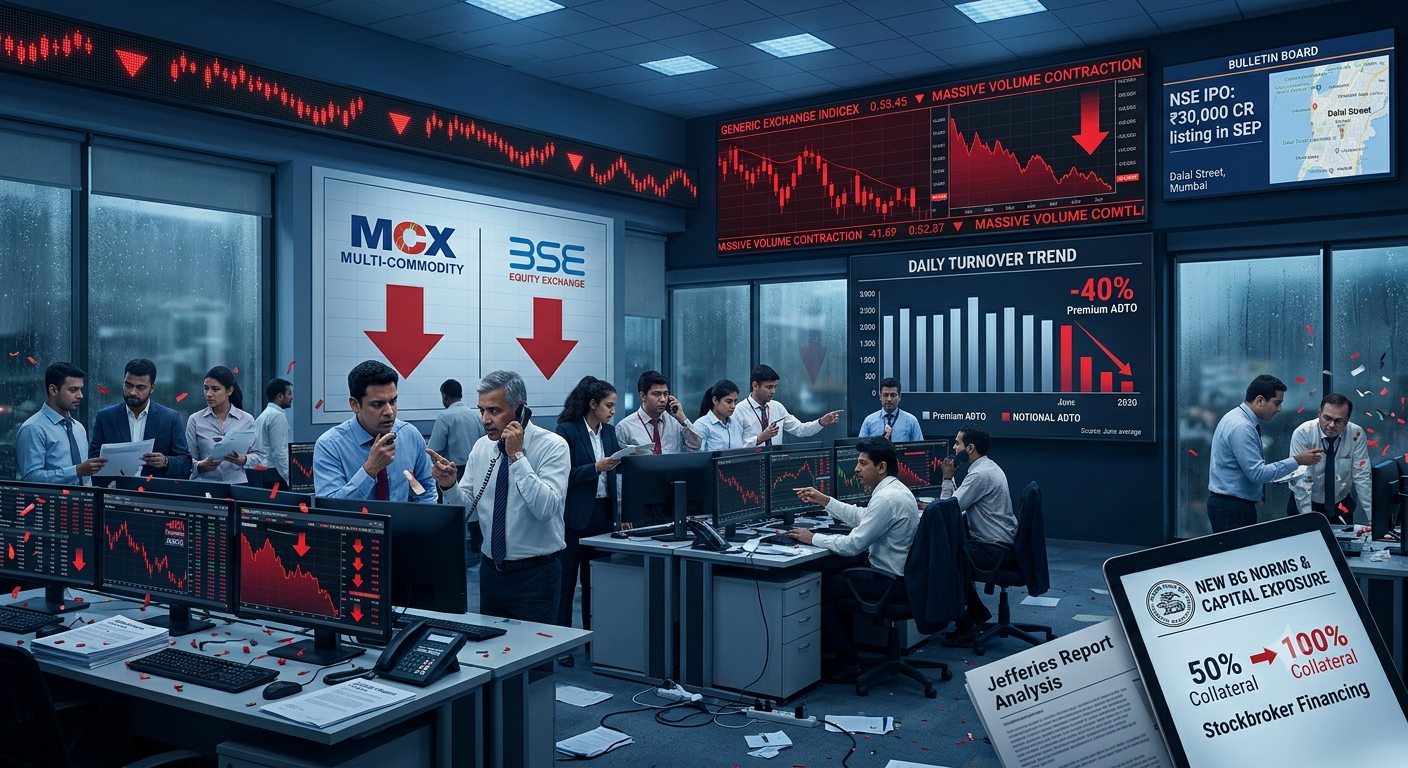
Shares of the Multi Commodity Exchange of India (MCX) and BSE Limited witnessed intense selling pressure, extending their losing streak to a fourth consecutive trading session. Over these four sessions, MCX shares have shed nearly 10% of their value, while BSE has registered a sharp decline of around 8%.
The primary catalyst driving this sudden downturn is the formal implementation of the Reserve Bank of India’s (RBI) revised capital exposure and Bank Guarantee (BG) norms, which took effect on July 1. These tightened regulatory frameworks have led to an immediate contraction in market trading volumes, weighing heavily on investor sentiment.
During the intraday session, MCX shares opened lower at ₹2,730 and slipped to a low of ₹2,577.50, down 5.35%. Similarly, BSE shares opened in the red at ₹3,820 and declined to a session low of ₹3,630.60, marking a drop of 4.52%.
RBI’s Tightened Capital Norms Restrict Broker Leverage
The newly enforced regulatory updates heavily impact how commercial banking institutions extend credit, fund-based, and non-fund-based facilities to stockbrokers and capital market intermediaries.
Clampdown on Proprietary Trading
The updated guidelines are specifically aimed at barring bank financing from being utilized for proprietary trading. Proprietary trading refers to activities where stockbrokers and financial institutions trade financial instruments using their own corporate capital to earn direct profits, rather than trading on behalf of clients. By restricting bank lines for this purpose, the regulator aims to curb systemic leverage.
The 100% Cash Collateral Mandate
The overall Average Daily Turnover (ADT) on exchanges has taken a significant hit due to the modified Bank Guarantee rules. Under the new mandate, BGs issued by commercial banks to stockbrokers on behalf of exchanges must now be backed by 100% collateral, a steep hike from the 50% collateral requirement applicable previously. This has drastically reduced the operational leverage available to large trading desks.
Operational Volumes Plunge Post-Implementation
The immediate fallout of these stringent credit and collateral restrictions has manifested as a substantial drop in operational turnover across both premier exchanges:
-
BSE Volume Contraction: In the first two trading days of July, equity and derivative trading volumes on the BSE plummeted between 7% and 10% compared to the identical trading sessions of the previous week.
-
MCX Options ADT Slump: The Options Premium Average Daily Turnover (ADTO) for MCX plunged nearly 40% to ₹5,632 crore during the first three trading days of July, down from June’s average of ₹9,338 crore.
-
Options Notional Volume Drop: The Options Notional ADT on the commodity exchange witnessed an even steeper sequential contraction, diving 71% month-on-month.
Market experts suggest that while the near-term impact of the new BG norms is higher than initially expected, it remains too early to ascertain the permanent structural damage. The velocity of the ADT recovery over the next few weeks will serve as a critical monitorable for investors seeking fresh entry points into these exchange stocks.
Jefferies Report and Impending NSE IPO Intensify Sentiment Pressures
Compounding the regulatory headwinds is a newly released institutional report by global brokerage firm Jefferies, which underscores intensifying competitive dynamics among Indian market operators.
NSE's Structural Dominance
The Jefferies report highlights that the IPO-bound National Stock Exchange (NSE) commands a significantly more diversified product mix compared to both BSE and MCX, holding a dominant market share of over 90% across most asset categories. Furthermore, NSE’s superior clearing market share and a higher premium-to-notional turnover ratio in equity options have yielded structurally superior profitability metrics relative to BSE. Jefferies also noted that NSE is aggressively expanding its product suite in commodities to rival MCX.
Mega Listing on the Horizon
Adding to the near-term headwinds, the NSE is actively targeting to launch its highly anticipated ₹30,000 crore Initial Public Offering (IPO) in September. The impending mega-listing will bring all three major exchange operators onto Dalal Street, potentially triggering a broader re-allocation of institutional capital within the exchange sector.