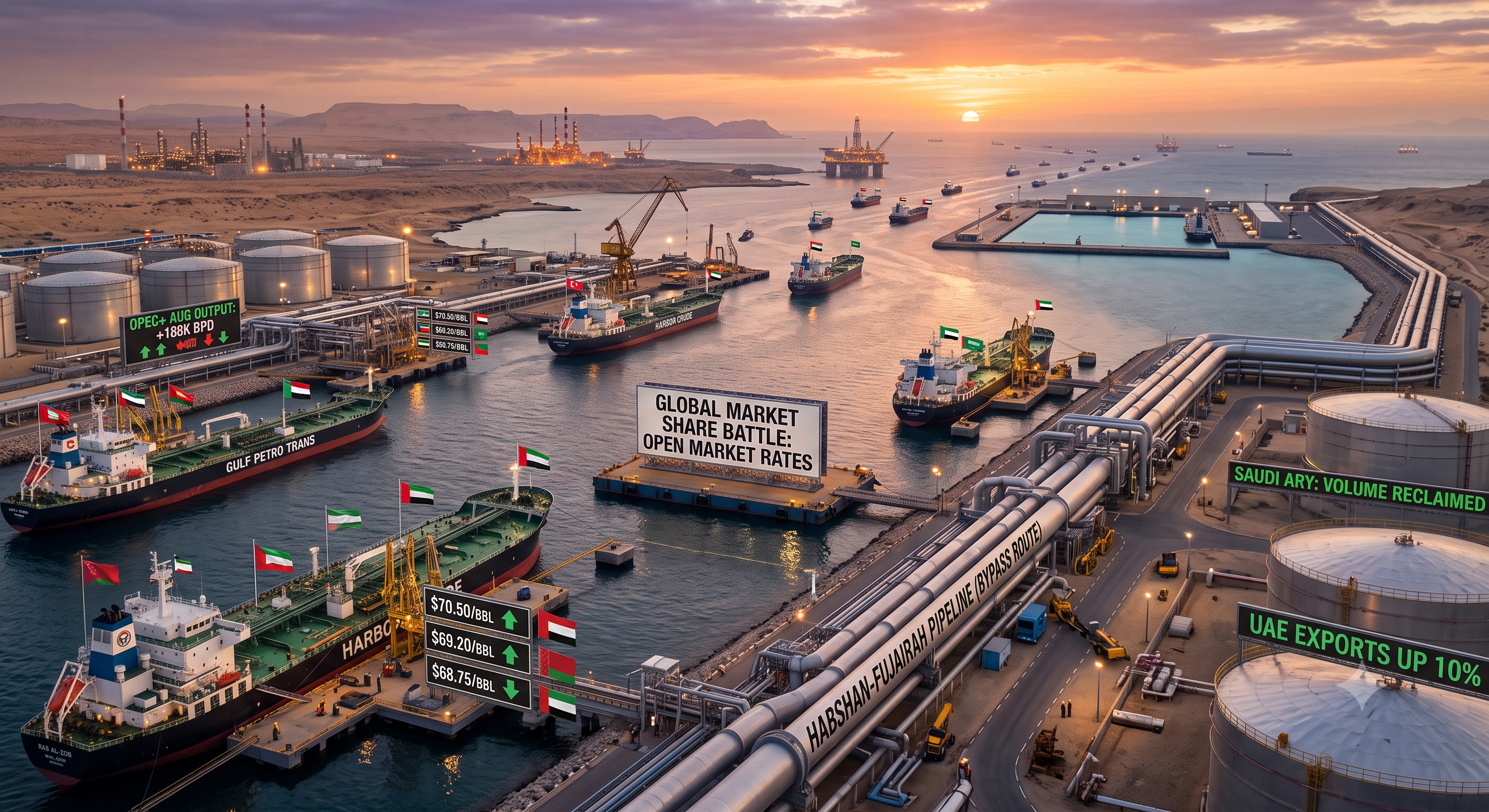
The geopolitical dynamics governing the global energy landscape have undergone a massive paradigm shift. After emerging from a period of severe military and logistical disruptions between March and May, the Middle East is entering a different kind of conflict—a high-stakes economic battle driven by the aggressive pursuit of global market share.
With crude flows through the critical Strait of Hormuz largely restored and supply chains normalizing, Gulf producers are rapidly escalating their output.
The OPEC+ Policy Shift: Prioritizing Volume Over Price Defense
The post-crisis strategy adopted by OPEC+ highlights a structural pivot within the producer alliance. While the cartel continues to command roughly 40% of global crude supply (excluding the UAE), recent policy adjustments demonstrate a growing willingness to tolerate lower benchmark prices to maintain long-term market relevance in an increasingly competitive ecosystem.
Gradual Production Normalization
The group's decision to hike August production by 188,000 barrels per day (bpd) marks its fifth consecutive monthly output increase.
Saudi Aramco’s Aggressive Pricing Strategy
Saudi Arabia’s latest pricing maneuvers offer the clearest evidence of this strategic transition. State energy giant Saudi Aramco slashed its August Official Selling Price (OSP) for its flagship Arab Light crude destined for Asia to just $1.50 per barrel above the Oman-Dubai benchmark.
Representing a massive $11 per barrel reduction from July levels, this move marks the sharpest monthly price cut in more than two decades and drags the Saudi premium down to its lowest level since mid-2020.
Logistical Winners and Changing Demand Structural Patterns
The fallout from the recent crisis has permanently altered regional supply mechanics and highlighted shifting consumption trends across major economies.
The UAE’s Structural Infrastructure Advantage
Among the Gulf producers, the United Arab Emirates (UAE) has emerged as a distinct structural winner. Operating outside of strict OPEC+ production constraints, Abu Dhabi has successfully ramped up its output to approximately 3.9 mbpd.
More importantly, the nation's investment in the 1.5 mbpd Habshan–Fujairah pipeline paid massive dividends, enabling UAE crude exports to completely bypass the volatile Strait of Hormuz throughout the conflict. This critical logistical edge has insulated the UAE, even as the broader OPEC+ alliance faces the arduous challenge of balancing higher export volumes against the risk of triggering a renewed global oil surplus.
A Bifurcated Asian and Global Demand Landscape
Global demand patterns are actively fracturing along structural and geographical lines:
-
China and Japan: Crude imports into these industrial powerhouses collapsed by roughly 40% during the crisis. While Chinese independent refiners are expected to respond strongly to the latest GCC discounts in the coming weeks, China's long-term demand recovery faces a structural ceiling driven by rapid vehicle electrification. In May alone, electric vehicles (EVs) captured a staggering 42% of Chinese car sales.
-
India's Resilient Cushion: In contrast, India's domestic fuel demand proved remarkably resilient throughout the supply shocks. This stability was intentionally cushioned by state-run refiners, who absorbed steep refining margin losses to freeze domestic pump prices for consumers.
-
The Western EV Divergence: The geopolitical crisis has accelerated the broader energy transition unevenly.
In the United Kingdom, battery-EV registrations hit a monthly record in March, jumping 24% year-on-year. Conversely, United States new EV sales fell by an estimated 28% following the elimination of the federal tax credit, creating a stark policy divergence.
The Bullish Counter-Story: Depleted Global Inventories
While a combination of rising supply and structural demand headwinds paints a fundamentally bearish long-term picture, the current state of global oil inventories provides a powerful counter-narrative that should prevent a total price collapse.
-
Aggressive Global Stock Draws: Global crude inventories have been drawing down at a rapid average pace of 3.8 million bpd since the onset of the Middle Eastern conflict.
-
OECD Inventories at Multi-Decade Lows: According to the International Energy Agency (IEA), OECD government-controlled inventories fell by 163 million barrels, touching their lowest levels since December 1990.
-
The US SPR Void: The US Strategic Petroleum Reserve was aggressively drawn down by approximately 89.5 million barrels to just 325 million barrels—its lowest operational level since 1984. This historic draw was part of a broader, 172-million-barrel IEA-coordinated emergency release, meaning that Washington will inevitably transition into a structural buyer to refill its caverns once market prices stabilize.
Outlook: Q3 2026 Price Projections
Institutional sentiment is visibly shifting toward a more cautious, bearish framework. The latest Commodity Futures Trading Commission (CFTC) data reveals that money managers reduced their net-long exposure in WTI crude futures and options by 6,582 contracts to 93,713 contracts. This liquidation reflects a clear waning of conviction in any sustained bullish narrative amid rapidly improving physical supply conditions.