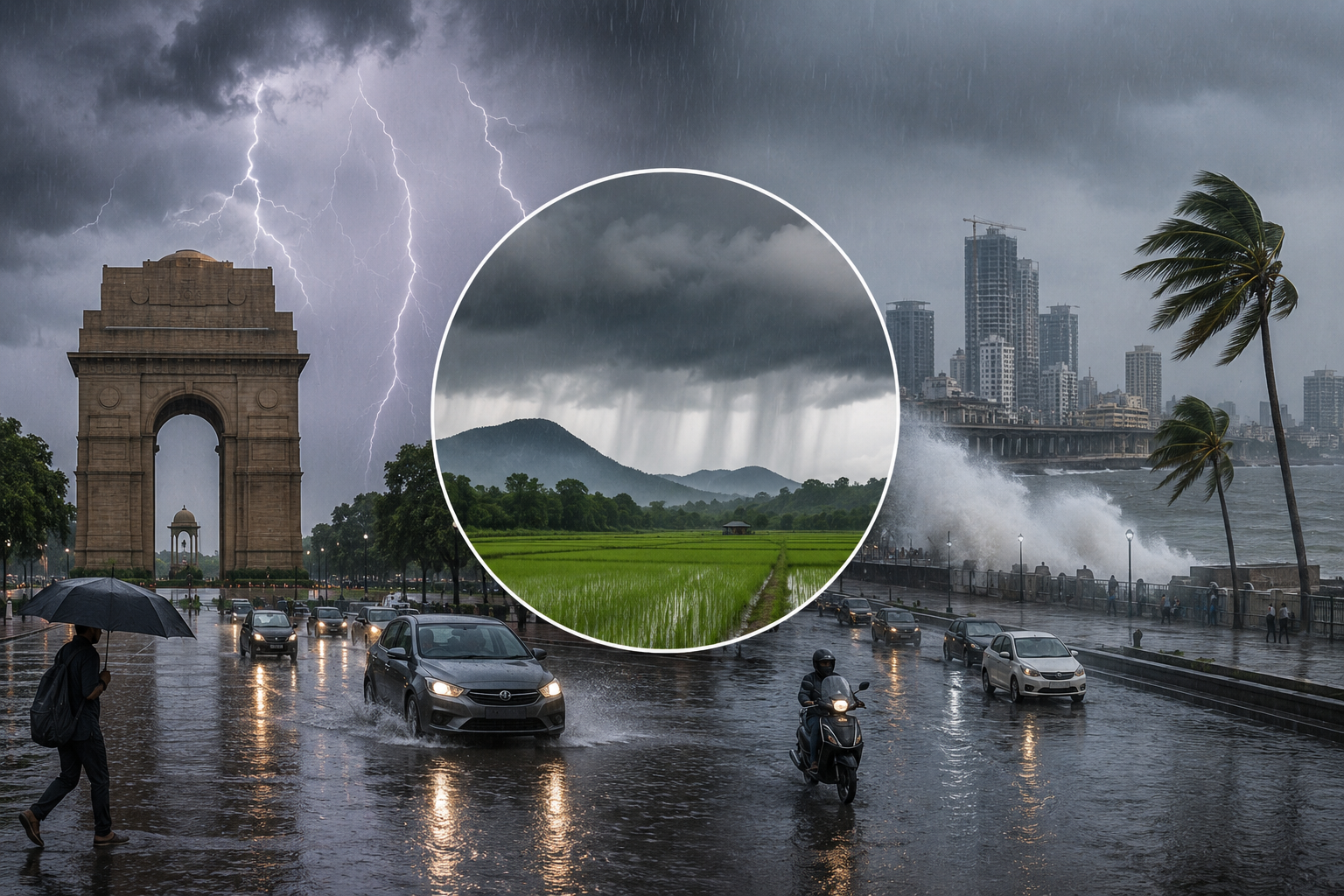
Delhi Under Yellow Alert, Mumbai Faces Major Disruptions; IMD Warns of Intense Rainfall Across Several States This Week
The southwest monsoon has entered an active phase, bringing widespread rainfall and prompting weather alerts across several parts of the country. The India Meteorological Department (IMD) has forecast heavy to very heavy rainfall in multiple states over the coming days, while issuing a yellow alert for Delhi and an orange alert for Mumbai due to increasing rainfall intensity.
The weather department said favourable atmospheric conditions are helping the monsoon advance further into northwestern India, including additional parts of Gujarat, Rajasthan, Haryana and Punjab. The latest forecast indicates that rainfall activity is likely to remain above normal in many regions during the week.
Delhi Braces for Rain, Thunderstorms and Gusty Winds
The national capital is expected to witness cloudy skies, intermittent rain showers and thunderstorms accompanied by lightning. Gusty winds of up to 50 kmph may occur during evening and night hours, potentially affecting traffic movement and outdoor activities.
The IMD has forecast isolated heavy rainfall in Delhi between July 6 and July 8 as monsoon conditions strengthen. Daytime temperatures are expected to remain comfortable compared to recent weeks, with maximum temperatures ranging between 34°C and 36°C and minimum temperatures around 26°C to 28°C.
Authorities have advised residents to stay updated with weather advisories, avoid unnecessary travel during thunderstorms and take precautions against waterlogging in low-lying areas.
Mumbai Receives Heavy Downpour, Transport Network Affected
Mumbai continues to experience intense monsoon showers, prompting the IMD to issue an orange alert for the city. Heavy rainfall, accompanied by strong winds, has disrupted normal life across Mumbai and surrounding districts.
As a precautionary measure, schools and colleges in Mumbai, Pune, Thane and Palghar remained closed. Waterlogging, reduced visibility and traffic congestion were reported in several areas, while civic authorities remained on high alert to tackle emergencies.
Road connectivity between Mumbai and Pune was significantly affected after heavy rainfall triggered landslides and flooding. Parts of the Mumbai-Pune Expressway and the old highway were temporarily closed following damage caused by a fallen concrete structure and debris accumulation.
Rail services between Mumbai and Pune also faced disruptions after landslides occurred in the Karjat-Lonavala section, affecting passenger movement.
Heavy Rainfall Expected Across Several Regions
The IMD has warned that the active monsoon spell will continue to influence weather conditions across large parts of the country.
Northwest India: Delhi, Haryana, Punjab, Himachal Pradesh, Uttarakhand, Uttar Pradesh and parts of Rajasthan are expected to receive moderate to heavy rainfall, with isolated locations witnessing very heavy showers.
Central India: Madhya Pradesh, Chhattisgarh and the Vidarbha region are likely to experience heavy rainfall. Some parts of Chhattisgarh could receive extremely heavy rainfall, increasing the risk of flash floods and localized flooding.
Eastern India: Odisha, Bihar, Jharkhand, Gangetic West Bengal and Sub-Himalayan West Bengal are expected to witness widespread rainfall. Isolated areas in Odisha may receive extremely heavy precipitation during the week.
Northeast India: Arunachal Pradesh, Assam, Meghalaya, Nagaland, Manipur, Mizoram and Tripura are also likely to receive widespread rainfall under the influence of active monsoon conditions.
Western and Southern India: Gujarat, Konkan and Goa, Saurashtra and Kutch, Madhya Maharashtra, Kerala, Coastal Karnataka and interior Karnataka are expected to remain under an active rainfall spell. Extremely heavy rainfall is possible in isolated pockets of Gujarat and Konkan-Goa.
Agriculture and Water Reservoirs to Benefit
The widespread rainfall is expected to provide a significant boost to the kharif cropping season by improving soil moisture levels and replenishing reservoirs. Farmers in rain-fed regions are likely to benefit from the timely advancement of the monsoon, although excessive rainfall in certain areas may pose risks to standing crops and rural infrastructure.
Water storage levels in reservoirs are also expected to improve, supporting irrigation needs and strengthening water availability for urban and agricultural consumption in the months ahead.
Authorities Urge Public to Remain Cautious
Disaster management agencies and local administrations have advised citizens to remain vigilant as heavy rainfall may lead to waterlogging, flash floods, landslides and traffic disruptions in vulnerable areas. Travelers have been urged to check weather and transport updates before planning journeys, especially in regions experiencing intense rainfall.
With the southwest monsoon becoming increasingly active, weather experts expect rainfall activity to remain elevated across much of India over the next several days. Close monitoring of forecasts and timely precautionary measures will be crucial in minimizing the impact of adverse weather conditions.