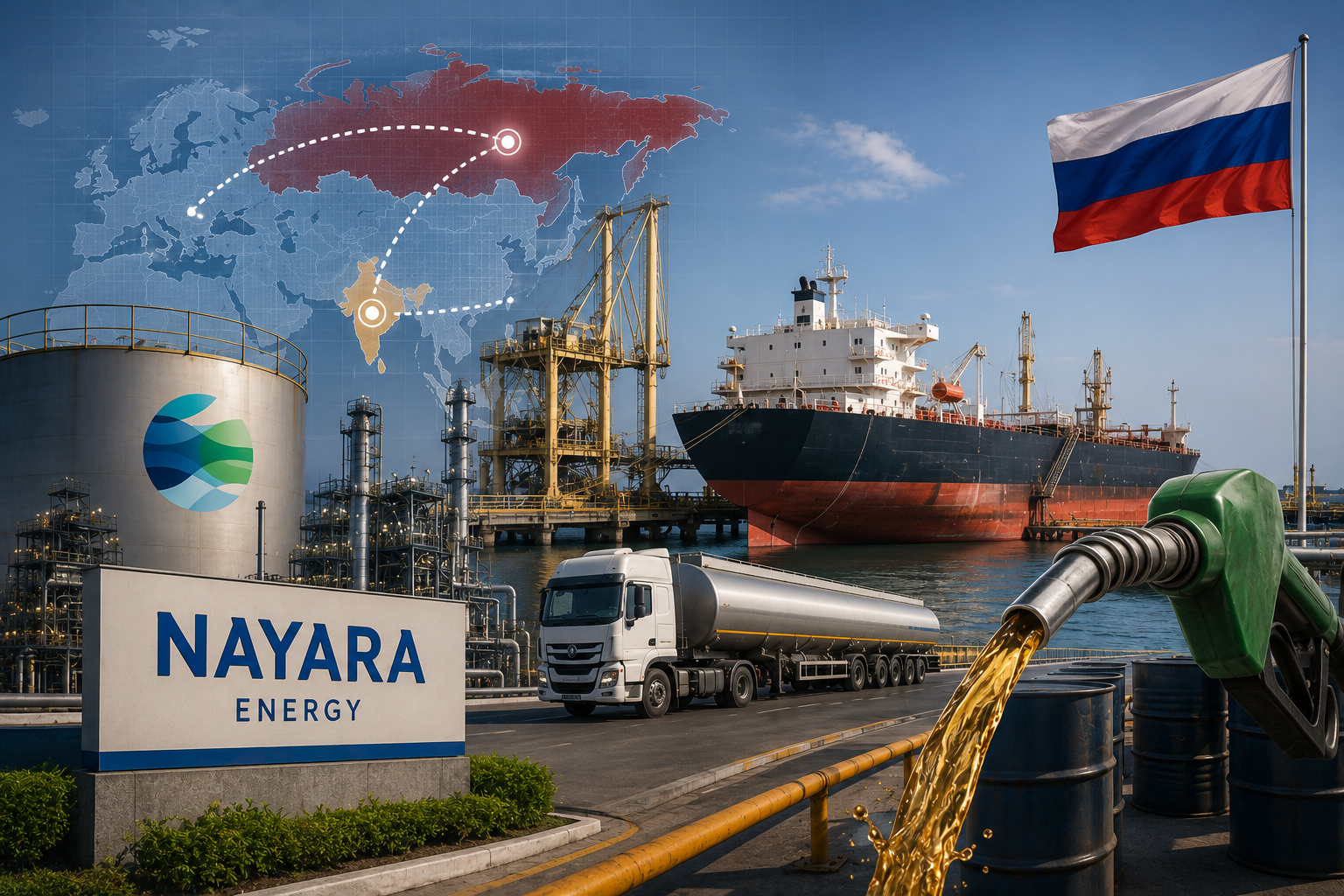
Nayara Energy's Refined Gasoline May Have Entered Russian Market via International Trading Houses Amid Ongoing Fuel Shortages
Global energy trade has once again come under the spotlight after reports suggested that gasoline refined at Nayara Energy's Vadinar refinery in India may have reached Russia through international commodity traders. The development comes at a time when Russia is facing periodic fuel shortages following repeated attacks on its refinery infrastructure, forcing the country to seek additional supplies of refined petroleum products despite being one of the world's largest crude oil producers.
While the Indian government has clarified that domestic refiners are not directly exporting fuel to Russia, officials acknowledged that petroleum products sold to global traders can eventually be resold to buyers in different countries through international trading networks. The episode highlights the increasingly complex nature of global oil markets, where ownership of crude and refined products frequently changes multiple times before reaching the final consumer.
Russia's Refining Challenges Drive Fuel Imports
Although Russia remains among the world's leading crude oil exporters, its domestic refining industry has faced significant operational challenges over the past year.
Repeated attacks on oil depots and refining facilities have disrupted fuel production, creating temporary shortages of gasoline and diesel in certain regions. These supply constraints have increased Russia's dependence on imported refined products to maintain domestic fuel availability.
Industry analysts believe the country's growing need for imported gasoline reflects the pressure on refining infrastructure rather than any shortage of crude oil supplies.
Nayara Energy at the Centre of Global Fuel Trade
Nayara Energy operates one of India's largest private refineries at Vadinar, Gujarat, with a refining capacity of approximately 400,000 barrels per day.
The refinery has increasingly processed Russian crude oil after geopolitical developments reshaped global energy trade.
Following international sanctions on Russia, Nayara has relied more heavily on independent commodity traders for both crude procurement and exports of refined petroleum products. This trading model has enabled the company to continue operating efficiently while navigating evolving financial and logistical restrictions.
According to market reports, gasoline produced at the Vadinar refinery was purchased by international traders before eventually being shipped toward Russia.
Government Clarifies India's Position
The Indian government has reiterated that domestic oil companies are not directly exporting fuel to Russia.
However, Petroleum Minister Hardeep Singh Puri acknowledged that once refined petroleum products are sold to independent trading companies, those cargoes may subsequently change ownership several times before reaching their final destination.
This distinction is significant because international commodity trading operates independently of bilateral government trade arrangements.
In today's interconnected energy markets, the final destination of a cargo is often determined by commercial demand, pricing opportunities, freight economics, and geopolitical developments.
Why Commodity Traders Play a Critical Role
Global commodity trading houses have become increasingly important participants in international energy markets.
These firms purchase crude oil and refined products from producers before redistributing them across multiple regions based on supply-demand dynamics.
A single cargo may pass through several entities, including:
-
Refiners
-
Commodity traders
-
Shipping companies
-
Storage terminal operators
-
Regional distributors
-
Final buyers
As a result, determining the ultimate destination of petroleum products has become considerably more complex than traditional exporter-to-importer transactions.
Sanctions Continue to Reshape Global Oil Flows
International sanctions imposed on Russia have significantly altered global petroleum trade over the past few years.
Several notable trends have emerged:
Rise of Alternative Trading Networks
Independent trading firms have become increasingly important in facilitating cross-border energy transactions.
New Shipping Routes
Oil cargoes are frequently rerouted through regional trading hubs before reaching final buyers.
Flexible Payment Mechanisms
Energy companies have adopted alternative financial arrangements to facilitate international transactions.
Higher Demand for Asian Refiners
Countries with sophisticated refining capabilities, including India, have benefited from increased demand for refined petroleum products.
These structural changes continue to redefine global energy supply chains.
India Strengthens Its Position as a Global Refining Hub
India has steadily emerged as one of the world's most important refining centres.
The country's large and technologically advanced refineries export gasoline, diesel, aviation turbine fuel, and petrochemical feedstocks to dozens of international markets.
Several factors support India's competitive position:
-
Large-scale refining capacity
-
Access to competitively priced crude oil
-
Efficient export infrastructure
-
Strong shipping connectivity
-
Advanced refining technology
As geopolitical realignments continue, India's role in global petroleum trade is expected to become even more significant.
Shipping Patterns Reflect Dynamic Energy Markets
Reports indicate that one of the gasoline cargoes initially departed for the Middle East before continuing toward other destinations.
Such routing is common in international commodity trading.
Cargoes may be redirected based on:
-
Price arbitrage opportunities
-
Regional fuel demand
-
Shipping costs
-
Storage economics
-
Inventory management
Consequently, the declared destination at the time of loading does not always represent the final delivery point.
Impact on India's Energy Sector
The reported transactions are unlikely to affect India's domestic fuel availability.
However, they reinforce India's growing importance in international energy markets as both a major crude oil importer and a leading exporter of refined petroleum products.
Higher refinery utilization rates and access to competitively priced crude have enabled Indian refiners to maintain strong export competitiveness despite global market volatility.
This trend is expected to continue as refining margins remain relatively attractive.
Key Factors Investors Should Monitor
Energy market participants will closely watch several developments over the coming months:
-
Global crude oil prices
-
Refining margins
-
Russian refinery operations
-
International sanctions
-
Freight rates
-
Middle East geopolitical developments
-
Indian petroleum exports
-
Demand for transportation fuels
These variables will influence the profitability of refiners and determine future trade flows across global energy markets.
Long-Term Outlook for Indian Refiners
India's refining industry is expected to remain one of the biggest beneficiaries of changing global energy dynamics.
Growing domestic demand, expanding export opportunities, and investments in refining capacity are likely to support sustained long-term growth.
Companies with integrated refining operations, diversified crude sourcing, and efficient export logistics are expected to remain well positioned despite geopolitical uncertainties.
As global energy markets continue to evolve, India's strategic location and advanced refining infrastructure provide significant competitive advantages.