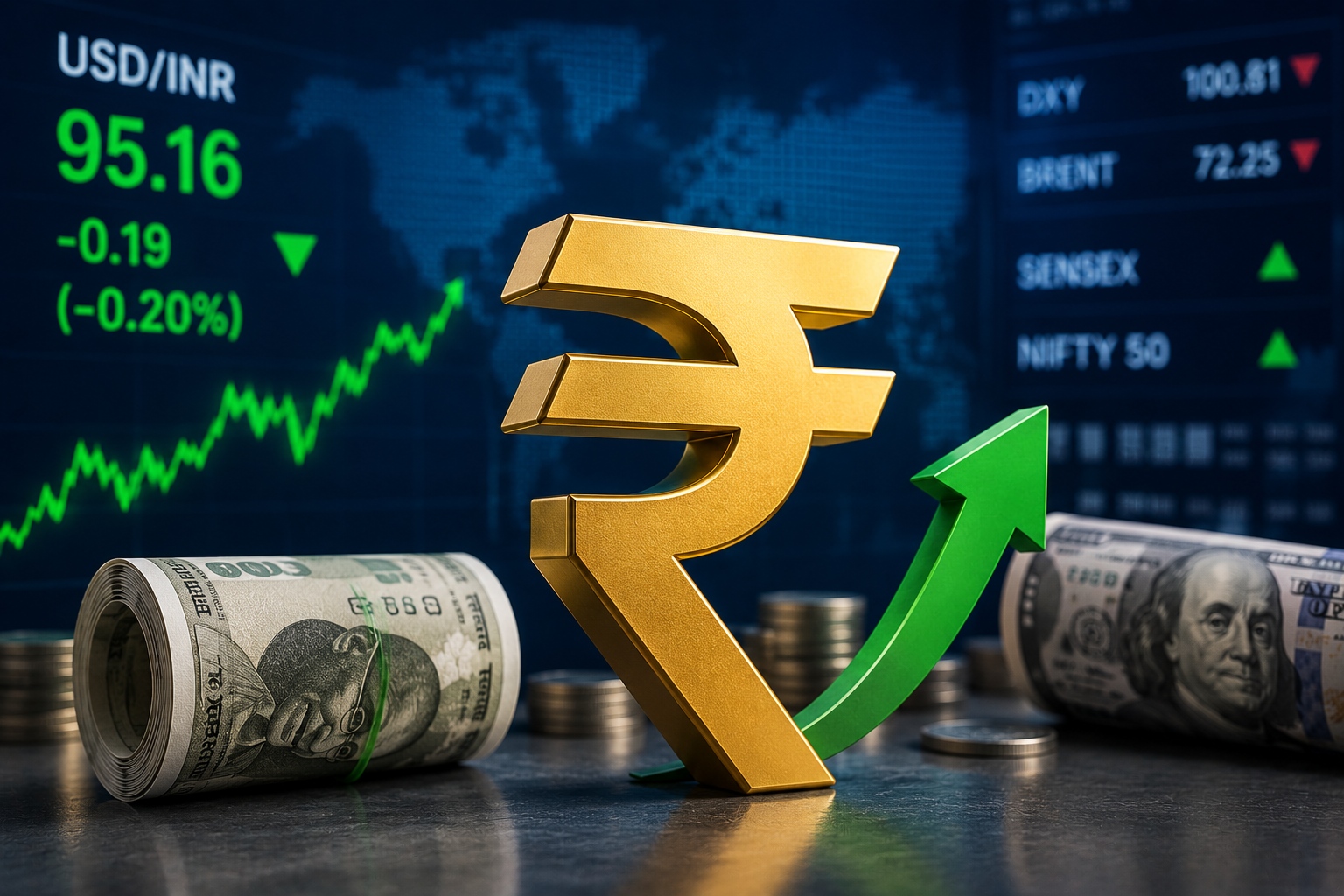
Domestic Currency Opens Stronger at 95.16; Importer Demand, RBI Intervention and FII Outflows Continue to Limit Upside
The Indian rupee strengthened against the US dollar in early trade on Friday, supported by a weaker US dollar index and easing global crude oil prices. The domestic currency appreciated 19 paise to 95.16 per US dollar, recovering from the previous session's decline as improved global risk sentiment encouraged buying in emerging market currencies.
However, forex market participants cautioned that despite favourable external conditions, the rupee continues to face resistance from strong dollar demand by importers, persistent foreign portfolio outflows and the Reserve Bank of India's (RBI) ongoing efforts to rebuild its foreign exchange reserves.
The movement in the currency also coincided with a strong rally in Indian equity markets, where the Sensex and Nifty extended gains for a third consecutive session.
Rupee Recovers After Previous Day's Weakness
At the interbank foreign exchange market, the rupee opened at 95.20 before strengthening further to 95.16 against the US dollar, marking an appreciation of 19 paise over Thursday's closing level.
The recovery follows a volatile trading session on Thursday, when the rupee had initially gained before reversing course to settle at 95.35, weighed down by importer demand and continued foreign capital outflows.
Friday's rebound indicates that external market conditions have become relatively supportive after the US dollar retreated from recent highs.
Weaker Dollar Index Supports Emerging Market Currencies
One of the biggest contributors to the rupee's appreciation was the decline in the US Dollar Index (DXY).
The dollar index, which measures the strength of the greenback against a basket of six major global currencies, eased to around 100.81, after recently touching a 15-month high of 101.60.
The decline in the dollar followed softer-than-expected economic data from the United States, which strengthened expectations that the US Federal Reserve may adopt a more accommodative monetary policy in the coming months.
A weaker dollar generally improves investor appetite for emerging market assets and supports currencies such as the Indian rupee.
Falling Crude Oil Prices Provide Relief to the Indian Economy
Another significant factor supporting the rupee was the continued decline in international crude oil prices.
Brent crude futures traded around $72.25 per barrel, extending recent losses as concerns over supply disruptions through the Strait of Hormuz eased.
For India, one of the world's largest crude oil importers, softer oil prices are a major macroeconomic positive because they help:
-
Reduce the country's import bill.
-
Lower inflationary pressures.
-
Improve the current account deficit.
-
Ease pressure on the rupee.
-
Reduce input costs for businesses.
Lower crude prices also improve fiscal stability by reducing the government's subsidy burden and supporting economic growth.
Importer Demand Continues to Cap Rupee Gains
Despite favourable global developments, currency dealers noted that strong demand for US dollars from Indian importers and corporate hedgers continues to prevent a sharper appreciation in the rupee.
Companies importing crude oil, electronic goods, machinery and industrial raw materials regularly purchase dollars to meet payment obligations, creating sustained demand for the US currency.
Corporate hedging activities also increase dollar demand during periods of exchange rate uncertainty, limiting the rupee's upside even when global conditions improve.
RBI Focuses on Rebuilding Forex Reserves
Market experts believe the Reserve Bank of India is likely to remain active in the foreign exchange market.
India's forex reserves have declined from a peak of nearly USD 728.49 billion recorded earlier this year to approximately USD 672.6 billion.
The RBI is expected to use periods of rupee strength to purchase dollars from the market in order to rebuild reserves and maintain adequate protection against future global financial shocks.
While such intervention strengthens India's external financial position, it also limits excessive appreciation of the domestic currency.
Analysts therefore expect the central bank to continue maintaining a balanced approach towards exchange rate management.
Strong Equity Markets Support the Currency
Positive sentiment in domestic equity markets also contributed to the rupee's recovery.
During morning trade:
-
Sensex gained over 545 points.
-
Nifty 50 advanced nearly 174 points.
A stronger equity market generally improves investor confidence and supports the domestic currency by attracting capital inflows.
However, sustained appreciation in the rupee will require stronger foreign investment participation in addition to healthy domestic market performance.
Foreign Portfolio Outflows Remain a Concern
Despite Friday's currency recovery, foreign investment trends continue to remain challenging.
Foreign Institutional Investors (FIIs) sold Indian equities worth approximately ₹311.82 crore on Thursday.
The broader trend has been even more significant.
During June 2026, Foreign Portfolio Investors (FPIs) withdrew nearly ₹49,340 crore from Indian equities.
Total FPI outflows during calendar year 2026 have now exceeded ₹2.7 lakh crore, substantially higher than the ₹1.66 lakh crore recorded during the entire year of 2025.
Persistent capital outflows continue to generate demand for US dollars and remain one of the key factors limiting sustained appreciation in the rupee.
What Will Drive the Rupee Going Forward?
Several domestic and global developments are expected to determine the rupee's direction over the coming weeks.
US Federal Reserve Policy
Any indication of future interest rate cuts in the United States could weaken the dollar further and benefit emerging market currencies.
Crude Oil Prices
Continued stability in global energy markets would remain supportive for the rupee.
RBI Intervention
The pace of reserve accumulation by the RBI will influence the extent of rupee appreciation.
Foreign Capital Flows
A return of sustained FII inflows into Indian equities would provide meaningful support to the domestic currency.
Domestic Economic Indicators
Inflation, GDP growth, industrial production and trade deficit data will continue to shape investor expectations regarding India's macroeconomic outlook.
Sectoral Impact of a Stronger Rupee
Currency movements affect various sectors differently.
Beneficiaries
-
Aviation companies
-
Oil marketing companies
-
Paint manufacturers
-
Chemical companies
-
Consumer electronics importers
-
Auto component manufacturers dependent on imports
Potentially Impacted
-
Information Technology exporters
-
Pharmaceutical exporters
-
Textile exporters
-
Engineering exporters
Export-oriented companies generally benefit from a weaker rupee, while import-dependent sectors gain when the domestic currency strengthens.
Outlook
Currency analysts expect the rupee to remain largely range-bound over the near term.
While easing crude prices and a softer dollar provide favourable conditions, strong importer demand, RBI reserve management and persistent foreign capital outflows are likely to prevent significant appreciation.
Any improvement in FII inflows or further decline in global oil prices could provide additional support to the domestic currency during the second half of the financial year.