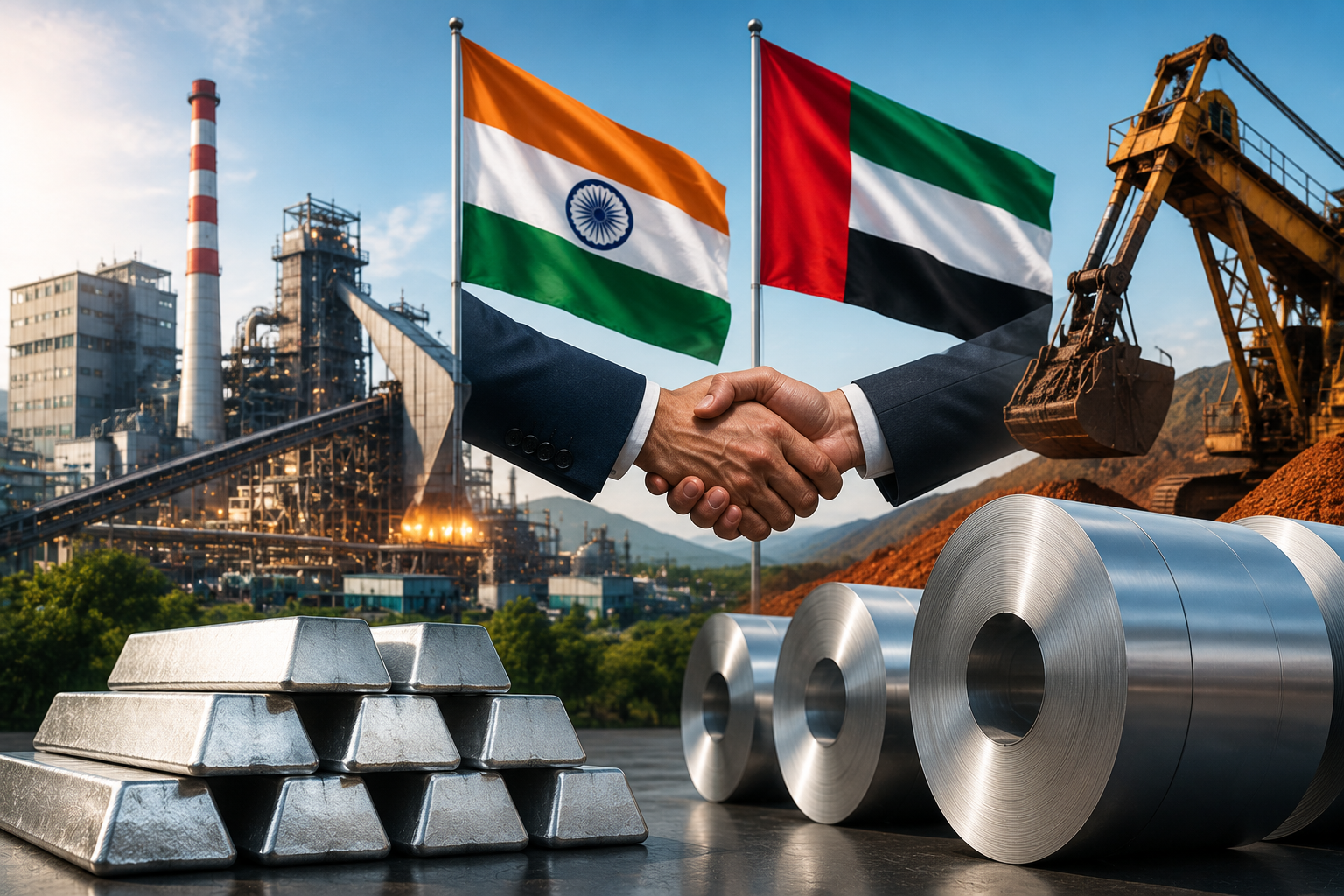
Landmark joint venture aims to build an integrated aluminium ecosystem spanning mining, refining, smelting, and downstream manufacturing, reinforcing India's position as a global industrial and metals powerhouse.
India is poised to receive one of its largest-ever foreign investments in the mining and metals sector as the Adani Group and Abu Dhabi-based International Holding Company (IHC) plan to jointly invest $11.5 billion in an integrated aluminium project in Odisha. The proposed venture is expected to become the largest foreign direct investment (FDI) ever made in India's mining and metallurgy industry, marking another milestone in the country's growing appeal as a global manufacturing destination.
The mega project will establish a fully integrated aluminium value chain covering bauxite mining, alumina refining, aluminium smelting, power generation, and downstream value-added manufacturing. Once operational, the project is expected to significantly strengthen India's aluminium production capacity, enhance export competitiveness, and support the government's long-term vision of building a self-reliant manufacturing economy.
The investment also reflects the rapidly expanding economic partnership between India and the United Arab Emirates (UAE), with both countries deepening collaboration across infrastructure, energy, logistics, manufacturing, and strategic industries.
Mega Investment Signals Strong Global Confidence in India
The proposed investment sends a strong message about international investor confidence in India's long-term economic growth.
Large-scale foreign investments in heavy industries require significant capital commitments and long investment horizons. The willingness of a global investment company such as IHC to participate in one of India's largest industrial projects highlights growing confidence in the country's policy environment, infrastructure development, and rising domestic demand.
The investment also aligns with India's ambition of becoming a global manufacturing hub under initiatives such as Make in India, Atmanirbhar Bharat, and the National Logistics Policy.
Odisha Emerges as India's Preferred Metals Manufacturing Hub
Odisha has steadily transformed into one of India's most important destinations for mining and heavy industries.
The state possesses some of the country's largest reserves of bauxite, the primary raw material used in aluminium production, making it strategically attractive for integrated aluminium manufacturing.
Apart from abundant mineral resources, Odisha offers robust port connectivity, expanding industrial corridors, reliable power infrastructure, and government support for large-scale industrial projects.
Several leading steel, mining, and metal companies already operate in the state, creating a well-established industrial ecosystem capable of supporting mega investments of this scale.
Integrated Aluminium Ecosystem to Improve Efficiency
Unlike standalone manufacturing facilities, the proposed project will cover the complete aluminium production chain.
The integrated model is expected to include:
-
Bauxite mining
-
Alumina refining
-
Aluminium smelting
-
Captive power generation
-
Downstream aluminium processing
-
Value-added aluminium products
This vertically integrated structure enables companies to optimise costs, improve operational efficiency, reduce dependence on external suppliers, and strengthen supply chain resilience.
It also enhances India's ability to manufacture higher-value aluminium products rather than exporting raw materials.
Rising Aluminium Demand Supports Long-Term Growth
Global demand for aluminium continues to increase as industries adopt lightweight, recyclable, and energy-efficient materials.
The metal is widely used across sectors including:
-
Electric vehicles (EVs)
-
Renewable energy infrastructure
-
Power transmission
-
Construction
-
Railways
-
Aerospace
-
Defence
-
Packaging
-
Consumer electronics
India's rapidly expanding infrastructure pipeline, urbanisation, renewable energy investments, and growing automobile industry are expected to drive sustained domestic demand for aluminium over the coming decades.
Industry experts believe integrated projects like this will help India reduce import dependence while strengthening export opportunities.
Employment and Regional Development Expected
The proposed aluminium complex is expected to generate substantial economic benefits for Odisha.
During construction and operations, the project could create thousands of direct employment opportunities across engineering, mining, manufacturing, logistics, infrastructure, and maintenance.
In addition, indirect employment is expected to be generated through ancillary industries, transportation services, equipment suppliers, housing, hospitality, and local businesses.
Large industrial investments also typically accelerate development of roads, rail connectivity, power transmission, water infrastructure, educational institutions, and healthcare facilities in surrounding regions.
India-UAE Economic Partnership Continues to Strengthen
The announcement further strengthens the strategic economic relationship between India and the United Arab Emirates.
Following the implementation of the Comprehensive Economic Partnership Agreement (CEPA), bilateral trade and investment have grown significantly across sectors such as renewable energy, ports, logistics, financial services, food processing, technology, and manufacturing.
For IHC, the aluminium project represents another strategic long-term investment in India's industrial growth story.
For India, the investment supports efforts to attract high-quality foreign capital into sectors that contribute to manufacturing expansion, exports, employment generation, and technology transfer.
Positive Outlook for Mining and Metals Sector
The project is expected to generate positive sentiment across India's broader mining and metals ecosystem.
Companies involved in mining equipment, industrial machinery, engineering services, logistics, construction materials, renewable power, and industrial infrastructure could potentially benefit from the large-scale investment.
The project also reinforces India's position as an increasingly attractive destination for global resource-based manufacturing investments.
Industry observers believe the announcement could encourage additional international investments in mining, non-ferrous metals, battery materials, and critical mineral processing.
Outlook
The proposed $11.5 billion aluminium project by Adani Group and UAE's International Holding Company has the potential to become one of the most transformative industrial investments in India's recent history. By combining large-scale mining operations with integrated aluminium manufacturing, the venture is expected to strengthen India's global competitiveness in the metals sector while supporting long-term industrialisation.
Beyond expanding production capacity, the project is likely to create employment, boost exports, stimulate infrastructure development, and attract further foreign investment into India's manufacturing economy. As demand for aluminium accelerates globally, particularly from electric vehicles, renewable energy, and infrastructure sectors, the project could play a pivotal role in positioning India as a major global supplier of value-added aluminium products.