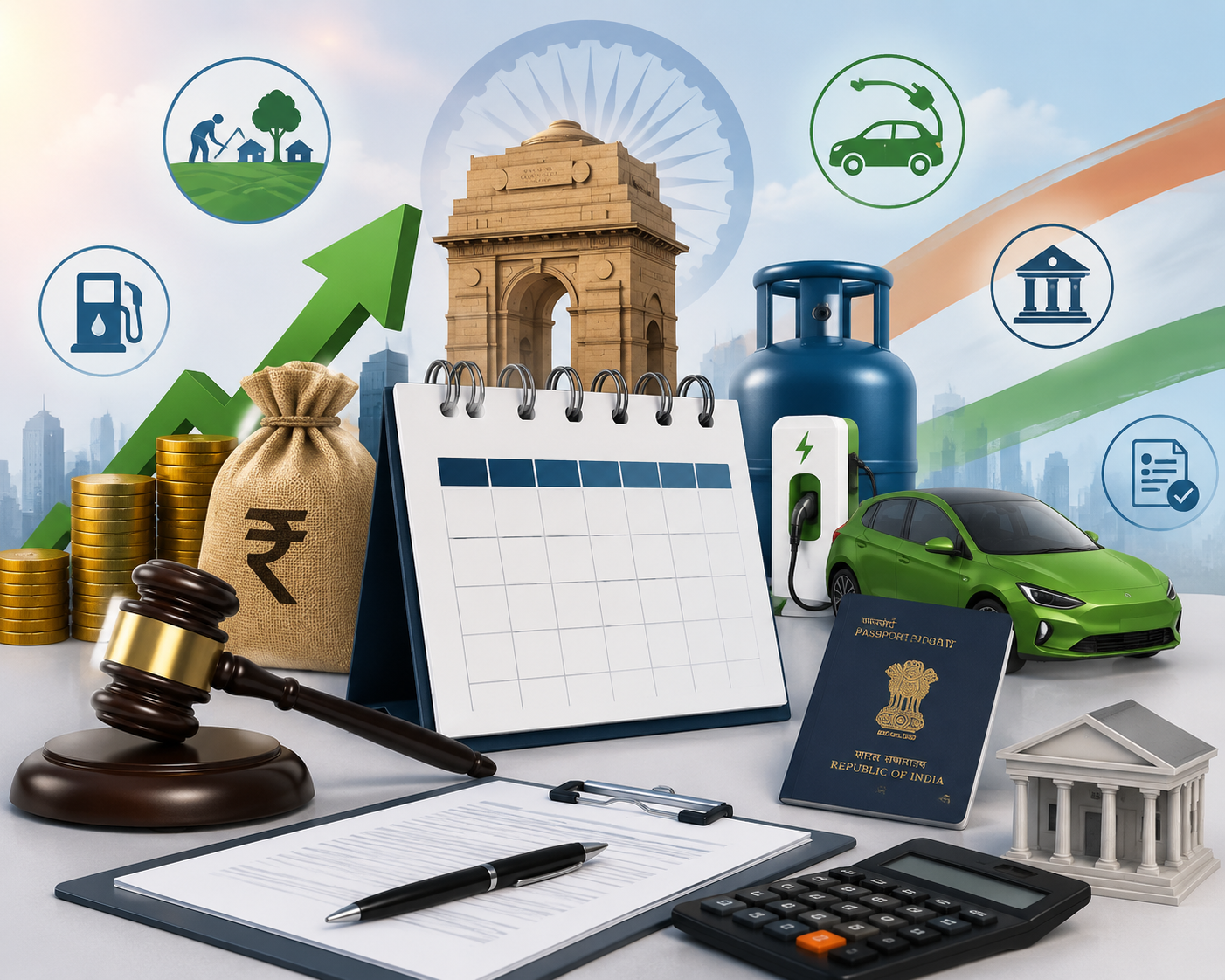
From the launch of a new rural employment law and Delhi's EV policy to revised RBI regulations, passport fees and tax deadlines, here's a comprehensive guide to the changes taking effect from July 1.
India enters the second half of 2026 with a series of significant policy, financial and regulatory reforms coming into effect from July 1. The changes span multiple sectors, including rural employment, banking, taxation, transportation, fuel pricing, passport services and capital markets, and are expected to impact millions of individuals, businesses and investors across the country.
The latest measures are aimed at strengthening rural incomes, promoting electric mobility, improving financial transparency, enhancing public services and ensuring greater discipline in the financial system. Here's a detailed look at the major changes that come into force from today.
New Rural Employment Law Replaces MGNREGA
One of the biggest reforms is the implementation of the Viksit Bharat–Guarantee for Rozgar and Ajeevika Mission (Gramin) Act, 2025 (VB-G RAM G), replacing the nearly 20-year-old Mahatma Gandhi National Rural Employment Guarantee Act (MGNREGA).
The revamped programme introduces several improvements designed to strengthen rural livelihoods.
Key Highlights
-
Employment guarantee increased from 100 days to 125 days per eligible household.
-
National average daily wage revised from ₹298.80 to ₹327.40.
-
A nationwide minimum wage floor of ₹300 per day introduced.
-
States with lower wage rates receive higher upward revisions.
The government expects the enhanced employment guarantee and wage increase to improve rural consumption, strengthen household incomes and support local economic activity.
Commercial LPG Prices Reduced
Commercial establishments received some relief as oil marketing companies reduced the price of 19-kg commercial LPG cylinders by ₹183.50.
Revised Prices
-
Delhi: ₹2,930
-
Mumbai: ₹2,884
The reduction is expected to benefit restaurants, hotels, caterers, food processing units and other commercial users by lowering operating costs.
However, domestic LPG cylinder prices remain unchanged, meaning household consumers will not see any immediate benefit.
Delhi Implements New Electric Vehicle Policy
The Delhi Government has officially launched its new Electric Vehicle (EV) Policy, aimed at accelerating clean mobility while attracting investments of nearly ₹15,000 crore over the next four years.
Major Benefits Under the Policy
-
Complete exemption from road tax and registration charges for electric cars priced up to ₹30 lakh.
-
Purchase incentives for electric two-wheelers.
-
Financial support for electric auto-rickshaws.
-
Incentives for scrapping older petrol and diesel vehicles.
-
Expansion of public EV charging infrastructure across Delhi.
The policy is expected to boost EV adoption while helping reduce vehicular emissions in the capital.
Fuel Purchase Restrictions Withdrawn for Businesses
The government has lifted temporary restrictions imposed on commercial purchases of petrol and diesel from retail fuel outlets.
The restrictions were introduced earlier to prevent fuel diversion after a significant difference emerged between retail and bulk fuel prices.
With supply conditions now improving, commercial users—including logistics firms, transport operators and industrial businesses—can once again procure fuel directly from retail pumps.
The move is expected to normalize fuel distribution and improve operational efficiency across sectors dependent on diesel consumption.
RBI Introduces Stricter Anti-Misselling Framework
The Reserve Bank of India (RBI) has implemented a new customer protection framework aimed at preventing the mis-selling of financial products by banks and regulated entities.
Key Provisions
-
Banks must obtain explicit customer consent before selling financial products.
-
Customers may be compensated if they incur losses due to mis-selling.
-
Financial institutions are required to improve disclosure and transparency.
-
Promotional and telemarketing calls are restricted between 9 AM and 6 PM.
The new rules are expected to strengthen consumer confidence and improve ethical sales practices across the banking sector.
Government Revises Export Duties on Petroleum Products
The Centre has revised windfall taxes on petroleum exports as part of its strategy to balance domestic fuel availability with export competitiveness.
Updated Export Duties
| Product | Earlier Duty | Revised Duty |
|---|---|---|
| Diesel | ₹14/litre | ₹8.5/litre |
| Aviation Turbine Fuel (ATF) | ₹12.5/litre | ₹7.5/litre |
| Petrol | ₹1.5/litre | ₹4/litre |
The changes are expected to influence refinery margins and export economics while ensuring adequate domestic fuel supplies.
Final Month Begins for Income Tax Return Filing
July is the final month for filing Income Tax Returns (ITRs) for Financial Year 2025-26 (Assessment Year 2026-27).
The deadline for individuals filing ITR-1 and ITR-2 is July 31, 2026.
Taxpayers should ensure they have:
-
Form 16
-
Bank statements
-
Capital gains statements
-
Interest certificates
-
Investment and deduction proofs
Missing the deadline could result in late filing fees, interest liabilities and delays in processing tax refunds.
Aadhaar Email Update Made Free for Six Months
The Unique Identification Authority of India (UIDAI) has waived the ₹75 fee for updating the email address linked to Aadhaar.
The waiver applies to updates made through the Aadhaar mobile application between July 1 and December 31, 2026.
The initiative is intended to encourage citizens to keep their Aadhaar information current, improving access to digital government and financial services.
Passport Fees Revised Across Categories
Passport applicants will now pay higher fees following the government's latest revision.
New Passport Charges
| Passport Category | Revised Fee |
|---|---|
| Normal 36-page Passport | ₹2,500 |
| Normal 60-page Passport | ₹3,500 |
| Tatkaal 36-page Passport | ₹5,000 |
| Tatkaal 60-page Passport | ₹6,000 |
The revised pricing applies to both fresh passport applications and renewals.
Indian Railways Doubles Penalty for Ticketless Travel
Indian Railways has increased the penalty for travelling without a valid ticket from ₹250 to ₹500.
Passengers travelling in prohibited or unsafe locations—including train roofs, footboards and engine compartments—may also face stricter enforcement measures and legal action where applicable.
The move is aimed at improving passenger safety and reducing revenue losses due to ticketless travel.
RBI Tightens Funding Norms for Capital Market Participants
The RBI has also introduced stricter collateral requirements for bank guarantees issued to stock brokers and proprietary trading firms.
New Requirements
-
Bank guarantees must now be fully backed by collateral.
-
At least 50% of the collateral must be maintained in cash.
The revised framework is expected to reduce systemic risk in the financial system while encouraging stronger capital discipline among market participants.
Sectors Likely to Be Impacted
The July 1 reforms are expected to influence multiple industries and economic segments.
Positive Impact:
-
Rural economy and consumer spending.
-
Electric vehicle manufacturers and charging infrastructure companies.
-
Hospitality and food service businesses due to lower commercial LPG prices.
-
Consumers benefiting from stronger banking safeguards.
Areas Facing Higher Costs or Compliance:
-
Passport applicants.
-
Capital market intermediaries subject to tighter RBI norms.
-
Taxpayers delaying return filing beyond July 31.
-
Rail passengers violating ticketing rules.
What Investors Should Watch
Several of these reforms could have broader implications for listed companies and sectoral performance. The new EV policy may benefit automobile manufacturers, battery makers and charging infrastructure providers. Lower commercial LPG prices could improve margins for hospitality and food-related businesses, while stricter RBI regulations may influence banking operations and brokerage firms. Increased rural wages could support demand for FMCG products, tractors, two-wheelers and affordable consumer goods over the medium term.