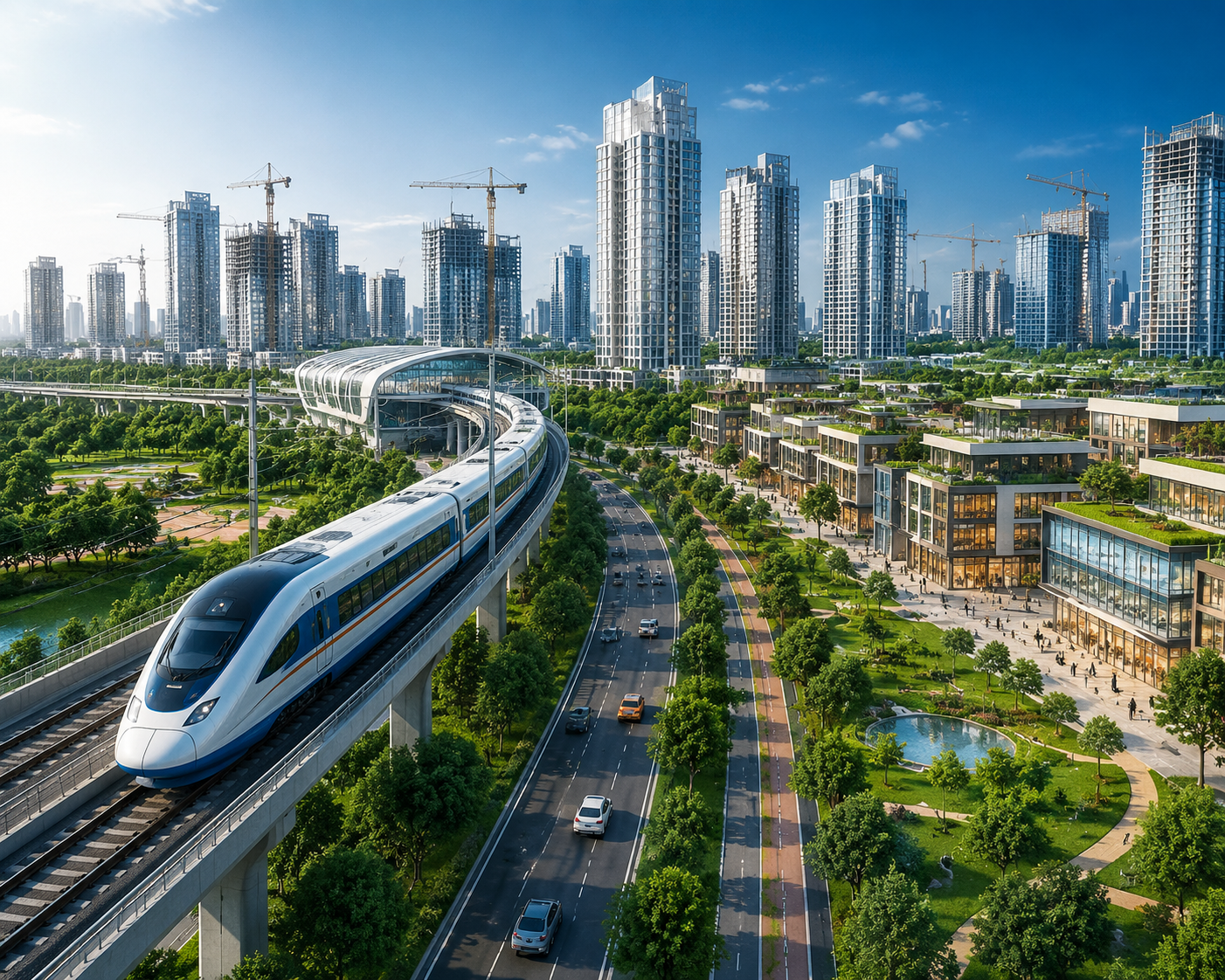
Regional Plan 2041 Envisions Four Transit-Oriented Smart Cities Around Namo Bharat Corridors; ₹5,000-Crore Push Expected to Unlock New Investment and Housing Opportunities
The Central Government has unveiled an ambitious blueprint to develop four new "Namo Cities" across the National Capital Region (NCR), a move that could transform India's largest urban cluster and create the next generation of real estate and economic growth hubs.
The project, proposed under the Regional Plan 2041, aims to build semi-greenfield, transit-oriented cities around the Namo Bharat Regional Rapid Transit System (RRTS). Unlike traditional satellite cities that expanded around highways, the new urban centres will be designed around high-speed rail connectivity, creating integrated residential, commercial and business districts that promote sustainable urban living.
Backed by a ₹5,000-crore incentive package, the initiative is expected to stimulate infrastructure development, attract private investment, improve regional connectivity and ease development pressure on Delhi, Gurugram and Noida.
Industry experts believe that if implemented efficiently, Namo Cities could emerge as the NCR's next major real estate hotspots over the coming decade.
A New Chapter in NCR's Urban Development
The Regional Plan 2041 represents a shift in the government's approach towards urban planning.
Rather than allowing economic activity to remain concentrated in Delhi and its established satellite cities, policymakers aim to create multiple self-sustaining urban centres connected through world-class transport infrastructure.
The objective is to:
-
Reduce congestion in Delhi.
-
Distribute employment across multiple cities.
-
Improve housing affordability.
-
Promote balanced regional development.
-
Encourage sustainable urbanisation.
The strategy reflects global urban planning trends where metropolitan regions increasingly rely on interconnected growth centres rather than a single dominant city.
What Exactly Are Namo Cities?
Namo Cities are proposed mixed-use, transit-oriented urban centres that will be developed around existing and future Namo Bharat RRTS stations.
Unlike conventional townships, these cities are being planned from the ground up with public transport as the central element.
Each city is expected to include:
-
Residential neighbourhoods.
-
Commercial office districts.
-
Retail and entertainment hubs.
-
Educational institutions.
-
Healthcare facilities.
-
Parks and recreational spaces.
-
Business parks.
-
Integrated public transport.
Residents would be able to access most essential services within walking or cycling distance of rapid transit stations, reducing dependence on private vehicles and lowering urban congestion.
Why Is the Government Launching Namo Cities?
The NCR is projected to witness a substantial increase in population over the next 15 years.
Existing urban centres such as Delhi, Gurugram and Noida already face challenges including:
-
Rising property prices.
-
Traffic congestion.
-
Infrastructure strain.
-
Environmental stress.
-
Limited availability of developable land.
To accommodate future growth, the government plans to adopt a polycentric development model, where several interconnected cities share residential, commercial and industrial growth instead of concentrating economic activity in a few locations.
Officials believe this approach will create a more balanced and sustainable metropolitan region.
Where Will the Four Namo Cities Be Located?
The proposal envisages:
-
One city in Delhi.
-
One city in Haryana.
-
One city in Uttar Pradesh.
-
One city in Rajasthan.
The exact locations are yet to be announced.
Instead of allocating projects directly, the Centre has invited participating states to submit proposals. Final selection will be made through a challenge-based competitive process, encouraging innovation in urban planning and infrastructure development.
₹5,000 Crore Incentive Package
To encourage implementation, the Central Government has announced a ₹5,000-crore performance-linked incentive programme.
The package may include:
-
Infrastructure grants.
-
Development loans.
-
Credit guarantees.
-
Financial support for transit-oriented projects.
-
Incentives linked to project performance.
The funding is expected to accelerate construction while encouraging state governments to adopt internationally recognised urban planning standards.
Namo Bharat RRTS: The Foundation of the Project
The proposed cities are closely linked to the expansion of the Namo Bharat Regional Rapid Transit System, India's first regional high-speed rail network.
The RRTS is designed to:
-
Reduce travel time across NCR.
-
Improve connectivity between major economic centres.
-
Encourage sustainable commuting.
-
Support large-scale urban expansion.
Officials describe the rail network as more than a transportation project—it is intended to become an engine of economic development capable of creating entirely new investment corridors.
How Are Namo Cities Different from Gurugram and Noida?
While Gurugram and Noida developed largely because of highways, expressways and proximity to Delhi, Namo Cities are being planned using a modern Transit-Oriented Development (TOD) model.
Key differences include:
| Traditional Satellite Cities | Namo Cities |
|---|---|
| Road-centric development | Rail-centric development |
| Expansion after infrastructure | Infrastructure planned before development |
| Mixed planning over time | Integrated master planning |
| Heavy dependence on private vehicles | Public transport-focused mobility |
| Longer commuting distances | Walkable mixed-use neighbourhoods |
Urban planners believe this approach can significantly reduce congestion while improving overall quality of life.
Potential Impact on NCR Real Estate
Perhaps the biggest beneficiary of the initiative could be the real estate sector.
Infrastructure projects have historically been one of the strongest drivers of property appreciation in India.
Recent experience along the Delhi-Ghaziabad-Meerut Namo Bharat corridor provides encouraging evidence.
According to industry estimates:
-
Residential prices within approximately 2 kilometres of operational RRTS stations have appreciated by 30% to 67% during the past two years.
-
Housing demand has increased significantly in Ghaziabad, Muradnagar, Modinagar and Meerut.
Developers expect similar appreciation patterns if the new Namo Cities are executed successfully.
₹20 Lakh Crore Investment Opportunity
According to estimates by Knight Frank India, the Regional Plan 2041 has the potential to attract nearly ₹20 lakh crore in investments.
The plan could also:
-
Accommodate around three crore additional residents.
-
Develop multiple new urban centres.
-
Create significant employment opportunities.
-
Expand commercial real estate.
-
Strengthen industrial and logistics infrastructure.
-
Support long-term regional economic growth.
Improved connectivity is expected to unlock large parcels of currently underutilised land across the NCR.
Developers See Emerging Growth Corridors
Leading developers believe infrastructure-led development will drive the next phase of NCR's expansion.
Industry participants expect improved connectivity to encourage:
-
Residential township development.
-
Commercial office projects.
-
Warehousing and logistics parks.
-
Retail destinations.
-
Educational campuses.
-
Healthcare infrastructure.
Some developers believe the Delhi–Gurugram–SNB corridor could evolve into the NCR's next major growth axis, while Sonipat, Meerut and other Tier-II locations could also witness increased investor interest.
No Change in NCR Boundaries
Despite the ambitious development plan, the NCR Planning Board has clarified that the geographical boundaries of the National Capital Region will remain unchanged.
Instead of expanding the NCR, the focus will remain on improving connectivity, planning and infrastructure within the existing region.
This ensures that future growth is driven by better urban planning rather than geographical expansion.
Execution Will Determine Success
Although the proposal has generated considerable optimism, successful implementation will depend on several critical factors.
These include:
-
Timely completion of the Namo Bharat network.
-
Coordination between the Centre and state governments.
-
Efficient land acquisition.
-
Adequate financing.
-
Employment generation.
-
Availability of civic infrastructure.
-
Private sector participation.
Urban planners note that previous regional development plans have often faced delays, making project execution the biggest challenge.
What It Means for Homebuyers and Investors
For prospective homebuyers, the initiative could create access to:
-
Better-planned urban communities.
-
Modern infrastructure.
-
Improved public transport.
-
More affordable housing options.
-
Shorter commuting times.
For investors, the project offers long-term opportunities in:
-
Residential real estate.
-
Commercial properties.
-
Land development.
-
Infrastructure companies.
-
Construction materials.
-
Logistics.
-
Urban utilities.
However, experts recommend waiting for final project locations before making investment decisions.