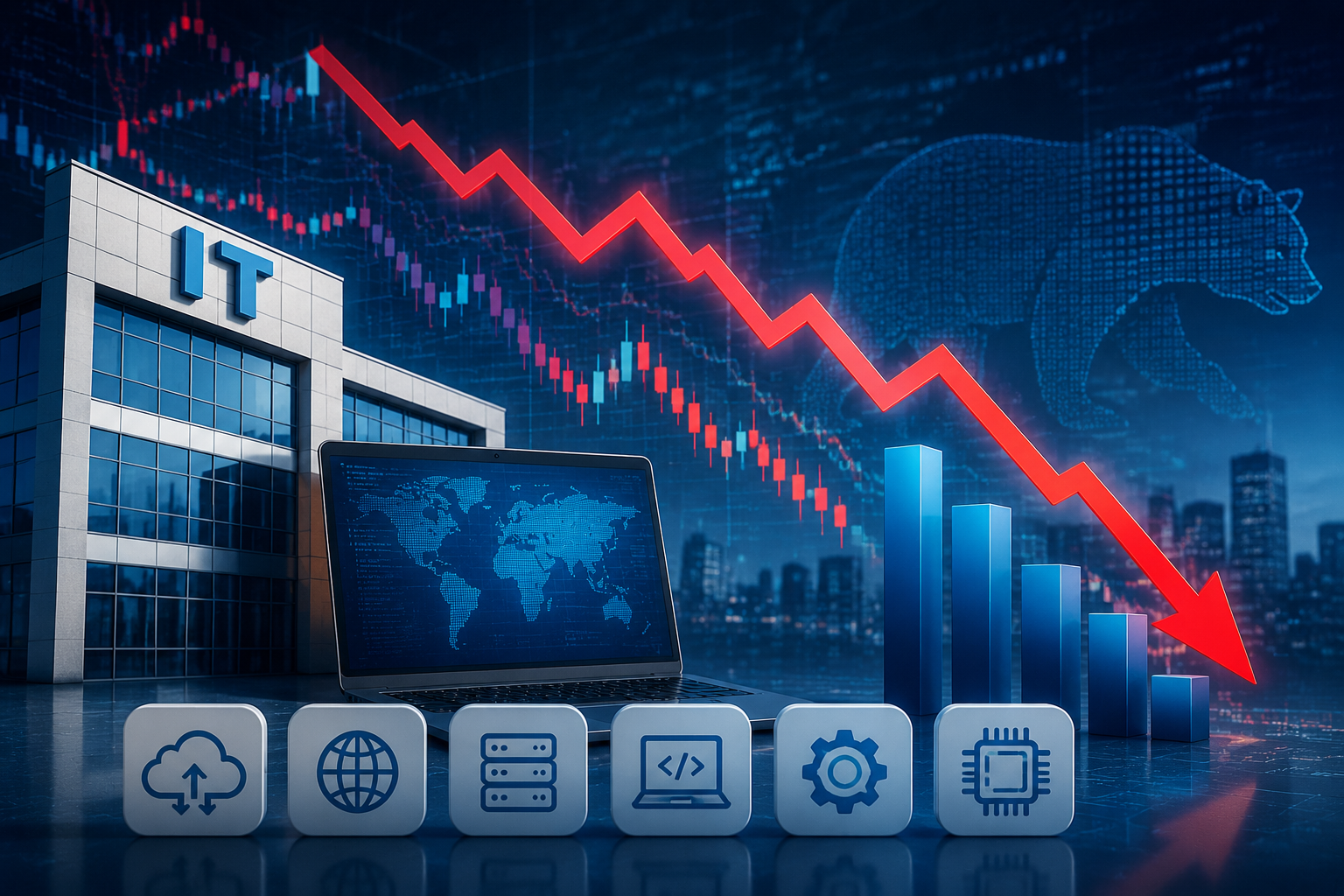
Sector Down 42% from Peak Amid Weak Global Tech Spending, Pricing Pressure and Delayed Recovery Outlook; Analysts Advise Patience
India's information technology sector continued to witness intense selling pressure on Tuesday, with the Nifty IT Index falling more than 2% to its lowest level in nearly three years. The sharp decline was led by heavyweight companies Tata Consultancy Services (TCS), Infosys, HCLTech, and LTIMindtree, all of which slipped to fresh 52-week lows as investors remained concerned about slowing global demand, pricing pressure, and muted earnings visibility.
The latest decline marks the third consecutive session of losses for the sector and extends one of the deepest corrections witnessed by Indian IT stocks in recent years. Despite attractive valuations following the sharp correction, market participants remain cautious as the industry continues to grapple with an uncertain business environment.
Nifty IT Extends Correction to 42% from Record High
The Nifty IT Index declined to an intraday low of 26,425.85, its weakest level since April 2023.
The correction has been severe:
-
Nearly 42% below its all-time high of 46,089, recorded in December 2024.
-
Down approximately 30% since the beginning of 2026.
-
Significantly underperforming the broader Nifty 50, which has declined around 6.5% during the same period.
The sustained weakness has erased a substantial portion of the sector's gains made during the post-pandemic technology boom.
Heavyweights Continue to Lead the Decline
Selling pressure remained broad-based across large-cap technology companies.
Among the major losers:
-
Tata Consultancy Services (TCS) fell over 2%, touching a fresh 52-week low.
-
Infosys also declined more than 2%, slipping to its lowest level in one year.
-
HCLTech dropped to a new annual low.
-
LTIMindtree witnessed heavy selling and touched fresh 52-week lows.
Other frontline IT companies including Wipro, Tech Mahindra, and Mphasis also traded lower, indicating that weakness is affecting the entire sector rather than isolated companies.
The broad-based decline reflects growing investor concerns about future earnings rather than company-specific developments.
Global Demand Remains the Biggest Concern
The primary challenge facing India's IT industry continues to be weak demand from global clients.
Many multinational companies have adopted a cautious approach towards technology spending due to:
-
Economic uncertainty in major markets.
-
Elevated interest rates.
-
Pressure on corporate profitability.
-
Delayed decision-making for large digital transformation projects.
-
Lower discretionary technology budgets.
Since North America and Europe contribute a significant share of revenue for Indian IT companies, any slowdown in these markets directly affects order inflows and earnings growth.
Pricing Pressure Continues to Hurt Profitability
Apart from slower demand, IT companies continue to face pricing pressure across several service segments.
Industry experts note that clients are increasingly negotiating:
-
Lower billing rates.
-
Smaller deal sizes.
-
Longer contract approval cycles.
-
Higher productivity expectations.
This has created a deflationary environment where revenue growth remains subdued despite companies continuing to secure new contracts.
The ongoing pricing pressure is expected to remain one of the industry's biggest challenges over the next few years.
Recovery Timeline Remains Uncertain
Market experts believe the sector is unlikely to witness a meaningful turnaround in the near future.
While artificial intelligence, cloud migration, and digital transformation continue to generate opportunities, these segments have not yet been sufficient to offset weakness in traditional outsourcing services.
Several analysts expect:
-
Slow revenue growth.
-
Moderate earnings expansion.
-
Continued margin pressure.
-
Limited improvement in client spending over the next 18 to 24 months.
The timing of a full recovery will largely depend on improvements in the global economic environment and corporate technology budgets.
Valuations Becoming Increasingly Attractive
The prolonged correction has significantly reduced valuations across the IT sector.
Many frontline companies are now trading at price-to-earnings multiples considerably below their historical averages.
While attractive valuations have started drawing the attention of long-term investors, analysts caution that cheap valuations alone are unlikely to trigger a sustained rally unless earnings expectations begin to improve.
Historically, the market has rewarded IT stocks only after clear signs of revenue acceleration and margin recovery.
Technical Structure Remains Weak
Technical indicators continue to signal a bearish trend.
The Nifty IT Index remains below all major moving averages across daily and weekly charts, suggesting that selling pressure continues to dominate.
Momentum indicators also remain weak, indicating that investors are still reluctant to build fresh positions in the sector.
Although occasional short-covering rallies may occur, analysts believe they are likely to remain temporary until the broader trend improves.
Critical Support Zone Under Watch
Technical analysts have identified the 26,200–26,100 range as a crucial long-term support area.
Historically, the index has rebounded several times from this zone between June 2022 and April 2023, making it an important level for investors.
If the index manages to hold above this support, it could witness short-term recovery attempts.
However, a decisive break below this range could trigger another round of heavy selling and open the possibility of testing even lower levels.
Resistance Remains Around 28,000
Any meaningful recovery will require the index to reclaim the 27,950–28,000 range.
This zone coincides with the 20-day Exponential Moving Average (EMA) and represents a key technical resistance.
Until the index sustains above this level, analysts believe every recovery rally is likely to attract fresh selling pressure.
Artificial Intelligence Remains a Long-Term Opportunity
Despite current challenges, India's IT industry continues to invest aggressively in emerging technologies.
Companies are expanding capabilities in:
-
Artificial Intelligence (AI).
-
Generative AI solutions.
-
Cloud computing.
-
Cybersecurity.
-
Data analytics.
-
Automation.
-
Digital engineering.
These technologies are expected to become important growth drivers over the coming decade.
However, analysts believe monetisation of AI-led opportunities will take time and may not immediately offset weakness in traditional IT services.
Global Macroeconomic Factors Will Drive the Next Phase
Going forward, the sector's recovery will depend largely on global economic developments.
Key variables include:
-
US interest rate trajectory.
-
Corporate technology budgets.
-
Banking sector spending.
-
Global recession risks.
-
Currency movements.
-
Enterprise digital transformation investments.
Improvement in any of these factors could revive demand for Indian IT services.
Investment Strategy
Given the current environment, analysts recommend a measured investment approach.
Short-Term Traders
-
Avoid aggressive buying until technical indicators improve.
-
Watch the 26,200 support zone closely.
-
Use rallies to rebalance portfolios if required.
Long-Term Investors
-
Focus on fundamentally strong companies with diversified global client bases.
-
Accumulate gradually through staggered investments.
-
Avoid attempting to time the exact market bottom.
Companies with robust balance sheets, healthy cash generation and leadership in AI and digital transformation are expected to be better positioned when the sector eventually recovers.