Capital's Aggressive Electric Mobility Roadmap Raises Concerns for ICE Vehicle Makers but Creates Long-Term Growth Opportunities for EV Companies and Component Suppliers
Shares of automobile companies came under significant selling pressure on Tuesday after the Delhi Government approved its Electric Vehicle (EV) Policy 2.0, one of the country's most ambitious clean mobility initiatives. The policy, which comes into effect from July 1, 2026, outlines a phased transition away from internal combustion engine (ICE) vehicles, prompting investors to reassess the long-term growth prospects of traditional automobile manufacturers.
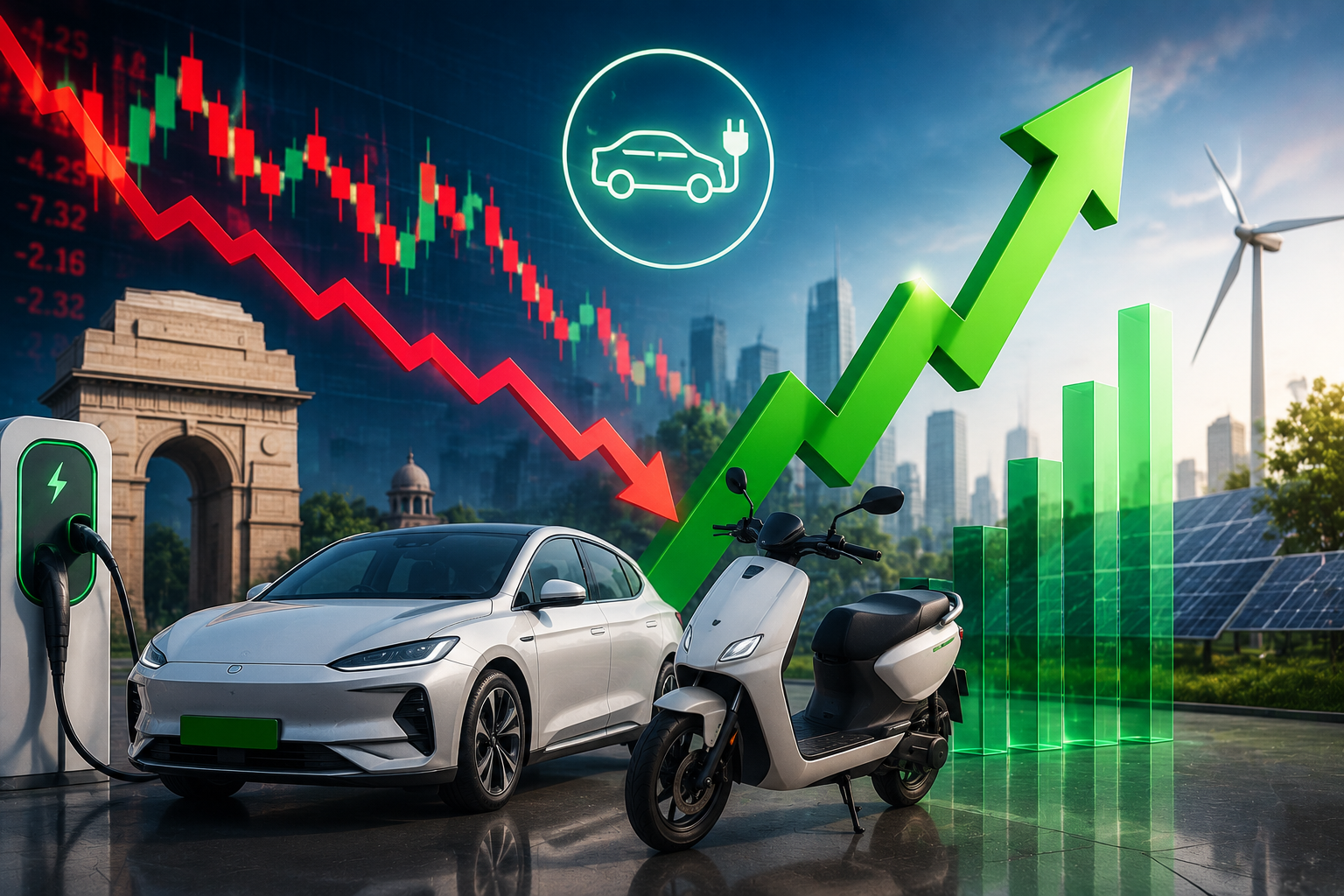
The announcement led to a sharp decline in several auto stocks, with Eicher Motors emerging as the biggest loser. In contrast, electric vehicle manufacturer Ather Energy hit a fresh all-time high, reflecting investor confidence in companies positioned to benefit from India's accelerating EV transition.
The contrasting market reaction underscores the structural transformation underway in India's automobile industry as government policies increasingly favour electric mobility.
Auto Stocks Witness Broad-Based Selling
The Nifty Auto Index declined around 1.2% during morning trade, significantly underperforming the benchmark indices. The sector has now lost more than 3% over the last two trading sessions, indicating growing concerns about the long-term impact of stricter electrification policies.
Among major listed companies:
-
Eicher Motors fell as much as 7%, becoming the biggest loser in the sector.
-
Bharat Forge declined nearly 5%.
-
Hero MotoCorp, Bajaj Auto, Uno Minda, Sona BLW Precision Forgings, and Samvardhana Motherson International slipped between 1% and 3%.
The decline reflects investor concerns that traditional two-wheeler manufacturers may face increasing pressure if similar policies are adopted across other Indian states.
Ather Energy Continues to Outperform
While conventional automobile stocks declined, Ather Energy continued its strong upward momentum.
The electric two-wheeler manufacturer surged around 4% to touch a new lifetime high of ₹1,125 during intraday trading.
The stock has gained nearly 49% in calendar year 2026, dramatically outperforming the broader market.
Investors believe companies focused exclusively on electric mobility stand to benefit the most from government incentives, rising consumer awareness, and expanding charging infrastructure.
What Is Delhi EV Policy 2.0?
Delhi's new EV Policy 2.0 is designed to accelerate the adoption of electric vehicles while reducing pollution and dependence on fossil fuels.
The policy will remain effective from July 1, 2026, until March 31, 2030, and introduces several landmark measures aimed at transforming urban transportation.
Its primary objectives include:
-
Increasing EV penetration across all vehicle categories.
-
Expanding public charging infrastructure.
-
Reducing vehicular emissions.
-
Encouraging vehicle scrappage.
-
Promoting clean mobility through financial incentives.
The Delhi Government has allocated approximately ₹15,000 crore over the next four years to implement the policy.
Major Policy Announcements
The policy introduces a phased roadmap for transitioning to electric mobility.
Mandatory Electric Auto-Rickshaws
From January 1, 2027, only electric auto-rickshaws will be eligible for fresh registration in Delhi.
Electric Two-Wheelers Become Mandatory
Beginning April 1, 2028, new registrations of petrol-powered two-wheelers will no longer be permitted, making electric two-wheelers the default option.
Vehicle Scrappage Incentives
Owners scrapping eligible BS-IV vehicles can receive incentives of up to ₹1 lakh, encouraging faster replacement with cleaner vehicles.
Purchase Subsidies
The policy offers attractive incentives for buyers of electric:
-
Two-wheelers.
-
Three-wheelers.
-
Commercial fleet vehicles.
The incentives will gradually taper over the policy period as EV adoption increases.
Hybrid Vehicles Left Out
One notable aspect of the policy is the exclusion of hybrid vehicles from incentive schemes.
Unlike previous expectations that hybrids might receive transitional support, Delhi has chosen to focus exclusively on battery electric vehicles (BEVs).
This sends a clear signal that future policy support will prioritize zero-emission mobility rather than intermediate technologies.
Why Eicher Motors Was the Biggest Loser
Among listed automobile companies, Eicher Motors experienced the sharpest decline.
The company is considered relatively more vulnerable because:
-
Royal Enfield has a meaningful presence in Delhi's premium motorcycle market.
-
The company's electric motorcycle portfolio remains in its early stages.
-
Premium motorcycle buyers may gradually shift toward electric alternatives as technology improves.
-
Future fuel-efficiency and emission norms may increase compliance costs.
Although Royal Enfield has announced plans to enter the electric motorcycle segment, investors remain cautious until commercial launches gain traction.
Traditional Two-Wheeler Makers Face Transition Pressure
Manufacturers with significant exposure to petrol-powered motorcycles and scooters could face long-term challenges if EV adoption accelerates.
Companies including:
-
Hero MotoCorp.
-
Bajaj Auto.
-
TVS Motor.
have already launched electric models, but conventional vehicles still account for the majority of their revenue.
The policy is expected to accelerate investment in:
-
Electric vehicle platforms.
-
Battery technology.
-
Charging solutions.
-
Manufacturing capacity.
While this transition creates long-term opportunities, it also requires substantial capital expenditure.
EV Ecosystem Emerges as Key Beneficiary
The policy is expected to benefit the broader EV ecosystem beyond vehicle manufacturers.
Potential beneficiaries include companies involved in:
-
Electric drivetrains.
-
Battery systems.
-
Charging infrastructure.
-
Power electronics.
-
EV software.
-
Lightweight automotive components.
Component manufacturers such as Sona BLW Precision Forgings, Samvardhana Motherson International, and Uno Minda are expected to benefit from increasing electrification despite Tuesday's temporary weakness in their share prices.
Brokerages See Structural Positive
ICICI Securities
According to ICICI Securities, Delhi's policy represents one of India's most comprehensive EV initiatives.
The brokerage believes:
-
Mandatory electrification creates a significant replacement cycle.
-
Purchase incentives should improve mass-market EV adoption.
-
Companies such as Tata Motors, Mahindra & Mahindra, Ather Energy, and electric three-wheeler manufacturers could benefit over the long term.
The brokerage also noted that Delhi accounts for only around 2.7% of India's total two-wheeler registrations, suggesting the immediate financial impact on manufacturers may remain manageable.
Nomura's View
Global brokerage Nomura described the policy as a strong endorsement of India's long-term EV transition.
According to Nomura:
-
EV penetration is reaching a structural inflection point.
-
Charging infrastructure investment is a major positive.
-
The policy could become a template for larger states.
If similar frameworks are introduced nationwide, India's EV adoption could accelerate significantly over the next decade.
Could Other States Follow?
Perhaps the biggest concern for investors is the possibility that Delhi's policy could influence other state governments.
States such as:
-
Maharashtra.
-
Karnataka.
-
Gujarat.
-
Tamil Nadu.
-
Uttar Pradesh.
may eventually introduce similar measures to meet climate and pollution goals.
If that happens, the impact on India's automobile industry would become far more significant than Delhi's relatively modest contribution to national vehicle sales.
Industry Challenges Remain
Despite strong policy support, the transition to electric mobility still faces several challenges.
These include:
-
Availability of affordable EVs.
-
Charging infrastructure expansion.
-
Battery supply chain security.
-
Raw material availability.
-
Consumer awareness.
-
Manufacturing capacity.
-
Skilled workforce development.
Successful implementation will require coordinated efforts from government, manufacturers, utilities, and infrastructure providers.
Long-Term Outlook for the Auto Sector
The automobile industry is entering a period of structural transformation.
Traditional manufacturers are expected to increase investments in:
-
Electric motorcycles.
-
Electric scooters.
-
Electric commercial vehicles.
-
Battery technology.
-
Software-defined vehicles.
Companies capable of balancing their conventional business while successfully scaling EV operations are likely to emerge as long-term winners.