Investors Brace for a Busy Week as Key Economic Indicators and Strategic Diplomatic Developments Take Centre Stage
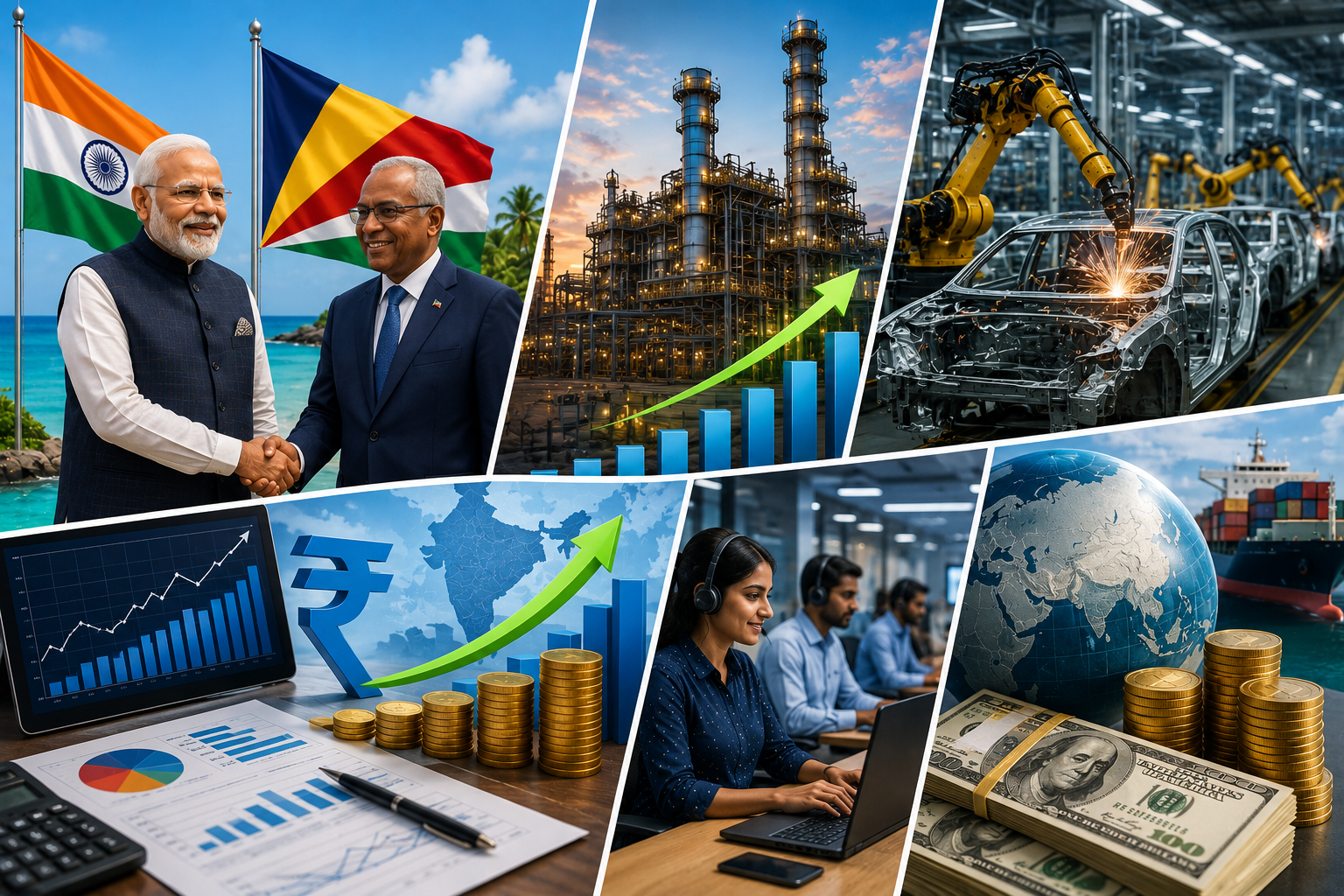
The week ahead promises to be an important one for investors, policymakers and businesses as India prepares for a series of crucial economic data releases alongside significant diplomatic engagements. From Prime Minister Narendra Modi's strategic visit to Seychelles to the release of Industrial Production (IIP) figures, HSBC Manufacturing and Services PMI data, and the latest foreign exchange reserves, the coming days will provide valuable insights into the strength of India's economy and its growing role on the global stage.
These developments are expected to influence market sentiment, provide direction for sectoral performance, and offer clues about the country's economic momentum heading into the second quarter of FY27.
PM Modi's Seychelles Visit Reinforces India's Indo-Pacific Strategy
Prime Minister Narendra Modi is on a three-day official visit to Seychelles from June 27 to June 29, marking another significant step in India's efforts to deepen strategic partnerships in the Indian Ocean Region.
The visit focuses on strengthening bilateral cooperation in areas ranging from maritime security and climate resilience to sustainable development and economic collaboration.
During the visit, Prime Minister Modi was honoured with the prestigious "Guardian of the Blue Horizon" award, recognising India's contribution towards environmental protection, ocean sustainability and its continued support for Small Island Developing States (SIDS).
The recognition also reflects India's increasing leadership role in addressing global environmental challenges while advocating for the interests of developing nations.
Strengthening India's Global South Leadership
Beyond bilateral cooperation, the Seychelles visit carries broader geopolitical significance.
India has consistently positioned itself as a leading voice for the Global South, advocating greater representation for developing economies in international institutions.
Key objectives of the visit include:
- Enhancing maritime cooperation.
- Expanding defence and security partnerships.
- Promoting the Blue Economy.
- Supporting renewable energy initiatives.
- Strengthening digital connectivity.
- Encouraging sustainable infrastructure development.
The visit also aligns with India's SAGAR (Security and Growth for All in the Region) doctrine, which seeks to promote peace, security and economic prosperity across the Indian Ocean.
Industrial Production Data to Reveal Economic Strength
Domestic attention will now shift towards the release of India's Industrial Production (IIP) data on June 29.
The Index of Industrial Production serves as one of the most important high-frequency indicators measuring activity across manufacturing, mining and electricity sectors.
Recent Industrial Growth
| Month | Industrial Growth |
|---|---|
| March (Revised) | 3.2% |
| April | 4.9% |
The acceleration in April reflected stronger industrial activity supported by improving manufacturing output and resilient domestic demand.
The upcoming figures will indicate whether this momentum has been sustained.
Manufacturing Continues to Lead Growth
Manufacturing remains the largest contributor to India's industrial economy.
Under the revised 2022–23 base year methodology:
- Manufacturing output expanded 6.2% in April.
- The sector now carries a 76.1% weight within the IIP basket.
The revised methodology provides:
- Better sector representation.
- Updated industrial weights.
- Improved coverage of emerging industries.
- A more accurate reflection of India's evolving economic structure.
A healthy manufacturing reading would reinforce expectations of sustained economic expansion.
Manufacturing PMI to Provide Early Business Confidence Indicator
On July 1, markets will closely watch the release of the HSBC India Manufacturing Purchasing Managers' Index (PMI).
Unlike industrial production, which reflects historical performance, PMI offers a forward-looking assessment of business conditions.
Recent Manufacturing PMI
| Month | PMI Reading |
| April | 54.7 |
| May | 55.0 |
The May reading represented the strongest expansion in three months.
Manufacturers reported:
- Higher domestic demand.
- Increased production.
- Stronger new orders.
- Stable hiring intentions.
Although export orders moderated slightly, domestic demand remained sufficiently robust to sustain growth.
Why Manufacturing PMI Matters
PMI is among the most closely tracked leading economic indicators.
A reading:
- Above 50 indicates expansion.
- Below 50 signals contraction.
Strong PMI numbers generally point towards:
- Higher factory output.
- Improved corporate earnings.
- Increased employment.
- Better investment activity.
- Stronger GDP growth.
Consequently, markets often react sharply to PMI surprises.
Services PMI to Measure India's Largest Economic Engine
India's services sector will also come under the spotlight when the HSBC Services PMI is released on July 3.
The services industry contributes more than 55% of India's Gross Domestic Product (GDP) and remains the country's primary growth engine.
Major industries covered include:
- Banking & Financial Services
- Information Technology
- Hospitality
- Healthcare
- Logistics
- Telecommunications
- Professional Services
Recent Services PMI
| Month | PMI Reading |
| April | 58.8 |
| May | 59.8 |
The May reading reached a six-month high, highlighting continued strength across the services economy.
Businesses reported:
- Strong customer demand.
- Healthy order inflows.
- Increased business activity.
- Expansion in client acquisition.
Domestic demand remained the primary driver of growth, while export demand remained relatively moderate.
Forex Reserves Continue to Demonstrate External Strength
Another closely watched release this week will be India's latest foreign exchange reserves data on July 3.
According to the Reserve Bank of India:
| Indicator | Latest Level |
| Forex Reserves | US$672.587 Billion |
| Weekly Increase | US$963 Million |
Although foreign currency assets declined marginally, higher gold reserves helped lift the country's overall reserve position.
Strong forex reserves provide several macroeconomic advantages:
- Stability for the Indian Rupee.
- Protection against external financial shocks.
- Greater import financing capacity.
- Enhanced investor confidence.
- Stronger sovereign financial position.
What Markets Will Be Watching
Investors will closely analyse this week's releases for signs of continued economic resilience.
Key Indicators
Industrial Production
- Manufacturing activity
- Infrastructure demand
- Capacity utilisation
Manufacturing PMI
- Business confidence
- Factory orders
- Production outlook
Services PMI
- Consumer demand
- Employment trends
- Corporate activity
Forex Reserves
- External sector stability
- Currency resilience
- Capital flow dynamics
Together, these indicators provide one of the most comprehensive snapshots of India's economic health.
Potential Market Impact
If the upcoming data remains strong, sectors likely to benefit include:
- Banking
- Capital Goods
- Industrials
- Infrastructure
- Manufacturing
- Automobiles
- Cement
- Engineering
A combination of improving industrial activity, resilient services growth and healthy external reserves could further strengthen investor confidence in India's long-term growth story.
Conversely, weaker-than-expected data may prompt markets to reassess earnings expectations and growth projections.
Economic Calendar
| Date | Event |
| June 27–29 | Prime Minister Narendra Modi's Seychelles Visit |
| June 29 | Industrial Production (IIP) Data |
| July 1 | HSBC Manufacturing PMI |
| July 3 | HSBC Services PMI |
| July 3 | RBI Foreign Exchange Reserves |
Why This Week Matters
The coming week combines macroeconomic data with strategic diplomatic developments, making it particularly significant for financial markets.
Strong industrial output and PMI readings would reinforce the view that India's economy continues to outperform many global peers despite external uncertainties. At the same time, Prime Minister Modi's Seychelles visit strengthens India's geopolitical influence in the Indian Ocean and supports the country's long-term strategic and economic interests.
Together, these developments are expected to provide investors with greater clarity on both India's domestic economic momentum and its expanding global role.