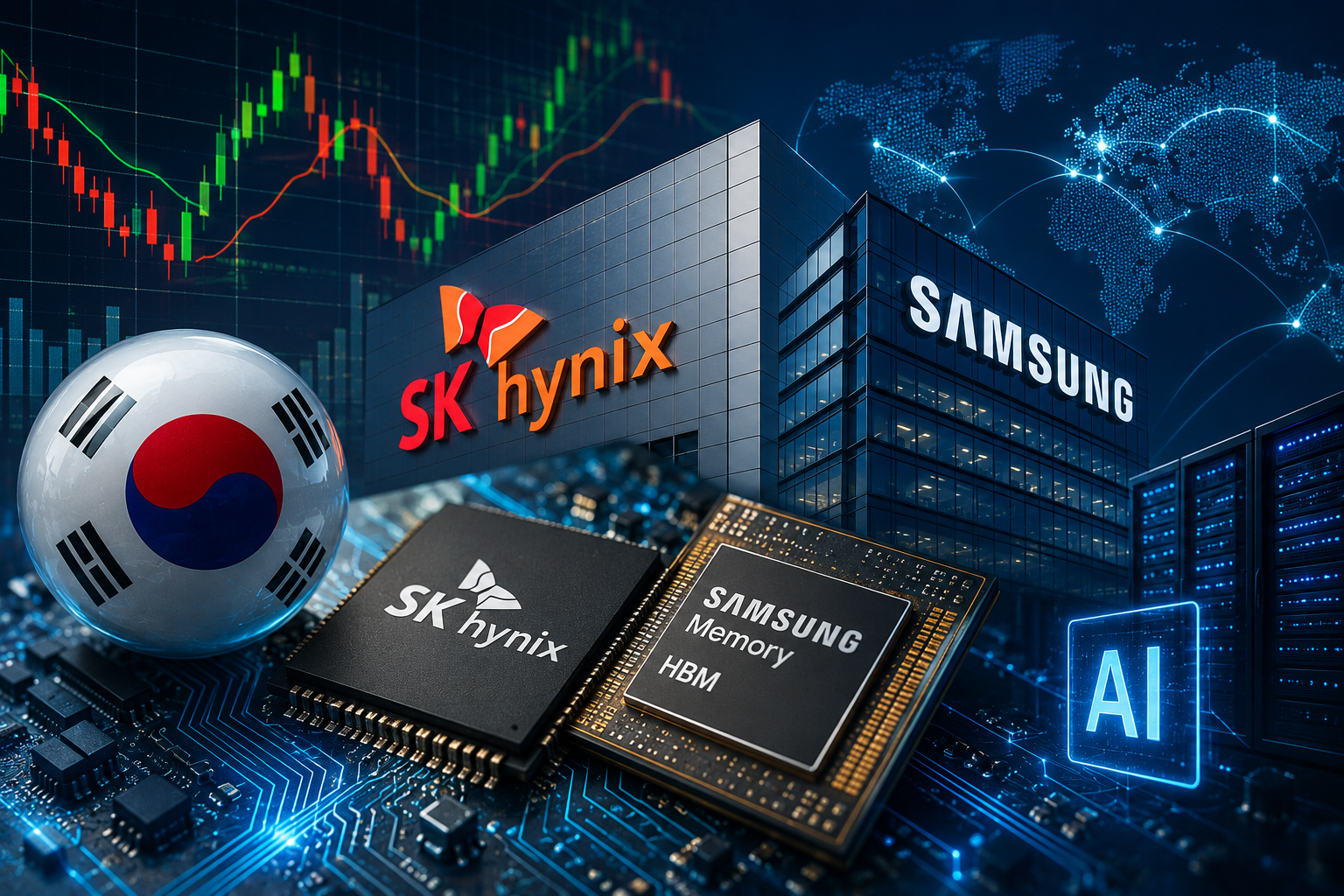
Semiconductor Stocks Under Pressure, But Jefferies Sees Memory Chip Makers as the Biggest Winners of the Global AI Revolution
At a time when global investors are trimming exposure to artificial intelligence (AI) and semiconductor stocks amid concerns over stretched valuations, Christopher Wood, Global Head of Equity Strategy at Jefferies, has adopted a contrarian stance by increasing his investments in SK Hynix and Samsung Electronics.
Wood believes that while many AI-related technology stocks have become expensive, leading memory semiconductor manufacturers remain attractively valued and are among the strongest long-term beneficiaries of the global AI infrastructure boom.
His latest portfolio reshuffle comes even as South Korea's semiconductor sector witnessed one of its sharpest corrections in recent months, creating what he believes is an attractive entry point for long-term investors.
South Korea's Semiconductor Stocks Witness Sharp Correction
The South Korean equity market has come under intense selling pressure over the past week as investors booked profits in technology stocks following a strong rally.
The benchmark KOSPI Index experienced a steep decline, with semiconductor giants leading the correction.
Recent Market Performance
| Company | Five-Day Performance |
|---|---|
| SK Hynix | ▼ Around 12% |
| Samsung Electronics | ▼ Around 9% |
| KOSPI Index | Sharp Correction |
The sell-off became severe enough to trigger multiple 20-minute trading halts, reflecting heightened market volatility and aggressive selling by leveraged investors.
Market participants cited several factors behind the correction:
-
Rich technology valuations.
-
Rising production costs.
-
Margin concerns.
-
Slower consumer electronics demand.
-
Elevated retail participation and leverage.
Despite the weakness, Wood argues that the market has become overly pessimistic.
Why Chris Wood Is Buying Semiconductor Stocks Now
Unlike many investors who are reducing exposure to AI-related stocks, Wood believes the correction has created an attractive long-term buying opportunity.
His investment thesis is based on one simple idea:
The companies supplying the critical hardware required for Artificial Intelligence may ultimately benefit more than many AI software companies.
Rather than focusing on hyperscale cloud providers facing rising capital expenditure and margin pressure, Wood prefers companies manufacturing the memory chips that power AI servers.
Memory Chips Are the Backbone of Artificial Intelligence
Modern AI systems require enormous computing power.
Every AI application—from generative AI and large language models (LLMs) to cloud computing and autonomous technologies—depends heavily on advanced semiconductor memory.
Demand is accelerating for:
-
High-Bandwidth Memory (HBM)
-
Dynamic Random Access Memory (DRAM)
-
NAND Flash Storage
-
AI Accelerator Memory Modules
These chips enable faster processing, higher bandwidth and efficient handling of massive AI datasets.
As AI infrastructure investments continue to rise globally, demand for memory solutions is expected to remain robust for years.
DRAM Industry Has Entered a New Era
Christopher Wood believes the global DRAM industry has undergone a structural transformation.
Historically, memory manufacturers were considered highly cyclical businesses and were valued mainly on Price-to-Book (P/B) multiples.
However, the rapid expansion of AI infrastructure has fundamentally altered industry dynamics.
According to Wood:
-
AI demand has created more predictable earnings.
-
Memory shortages could remain persistent.
-
Profitability has become structurally stronger.
-
Companies deserve valuation based on earnings rather than book value.
This marks an important shift in how investors should evaluate semiconductor companies.
Valuations Still Appear Attractive
Despite their exposure to the AI boom, Wood believes memory manufacturers continue to trade at attractive valuations compared to many global technology companies.
Forward Earnings Valuation
| Company | Forward P/E |
|---|---|
| Samsung Electronics | 6.8x |
| SK Hynix | 7.8x |
| Micron Technology | 9.2x |
Compared to several AI software companies trading at significantly higher earnings multiples, these valuations remain relatively inexpensive.
Wood argues that investors have yet to fully price in the long-term earnings potential of memory manufacturers.
Strong Free Cash Flow Could Unlock Shareholder Rewards
Another key pillar of Wood's investment thesis is the expected surge in free cash flow generation.
According to discussions referenced in his GREED & Fear newsletter, SK Hynix could generate nearly US$400 billion in free cash flow over the next two years.
If this materialises, the company could significantly enhance shareholder returns through:
-
Higher dividend payouts.
-
Special dividends.
-
Large-scale share buyback programmes.
-
Balance sheet strengthening.
Such capital allocation measures could become major catalysts for future stock performance.
Major Portfolio Reshuffle Reflects High Conviction
Wood has made meaningful changes across several of Jefferies' model portfolios.
Global Long-Only Portfolio
New Investments
-
SK Hynix (4% allocation)
-
Kioxia (4% allocation)
Removed
-
Alphabet
-
Alibaba
Samsung Electronics' allocation has also been increased by one percentage point.
International Long-Only Portfolio
For the international portfolio excluding US equities:
-
SK Hynix has been introduced with a 4% allocation.
-
Samsung Electronics' weight has been increased.
-
Alibaba has been removed.
Asia ex-Japan Portfolio
Wood has also exited PolicyBazaar and replaced it with SK Hynix, signalling greater confidence in semiconductor manufacturing than internet platform companies.
Changes in India Portfolio
Wood has simultaneously rebalanced his India-focused strategy.
Stock Removed
-
Ambuja Cements
Exposure Reduced
| Company | Allocation Cut |
|---|---|
| GMR Airports | 2% |
| JSW Energy | 1% |
| Adani Energy Solutions | 1% |
The portfolio adjustments indicate a stronger preference for AI infrastructure and semiconductor themes over traditional infrastructure and industrial plays.
Global AI Spending Continues to Accelerate
Technology giants across the world continue investing billions of dollars into AI infrastructure.
Massive spending on:
-
AI data centres
-
Cloud computing
-
Graphics Processing Units (GPUs)
-
AI servers
-
High-performance computing
is driving unprecedented demand for advanced semiconductor memory.
Unlike previous technology cycles, memory demand is increasingly linked to structural AI adoption rather than consumer electronics alone.
Key Risks Investors Should Monitor
While Wood remains optimistic, several risks remain.
Potential Challenges
-
Semiconductor industry cyclicality.
-
Geopolitical tensions affecting chip exports.
-
US-China technology restrictions.
-
Inventory corrections.
-
Slower global economic growth.
-
AI spending moderation.
Investors should balance the long-term growth story with the inherent volatility associated with semiconductor stocks.
Why This Matters for Indian Investors
Although SK Hynix and Samsung Electronics are listed overseas, their performance often influences sentiment toward the broader global semiconductor ecosystem.
Indian companies involved in:
-
Electronics manufacturing
-
Semiconductor packaging
-
AI infrastructure
-
Data centres
-
Advanced manufacturing
could also benefit as global investment in AI hardware continues to expand.
The trend reinforces the growing importance of semiconductor supply chains in global equity markets.