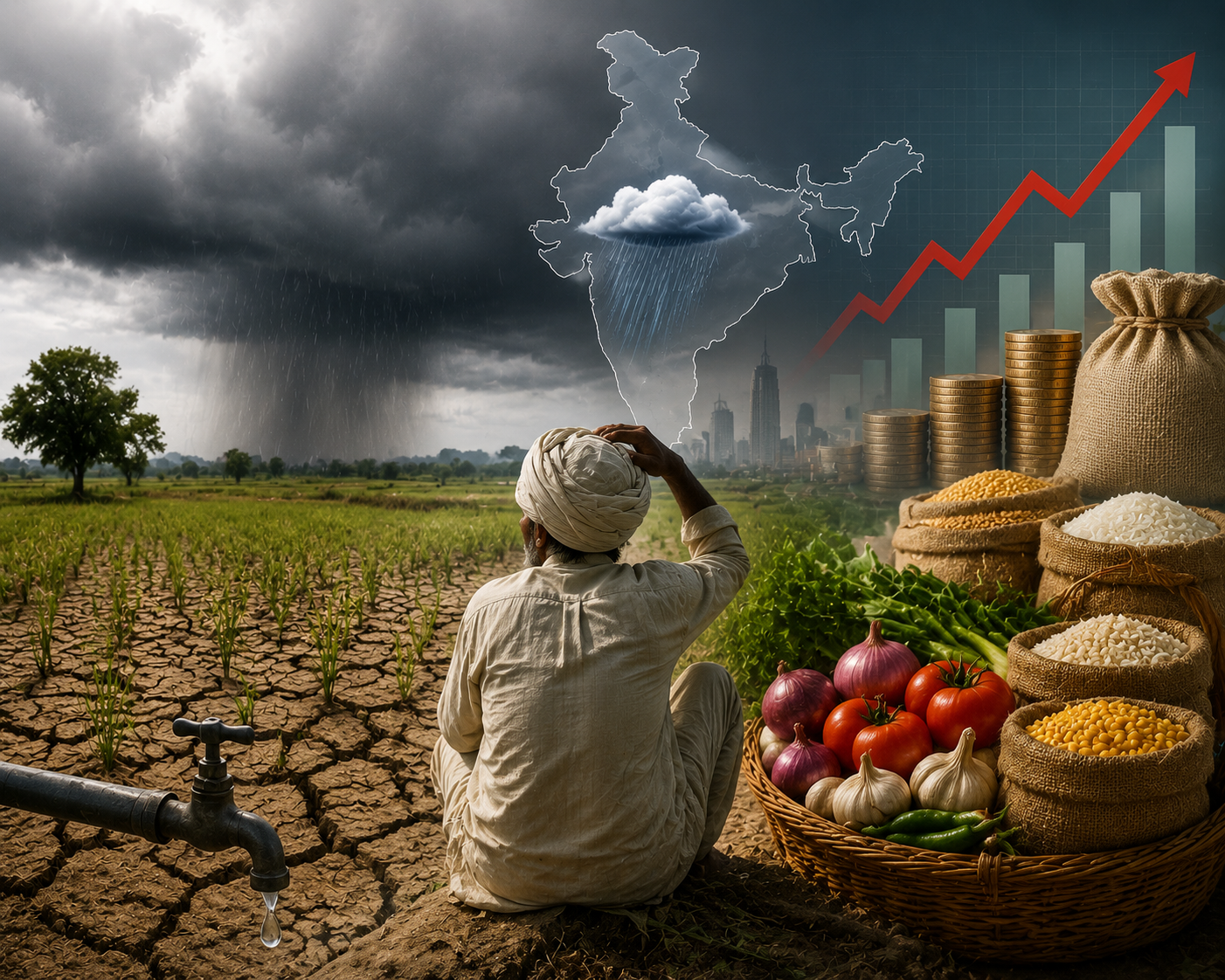
El Niño threat and uneven rainfall raise concerns for food prices and consumption recovery
A weakening monsoon pattern is emerging as a new macroeconomic headwind for India, with economists warning that deficient rainfall could reverse recent gains from easing crude oil prices and stable inflation trends. The southwest monsoon, which drives nearly 70% of India’s annual rainfall, is now under close watch amid concerns of uneven distribution and potential El Niño influence.
With agriculture forming a critical link in India’s consumption-driven economy, any sustained rainfall deficit could directly impact food inflation, rural income, and overall GDP momentum.
Monsoon Weakness Raises Inflation Risk
Food prices could see renewed pressure after recent stability
A below-normal monsoon typically leads to higher volatility in food prices, particularly in vegetables, pulses, and edible oils. Economists estimate that a significant rainfall shortfall can quickly translate into higher headline inflation due to India’s heavy dependence on monsoon-driven agriculture.
Early indicators suggest uneven rainfall distribution across key agricultural belts, increasing the risk of supply disruptions in the upcoming crop cycle. This comes at a time when inflation had been moderating and monetary conditions remained stable.
The Reserve Bank of India (Reserve Bank of India) has already indicated that it is closely monitoring weather patterns as part of its inflation assessment framework.
Rural Economy Showing Early Stress Signals
Weak monsoon impact first visible in agri-linked consumption trends
The first impact of a weak monsoon is usually reflected in rural economic activity rather than official GDP data. Market participants are already tracking early signals such as:
- Slower tractor and farm equipment demand
- Reduced fertiliser off-take
- Weak rural credit demand
- Delayed FMCG inventory restocking
These trends often act as leading indicators for broader consumption slowdown, especially ahead of the festive season, which is a key demand driver for the Indian economy.
Agriculture and Food Supply Chain at Risk
Sowing delays and output uncertainty could extend inflation cycle
A delayed or uneven monsoon can disrupt the entire agricultural cycle—from sowing to harvesting. Key risks include:
- Lower kharif crop output
- Stress on pulse and oilseed production
- Higher dependence on imports for edible oils
- Regional imbalances in agricultural productivity
While India currently holds comfortable grain stocks, experts note that buffers are unevenly distributed across commodities, limiting their ability to fully absorb supply shocks.
Policy Watch: RBI and Government Response
Inflation management may become more complex if rainfall deficit persists
The Reserve Bank of India (Reserve Bank of India) has maintained a neutral policy stance so far, but a sustained food inflation shock could complicate future monetary decisions.
On the fiscal side, the government has already identified rainfall-vulnerable districts and initiated contingency planning, including:
- Crop diversification guidance
- Water management strategies
- State-level coordination for agricultural support
- Monitoring of irrigation-dependent regions
These measures aim to reduce the impact of rainfall variability on rural livelihoods and food supply stability.
Sectoral Impact: Winners and Pressure Points
Rural-linked sectors most exposed to monsoon weakness
A weak monsoon scenario typically creates a mixed sectoral impact across markets:
Potential pressure areas:
- FMCG rural demand
- Two-wheeler and tractor sales
- Agri-input and fertiliser companies
- Rural NBFC credit growth
Relative beneficiaries (short term):
- Food processing companies (pricing power gains)
- Irrigation and agri-tech solutions
- Urban-focused consumption segments
Macro Outlook
Balancing inflation control with growth stability becomes key challenge
India’s macroeconomic stability in the coming months will depend heavily on the trajectory of monsoon rainfall. While lower crude oil prices have provided relief on external inflation pressures, domestic food inflation could become the dominant driver if rainfall remains below normal.
Economists broadly expect that:
- Inflation could trend higher if rainfall deficit persists
- Rural demand recovery may get delayed
- Monetary policy easing expectations could be pushed back
Outlook
Monsoon performance to define near-term economic direction
The evolving monsoon situation is now a critical variable for India’s economic outlook. A normalisation in rainfall patterns could quickly stabilise food prices and support rural demand recovery. However, a sustained weak monsoon could create a dual challenge of higher inflation and slower consumption growth.
For policymakers and markets alike, the coming weeks of monsoon progression will be decisive in shaping India’s growth-inflation balance for the remainder of the fiscal year.