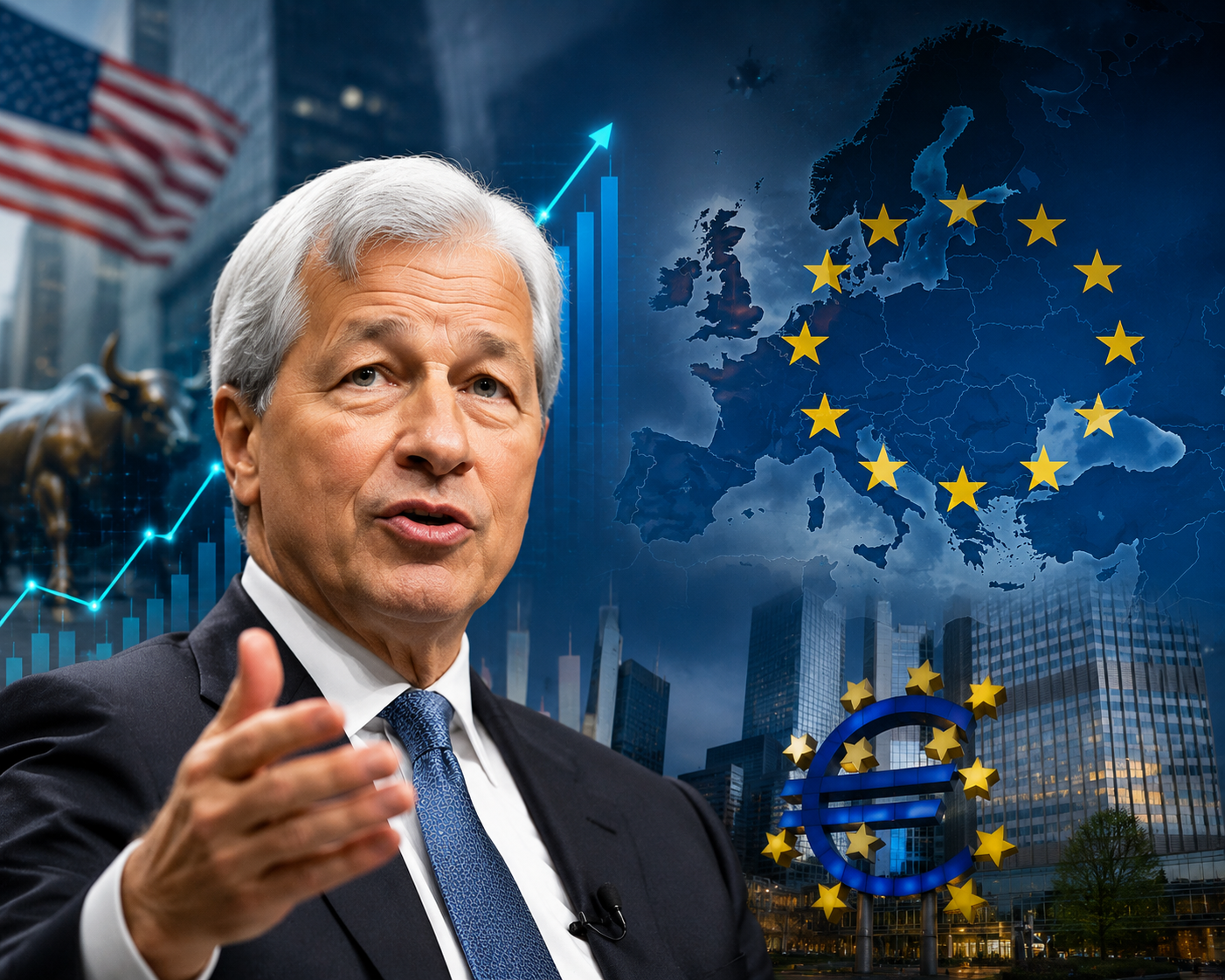
Dimon’s Remarks Trigger Wide Discussion on Global Economic Power Balance
JPMorgan Chase CEO Jamie Dimon has ignited a fresh global debate after describing the idea of “middle powers” uniting to counter large economies as unrealistic, while using Europe as a case study.
Speaking at the Council on Foreign Relations, Dimon argued that Europe’s attempt at economic integration has not delivered the scale or growth needed to compete effectively with the United States.
His comments quickly went viral, especially among policymakers and market participants tracking global capital flows.
Europe Cited as Example of Limited Economic Convergence
Dimon rejected the idea that coordinated mid-sized economies could rival global giants, pointing directly to Europe’s experience.
He highlighted that despite deep integration, Europe has not matched US economic expansion, noting:
-
Europe’s relative GDP share versus the US has declined over decades
-
Structural fragmentation remains across member states
-
Investment incentives remain weaker compared to the US
He argued that economic alignment alone does not automatically translate into higher productivity or faster growth.
Growth Gap Between US and Europe Remains Central Concern
Dimon pointed out that Europe’s economic weight has declined significantly relative to the United States, attributing this to long-term structural factors rather than short-term cycles.
Key issues highlighted include:
-
Slower productivity growth in major European economies
-
Higher taxation impacting corporate investment decisions
-
Regulatory fragmentation across countries
-
Lower risk appetite among investors
He suggested these factors collectively reduce Europe’s global competitiveness in capital-intensive sectors.
Capital Flows Continue to Favor US Markets
A major theme in Dimon’s remarks was the global shift in capital allocation toward the United States.
He argued that investors are increasingly attracted to markets offering:
-
Higher return on investment
-
Strong corporate earnings visibility
-
Deeper liquidity pools
-
More predictable regulatory environments
This trend, he said, has reinforced the dominance of US financial markets over European exchanges.
Stark Comparison of Market Capitalization
Dimon also underscored the valuation gap between US and European equity markets:
-
US stock market: roughly $60–70 trillion
-
Germany (Deutsche Börse): around $3 trillion
-
UK (FTSE market): around $4 trillion
-
France: around $3 trillion
The figures were used to highlight the widening divergence in financial scale and investor depth.
Structural Reform Debate Reignited in Europe
Dimon referenced the widely discussed report by former ECB President Mario Draghi, calling it a practical roadmap for restoring European competitiveness.
Key recommendations from the report include:
-
Deepening EU-wide capital and services markets
-
Coordinated industrial policy across member states
-
Increased investment in innovation and technology
-
Structural reforms to improve productivity
The debate reflects growing urgency in Europe to address long-term stagnation risks.
Economic Data Highlights the Scale Difference
Despite remaining one of the world’s largest economic blocs, Europe continues to trail the US in key macro indicators:
-
EU GDP: approximately $20 trillion
-
US GDP: approximately $29–30 trillion
-
EU population: ~450 million
-
US population: ~342 million
While Europe remains a major consumer market, the US retains dominance in high-growth and innovation-driven sectors.
Policy Implications: Fragmentation vs Scale Efficiency
Dimon’s remarks have reignited discussion on whether Europe’s structural fragmentation limits its ability to scale effectively in global competition.
Key challenges include:
-
Uneven fiscal policies across countries
-
Regulatory complexity
-
Limited cross-border capital mobility
-
Slower decision-making at the EU level
Analysts argue that these structural constraints may be more impactful than cyclical economic conditions.
Market Perspective: US Still Dominates Capital Allocation
From a financial markets standpoint, the trend highlighted by Dimon aligns with broader global investment patterns:
-
US equity markets continue to attract higher foreign inflows
-
European markets trade at relatively lower valuation multiples
-
Tech and AI leadership remains concentrated in the US
-
Venture capital and innovation ecosystems remain stronger in the US
This reinforces the long-standing “US premium” in global capital markets.
Key Takeaway
Jamie Dimon’s remarks have reignited debate on global economic alignment, challenging the effectiveness of regional blocs in competing with dominant economies. While Europe remains a major economic force, structural inefficiencies and slower growth continue to weigh on its global standing, reinforcing capital flow advantages for the United States.