Decade-Long Capital Push Targets AI, Semiconductors and Advanced Manufacturing
South Korea is preparing for one of its largest-ever corporate investment commitments as Samsung Group plans to unveil a 1,000 trillion won ($648 billion) long-term investment roadmap aimed at capturing opportunities from the global artificial intelligence boom.
The announcement is expected to be made during a meeting with President Lee Jae Myung at the presidential office, according to local media reports. The plan spans a 10-year horizon and is designed to reinforce South Korea’s position in next-generation technology infrastructure.
AI Data Centers and Chip Expansion at the Core of Strategy
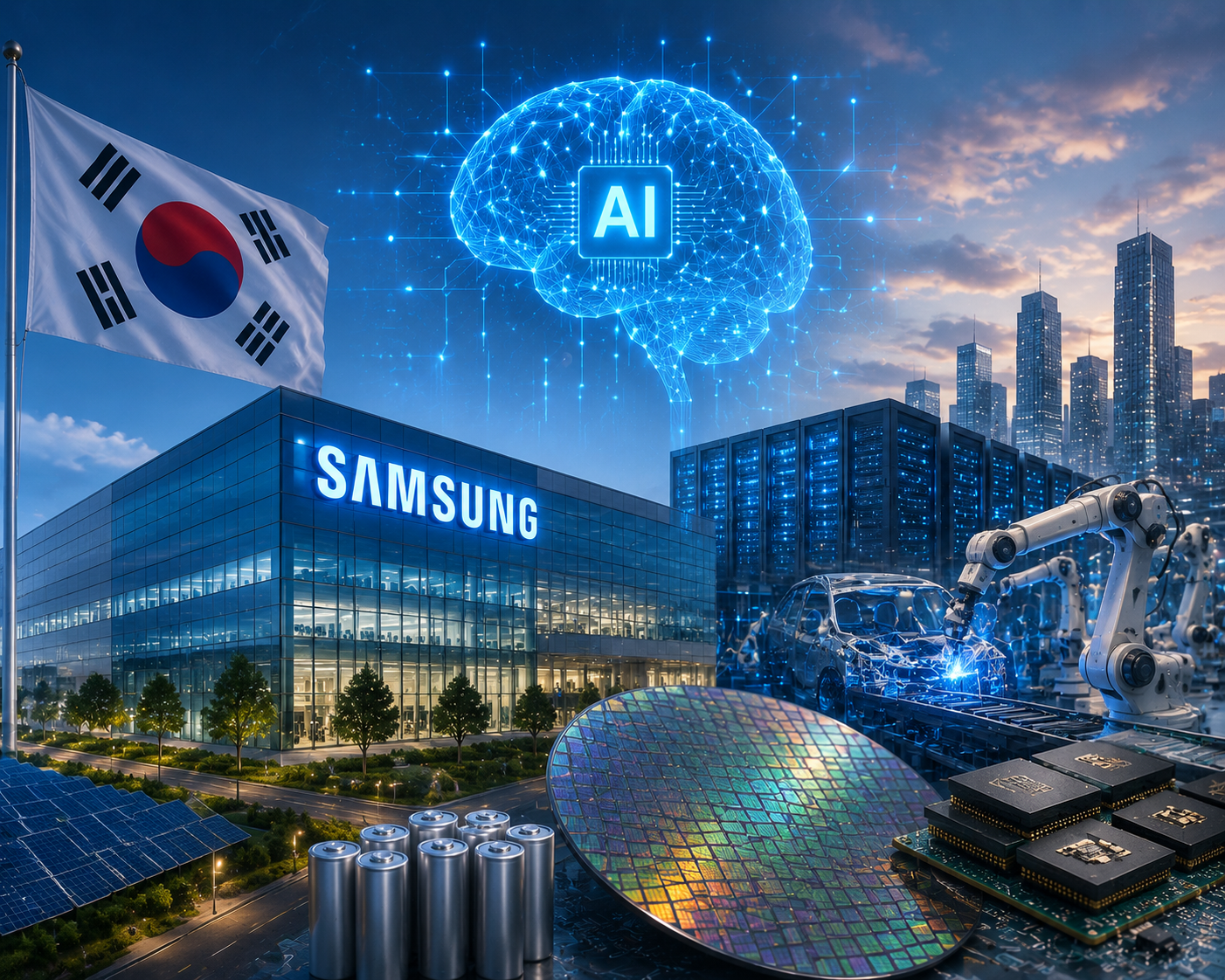
The investment plan is expected to focus heavily on building foundational AI and semiconductor infrastructure, including:
-
Large-scale AI data centers
-
Advanced semiconductor fabrication facilities
-
Battery manufacturing expansion
-
Display and next-generation electronics production
A significant portion of the plan is expected to support new chip fabrication capacity, with reports suggesting up to 300 trillion won could be allocated to semiconductor plants in southwestern South Korea.
Samsung and SK Hynix to Anchor National AI Industrial Push
Key industry players including Samsung Electronics and SK Hynix are expected to align their expansion strategies with the government’s national AI roadmap.
Senior executives from both companies are scheduled to present investment plans during discussions with policymakers, focusing on expanding capacity beyond the heavily concentrated Seoul metropolitan region.
The initiative reflects growing coordination between government policy and private-sector capital deployment in strategic industries.
Shift Toward Regional Semiconductor Clusters
A major theme of the proposed investment is decentralization of industrial activity away from Seoul.
The government is encouraging development of:
-
Semiconductor clusters in southwestern regions
-
AI and robotics industrial zones outside the capital
-
Distributed manufacturing infrastructure across provinces
This shift aims to reduce congestion in the capital region and promote more balanced economic development across the country.
Policy Push to Convert AI Boom into National Growth Engine
South Korea’s administration is positioning artificial intelligence as a core pillar of future economic growth.
The presidential office is expected to unveil three mega-projects covering:
-
Semiconductors
-
AI data centers
-
Robotics ecosystems
Officials believe these initiatives will transform AI demand into broad-based economic growth, supporting both industrial output and employment generation.
Strategic Motivation: Capacity Constraints and Global Demand Surge
Government advisers have highlighted structural constraints in the Seoul region, including limited land availability, power supply bottlenecks, and infrastructure saturation.
At the same time, global demand for high-bandwidth memory chips and AI processors is rising sharply, prompting firms to accelerate long-term capacity planning.
Policy planners argue that without geographic expansion, South Korea risks losing future growth opportunities in advanced manufacturing.
Debate Over Regional Allocation and Industrial Policy
The scale and direction of investment have triggered debate among policymakers, industry experts, and opposition groups.
Key concerns include:
-
Whether government should influence factory location decisions
-
Risk of inefficiencies in new industrial zones
-
Potential duplication of existing semiconductor capacity
-
Political influence over strategic investment decisions
Opposition leaders have argued that investment allocation should remain primarily driven by corporate strategy rather than state planning.
Talent and Infrastructure Gaps Remain Key Challenge
Despite strong investment intent, experts caution that execution challenges could limit impact.
Key structural risks include:
-
Shortage of highly specialized semiconductor talent
-
Underdeveloped supplier ecosystems in new regions
-
High capital requirements for AI-grade infrastructure
-
Power and water constraints in emerging industrial zones
Analysts note that building cutting-edge semiconductor ecosystems takes decades of ecosystem development, not just capital deployment.
Regional Competition Intensifies Across South Korea
Multiple regions are competing to attract semiconductor and AI investments, with proposals ranging from large-scale chip complexes to integrated tech cities.
This has intensified competition among provinces seeking to position themselves as future industrial hubs, particularly in southwestern South Korea.
Existing industrial clusters near Seoul have also raised concerns about potential production shifts and economic displacement.
Market Implications: Long-Term Capex Visibility Improves Tech Outlook
From an investment perspective, the announcement is expected to provide long-term visibility on capital expenditure in the global semiconductor cycle.
Potential market implications include:
-
Stronger demand outlook for semiconductor equipment suppliers
-
Improved earnings visibility for memory chip producers
-
Structural growth tailwinds for AI infrastructure ecosystem
-
Increased capex cycle stability in global tech sector
Key Takeaway
Samsung’s planned $648 billion investment underscores a strategic shift toward AI-driven industrial expansion, positioning South Korea as a key global technology hub. While the scale of investment signals strong long-term growth ambitions, execution risks around talent, infrastructure, and regional development remain critical factors for success.