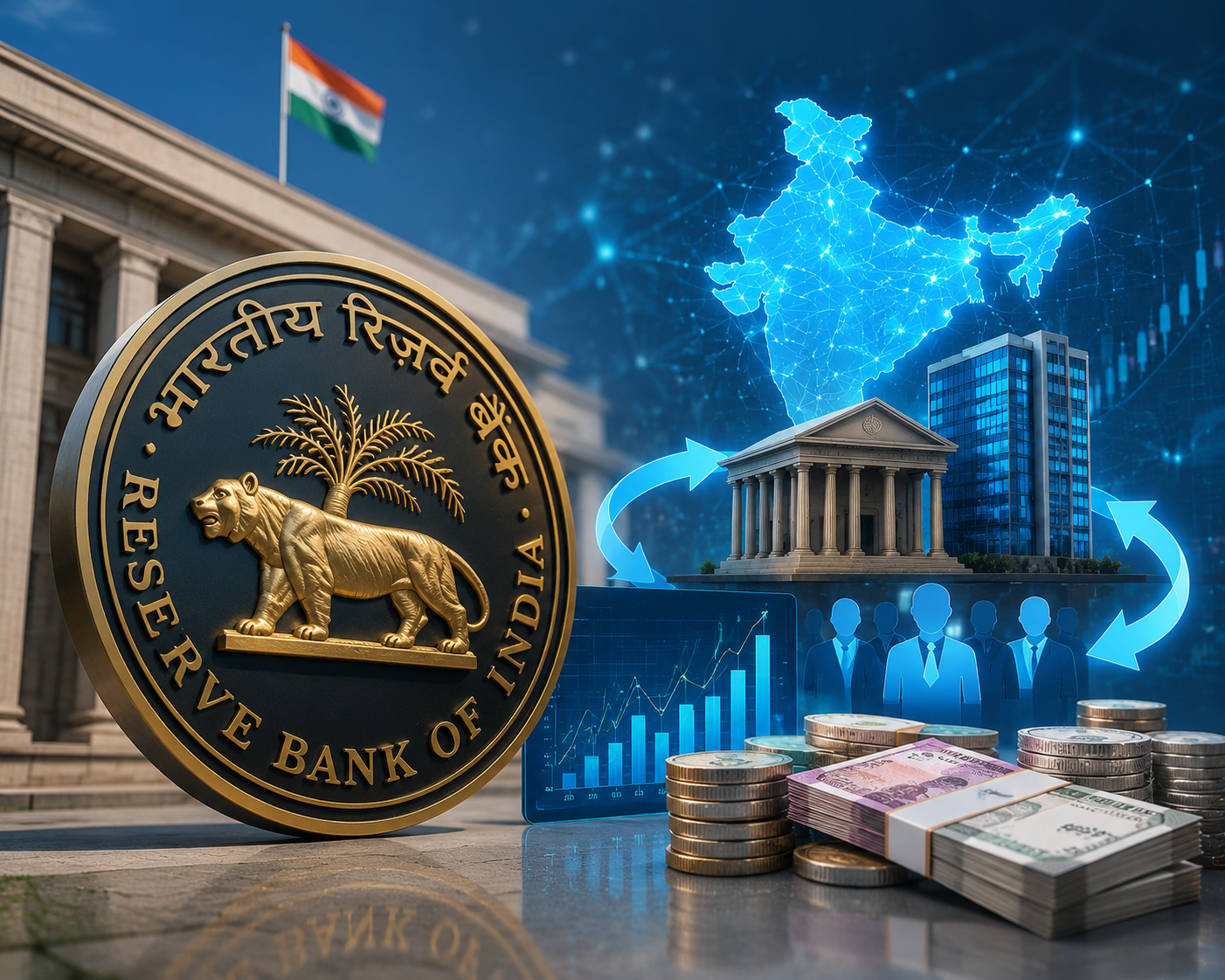
Central Bank Moves to Open Term Money Market Participation
The Reserve Bank of India (Reserve Bank of India) has proposed a significant expansion of participation in the country’s money markets, allowing a broader set of entities including non-banking financial companies (NBFCs), corporates, and select financial institutions.
The objective of the draft framework is to deepen short-term funding markets, improve liquidity distribution, and strengthen monetary policy transmission across the financial system.
NBFCs to Be Allowed as Borrowers and Lenders
Under the proposed changes, NBFCs, including housing finance and mortgage lending companies, will be permitted to participate in the term money market both as borrowers and lenders.
Currently, participation is largely restricted to banks and standalone primary dealers. The reform marks a structural shift toward a more inclusive funding ecosystem for non-bank lenders.
However, the RBI has clarified that smaller NBFCs will not be included, indicating a selective participation framework based on size and risk profile.
Corporates to Enter Money Markets as Lenders
In another key development, the draft proposal allows corporates to participate in the term money market as lenders.
This is expected to:
-
Broaden liquidity supply in short-term funding markets
-
Improve price discovery in money market instruments
-
Diversify the investor base beyond traditional banking channels
The move could also help corporates deploy surplus cash more efficiently in short-duration instruments.
Prudential Limits to Manage Systemic Risk
To ensure financial stability, the RBI has proposed strict exposure limits for new participants.
Key guidelines include:
-
NBFCs can participate up to 200% of net-owned funds (previous fiscal year basis)
-
Financial institutions will follow limits prescribed by the RBI’s regulatory department
-
Risk controls to prevent excessive leverage in unsecured segments
The framework is designed to balance market deepening with risk containment.
Current Market Structure and Need for Reform
India’s money market remains heavily concentrated, with banks and primary dealers accounting for the majority of activity.
Daily turnover in the segment is estimated at around $70 billion, reflecting strong liquidity but also structural concentration.
The RBI has been advocating for broader participation in the unsecured overnight call money market, which plays a key role in:
-
Short-term liquidity management
-
Transmission of policy rates
-
Interbank funding efficiency
Expected Benefits for NBFC Sector
If implemented, the reform could be a major positive for the NBFC ecosystem by:
-
Improving access to short-term funding
-
Reducing reliance on bank credit lines
-
Enhancing liquidity flexibility during tight cycles
-
Supporting balance sheet stability
Larger NBFCs are likely to benefit the most, given eligibility constraints for smaller entities.
Policy Background and Timeline
The proposal follows earlier signals from the RBI’s April monetary policy review, where the central bank highlighted the need to broaden market participation.
Stakeholders have been invited to submit feedback on the draft regulations by July 17, 2026, after which final guidelines will be issued.
Market Implications
The reform, if implemented, is expected to:
-
Improve depth and efficiency of India’s money markets
-
Reduce dependency on bank-centric liquidity channels
-
Strengthen transmission of interest rate policy
-
Expand institutional participation in short-term funding
However, analysts may watch closely how smaller NBFCs are impacted due to exclusion criteria.
Key Takeaway
The RBI’s proposed framework represents a structural reform aimed at widening participation in money markets while maintaining prudential safeguards. It could significantly enhance liquidity efficiency and reshape short-term funding dynamics in India’s financial system.