Understanding the Legal Difference Between Identity Documents and Citizenship Proof Under Indian Law
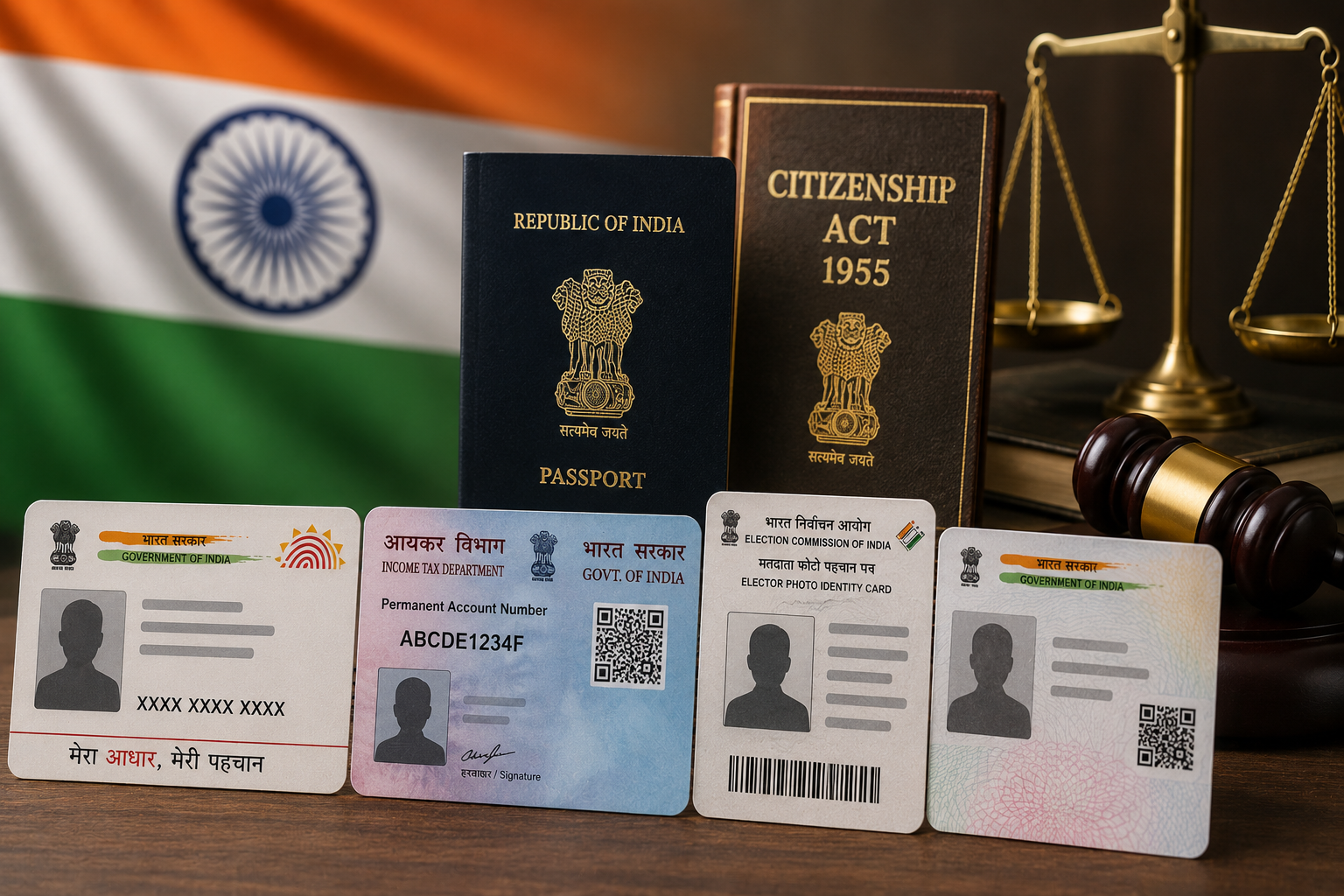
A renewed debate over what legally establishes Indian citizenship has emerged after the Ministry of External Affairs (MEA) clarified that an Indian passport, while issued only to Indian citizens, is primarily a travel document and not conclusive proof of citizenship in legal proceedings. The clarification aligns with previous observations by the Supreme Court and several High Courts, which have consistently held that documents such as Aadhaar, PAN Card, Voter ID and even a passport cannot, by themselves, establish Indian citizenship in a court of law.
The issue has gained attention because millions of Indians routinely use these documents for banking, taxation, travel, government benefits and voting. However, Indian law makes a clear distinction between documents that establish identity and documents that establish citizenship.
Unlike some countries that issue a dedicated national citizenship certificate, India determines citizenship under the provisions of the Citizenship Act, 1955, based on the manner in which citizenship was acquired.
Identity Proof vs Citizenship Proof: Understanding the Difference
Although the terms are often used interchangeably, identity proof and citizenship proof serve entirely different legal purposes.
Identity Proof
Identity documents help verify:
- A person's identity.
- Residential address (where applicable).
- Eligibility to access specific government services.
- Banking and financial transactions.
- Tax compliance.
- Travel and security verification.
Examples include:
- Aadhaar Card
- PAN Card
- Passport
- Voter ID (EPIC)
- Driving Licence
These documents confirm who a person is, but they do not automatically establish which country the person legally belongs to.
Citizenship Proof
Citizenship proof establishes that a person has been legally recognized as an Indian citizen under the Citizenship Act, 1955.
When questions regarding nationality arise, authorities examine the legal basis on which citizenship was acquired rather than relying on any single identity document.
This distinction becomes especially important in legal proceedings involving nationality disputes, immigration matters or foreign national verification.
Why a Passport Is Not Conclusive Proof of Citizenship
An Indian passport is issued after verification by the Government of India and serves as the country's official international travel document.
However, the Ministry of External Affairs has clarified that:
- A passport facilitates international travel.
- It confirms that the holder has been issued the document by the Government of India.
- It is not legally conclusive evidence of citizenship if nationality itself is challenged before a court.
In such situations, courts may require additional documentary evidence regarding birth, parentage or acquisition of citizenship under the Citizenship Act.
Aadhaar Establishes Identity, Not Nationality
The Aadhaar programme was introduced to create a unique identity number for residents of India.
Its primary objectives include:
- Digital identity verification.
- Delivery of welfare benefits.
- Financial inclusion.
- Authentication for government services.
- Simplification of public service delivery.
Importantly, Aadhaar is based on residency, not citizenship.
As a result, the Supreme Court has repeatedly clarified that Aadhaar should not be treated as proof of Indian citizenship.
PAN Card Is Designed for Tax Administration
The Permanent Account Number (PAN) is issued by the Income Tax Department to facilitate taxation and financial transactions.
Its functions include:
- Filing income tax returns.
- Banking transactions.
- Securities market investments.
- Business registration.
- High-value financial transactions.
PAN cards may also be issued to foreign nationals and foreign entities with tax obligations in India.
Consequently, possession of a PAN card cannot independently establish Indian citizenship.
Voter ID Indicates Electoral Eligibility
The Elector Photo Identity Card (EPIC), commonly known as the Voter ID, enables eligible individuals to participate in elections.
Although only Indian citizens are entitled to vote, courts have observed that:
- Electoral records may occasionally contain inaccuracies.
- Administrative errors may occur.
- Possession of a Voter ID alone is insufficient to conclusively establish citizenship in legal proceedings.
Authorities may therefore examine additional documentary evidence where nationality itself is under dispute.
How Indian Citizenship Is Acquired
The Citizenship Act, 1955 provides four principal methods through which a person may become an Indian citizen.
1. Citizenship by Birth
Individuals born in India may qualify for citizenship depending upon:
- Date of birth.
- Citizenship status of parents.
- Applicable provisions of the Citizenship Act at the relevant time.
Birth certificates and related records generally form an important part of the supporting evidence.
2. Citizenship by Descent
Persons born outside India may acquire Indian citizenship through their parents, subject to statutory conditions.
Supporting documents may include:
- Parents' citizenship records.
- Birth registration at an Indian embassy or consulate.
- Official government records.
3. Citizenship by Registration
Certain eligible individuals can obtain Indian citizenship through registration.
These categories include:
- Persons of Indian Origin.
- Certain Overseas applicants.
- Eligible spouses of Indian citizens.
Upon approval, applicants receive a Certificate of Registration, which serves as official evidence of citizenship.
4. Citizenship by Naturalisation
Foreign nationals who satisfy the eligibility criteria under the Citizenship Act may acquire Indian citizenship through naturalisation.
Typical requirements include:
- Prescribed period of residence in India.
- Good character.
- Adequate knowledge of an Indian language listed in the Eighth Schedule.
- Intention to permanently reside in India.
Successful applicants are issued a Certificate of Naturalisation, which legally establishes citizenship.
India Does Not Have a Single Universal Citizenship Document
Unlike several other countries, India does not issue one universal citizenship certificate to every citizen by default.
Instead, citizenship is determined through the legal framework established under the Citizenship Act.
Depending upon individual circumstances, authorities may examine multiple documents together, including:
- Birth certificates.
- School records.
- Parents' citizenship documents.
- Registration certificates.
- Naturalisation certificates.
- Government-issued records.
The objective is to determine whether the individual satisfies the legal requirements for Indian citizenship.
What Happens if Citizenship Is Questioned?
If a person's nationality is questioned, the matter may be examined under:
- Citizenship Act, 1955
- Foreigners Act, 1946
Under Section 9 of the Foreigners Act, when authorities produce credible material raising doubts regarding nationality, the individual may be required to establish that they are an Indian citizen.
Courts then evaluate all available documentary evidence before arriving at a legal conclusion.
No single identity document automatically determines the outcome.
Judicial Observations Reinforce the Legal Position
Indian courts have repeatedly emphasized the distinction between identity and citizenship.
Recent judicial observations have clarified that:
- Aadhaar establishes identity but not citizenship.
- PAN serves taxation purposes.
- Voter ID establishes electoral eligibility.
- Passport facilitates international travel but is not conclusive proof of nationality during legal disputes.
These observations underscore that citizenship is determined by statutory provisions rather than by possession of any one government-issued identity document.
Why This Distinction Matters
Understanding the legal distinction between identity and citizenship has become increasingly important.
It affects matters involving:
- Immigration proceedings.
- Passport disputes.
- Nationality verification.
- Foreign national investigations.
- Court proceedings.
- Government verification exercises.
- International travel documentation.
For everyday activities, identity documents remain sufficient for most administrative purposes. However, when nationality itself becomes the subject of legal scrutiny, authorities examine citizenship under the framework of the Citizenship Act, 1955, supported by relevant documentary evidence.
Outlook
The recent clarification by the Ministry of External Affairs has highlighted an important legal principle often misunderstood by the public: identity documents and citizenship proof are not legally identical. While Aadhaar, PAN Card, Passport and Voter ID remain essential documents for identification, taxation, elections and travel, none of them independently establish Indian citizenship when the issue is examined before a court.
Instead, citizenship in India is determined under the Citizenship Act, 1955, based on whether it was acquired by birth, descent, registration or naturalisation. In legal disputes, courts evaluate the complete documentary record rather than relying on a single identity document. As discussions around documentation and citizenship continue, understanding this distinction is essential for both citizens and policymakers navigating India's legal and constitutional framework.