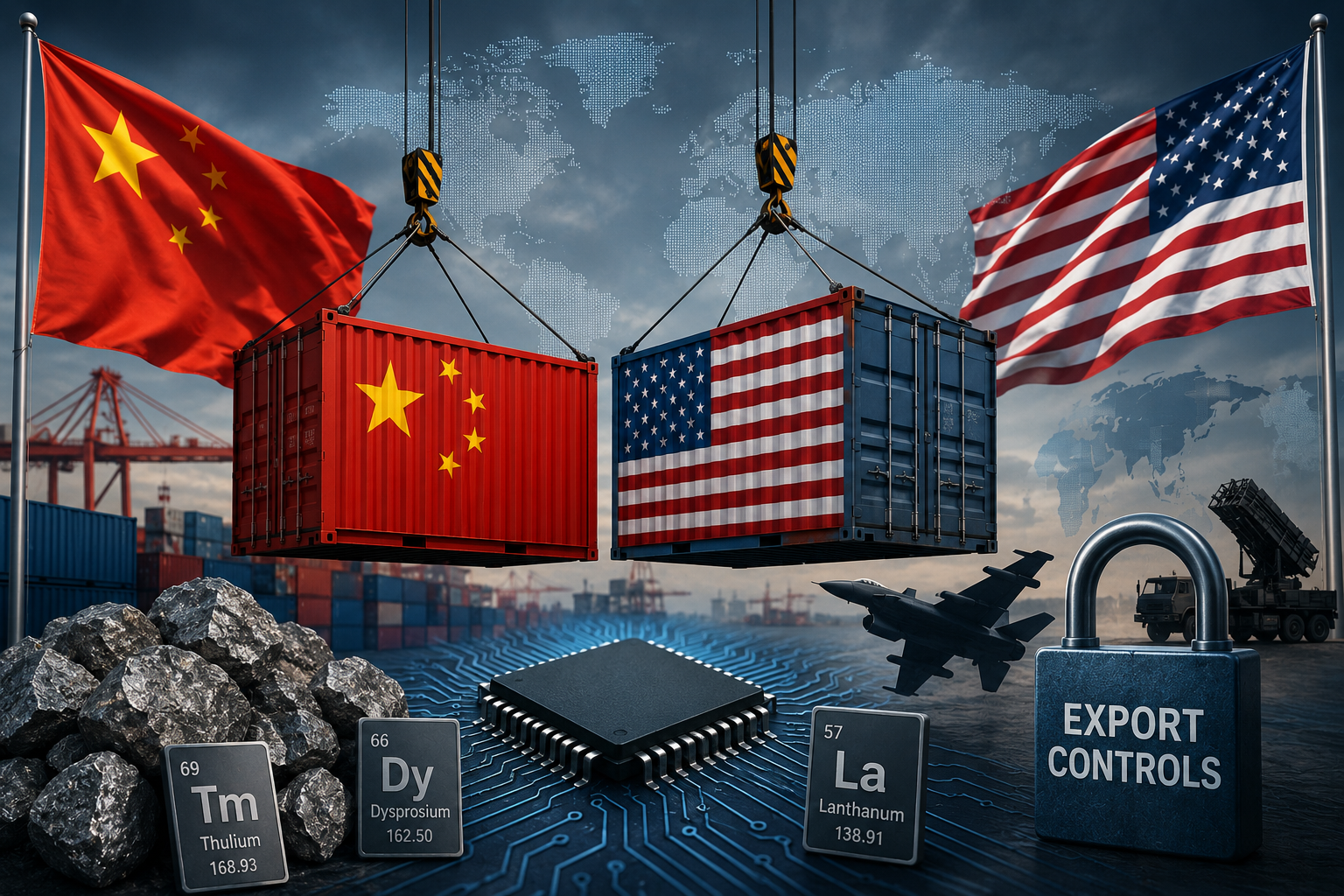
Escalating Technology and Defence Tensions Add New Layer to US-China Economic Rivalry
China has announced fresh export control measures targeting 10 United States companies with alleged links to the American defence sector, marking another escalation in the ongoing strategic and technological competition between the world's two largest economies.
The latest move comes shortly after the United States imposed restrictions on several major Chinese companies, accusing them of supporting China's military modernization efforts. Beijing's response signals a continuation of tit-for-tat actions that have increasingly expanded beyond tariffs into critical technologies, rare earth minerals, defence manufacturing and supply chain security.
Rare Earth Producers Among Key Targets
Among the companies affected by the new restrictions are major rare earth firms MP Materials and USA Rare Earth, both of which play a crucial role in the United States' efforts to build an independent rare earth supply chain.
Rare earth minerals are essential components used in electric vehicles, renewable energy equipment, semiconductors, aerospace systems, advanced electronics and military hardware. China's dominance in global rare earth processing has long been viewed as a strategic advantage, giving Beijing significant influence over critical industrial supply chains.
The new restrictions effectively prohibit Chinese entities from exporting dual-use products and technologies to the listed companies, significantly tightening previous regulations that merely required export licenses.
Defence and Strategic Manufacturing Under Spotlight
China's Commerce Ministry stated that the measures were introduced to safeguard national security interests and fulfill international non-proliferation obligations.
In addition to rare earth companies, the export control list includes firms involved in advanced manufacturing and mission-critical technologies used across defence and aerospace sectors.
The move underscores how economic and commercial policies are increasingly being used as strategic tools in geopolitical competition. Analysts note that technology, semiconductors, advanced materials and defence manufacturing have become key battlegrounds in the broader US-China rivalry.
Procurement Restrictions Expanded
Alongside the export controls, China's Finance Ministry announced additional measures affecting 46 American companies.
Under the new framework, Chinese organizations and government-linked buyers will be restricted from purchasing products manufactured by these companies. While certain US-funded enterprises operating within China may continue business activities under specific conditions, the broader restrictions are expected to create additional challenges for affected firms seeking access to the Chinese market.
The procurement ban represents another step in China's effort to reduce dependence on foreign suppliers in strategically important sectors.
Background: Growing US-China Technology Conflict
The latest measures follow Washington's decision earlier this month to place several Chinese companies under restrictions, including leading technology, automotive and internet firms.
US authorities have increasingly scrutinized Chinese companies over concerns related to national security, data protection, advanced technology transfers and military applications. Beijing has repeatedly denied such allegations and criticized the restrictions as attempts to contain China's technological development.
Over the past few years, tensions between the two nations have expanded from trade disputes to include semiconductor exports, artificial intelligence, electric vehicles, critical minerals, telecommunications equipment and advanced manufacturing technologies.
Potential Impact on Global Supply Chains
Industry experts believe the latest restrictions could have implications for global supply chains, particularly in sectors dependent on rare earth materials and advanced industrial components.
Companies involved in electric vehicles, renewable energy infrastructure, defence systems and high-tech manufacturing may closely monitor developments, as disruptions in rare earth supply chains can influence production costs and investment decisions worldwide.
Investors are also likely to watch for any retaliatory measures from Washington, which could further impact global trade flows and corporate investment strategies.
Market Implications
The announcement highlights the growing geopolitical risks facing multinational corporations and investors. As governments increasingly prioritize economic security and supply chain resilience, businesses may need to diversify sourcing strategies and reduce dependence on single-country supply networks.
For global markets, prolonged trade and technology tensions between the United States and China could contribute to increased volatility in sectors such as semiconductors, defence, electric vehicles, renewable energy and critical minerals.
Outlook
China's latest export controls reinforce the reality that economic competition between Beijing and Washington is entering a new phase centered on technology leadership, strategic resources and national security.
While both countries remain deeply interconnected through trade and investment, the increasing use of restrictions, sanctions and export controls suggests that geopolitical considerations will continue to play a major role in shaping global business and financial markets in the years ahead.
Investors, policymakers and corporations will closely monitor future developments, as decisions taken by the world's two largest economies have the potential to reshape international trade patterns and industrial supply chains across multiple sectors.