Precious Metal Loses Momentum After Sharp Rally as Investors Reassess Interest Rate and Growth Outlook
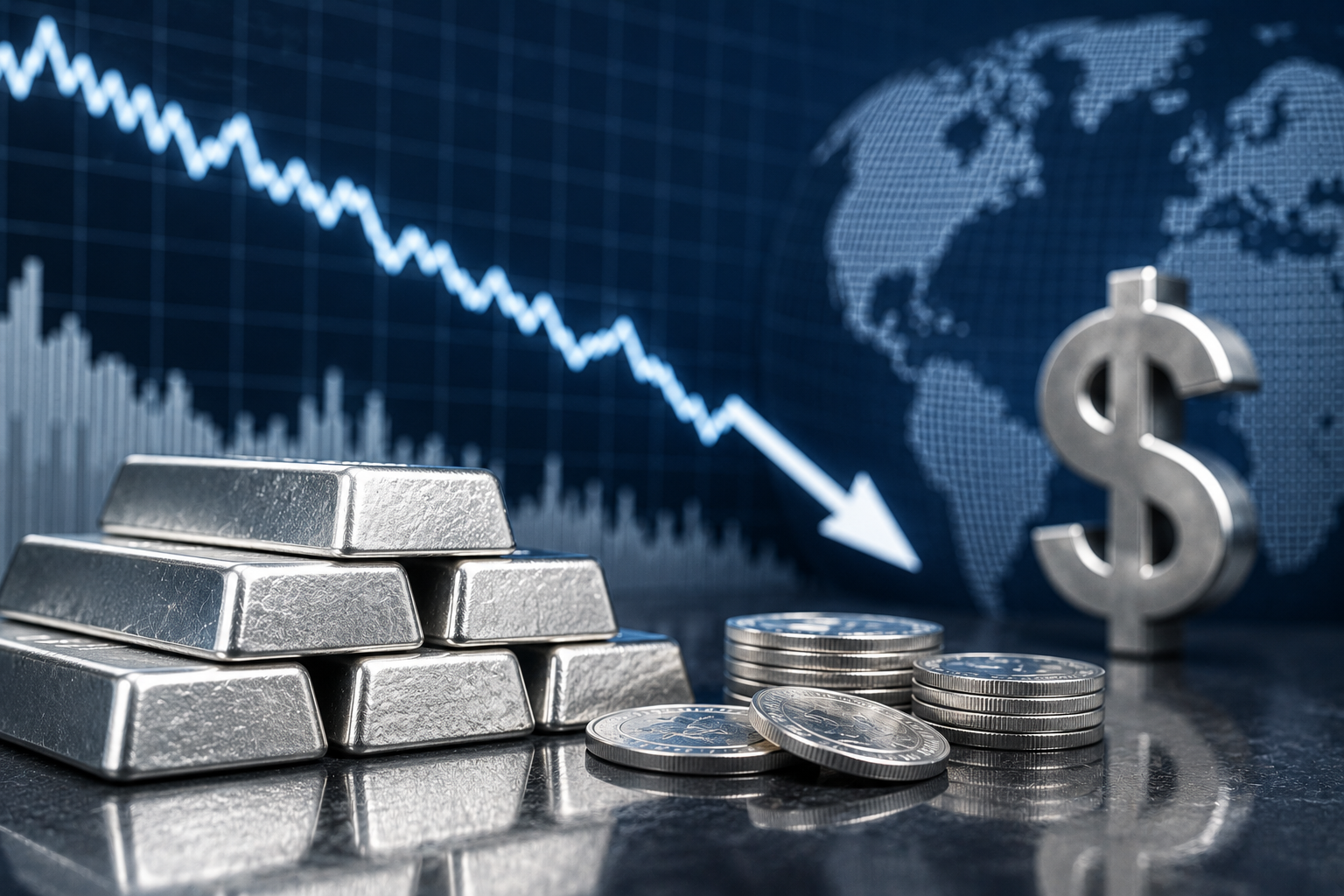
Silver prices have witnessed a sharp correction after a strong rally earlier this month, as a stronger US dollar, rising bond yields and a hawkish US Federal Reserve have triggered fresh selling across precious metals. Market analysts believe the white metal could remain under pressure in the near term, with prices potentially testing the critical $60 support level and, under a more bearish scenario, sliding toward $55.
The correction highlights the growing influence of monetary policy expectations on commodity markets, as investors shift focus from geopolitical risks to the prospect of higher interest rates and tighter financial conditions.
Strong Rally Gives Way to Profit Booking
Silver had recently staged an impressive rebound, supported by easing geopolitical tensions and falling crude oil prices.
The metal rallied sharply over several trading sessions as investors anticipated a more supportive environment for precious metals. Expectations that lower energy prices could reduce inflationary pressures initially encouraged buying interest in both gold and silver.
However, the momentum reversed following the latest policy signals from the US Federal Reserve, leading to widespread profit booking across the commodity complex.
The sharp decline demonstrates how quickly sentiment can shift when macroeconomic factors outweigh geopolitical developments.
Federal Reserve's Hawkish Pivot Shakes Markets
The most significant driver behind silver's recent weakness has been the Federal Reserve's firm stance on inflation.
Although the central bank left benchmark interest rates unchanged at its latest meeting, policymakers signaled that inflation remains a concern and indicated that interest rates could remain elevated for a longer period.
Several Federal Reserve officials suggested that additional policy tightening may still be necessary if inflation fails to return to target levels.
For silver, which is highly sensitive to interest-rate expectations, this development has reduced investor enthusiasm and increased concerns about slower demand growth.
Stronger Dollar Creates Additional Headwinds
The US dollar has strengthened considerably in response to the Federal Reserve's policy outlook.
A stronger dollar typically exerts downward pressure on commodity prices because most globally traded commodities, including silver, are priced in US currency.
As the dollar appreciates, silver becomes more expensive for international buyers, reducing demand and limiting upward price movement.
Currency analysts believe the dollar could remain firm if US economic data continues to support the case for higher interest rates, creating further challenges for precious metals.
Rising Bond Yields Reduce Appeal of Non-Yielding Assets
Treasury yields have also moved higher following the Federal Reserve's latest projections.
When bond yields rise, investors often shift capital toward interest-bearing assets and away from commodities such as silver and gold, which do not generate regular income.
The increase in both short-term and long-term yields has therefore become another major headwind for silver prices.
Market participants are closely monitoring fixed-income markets, as any further rise in yields could accelerate selling pressure across precious metals.
Geopolitical Risks Ease Following US-Iran Agreement
Recent diplomatic developments in the Middle East have also influenced silver's performance.
The preliminary agreement between the United States and Iran has reduced immediate concerns about supply disruptions and regional conflict. The easing of tensions has contributed to a sharp decline in crude oil prices and improved overall market sentiment.
As geopolitical uncertainty decreases, demand for traditional safe-haven assets such as silver often weakens.
However, analysts caution that unresolved issues remain and geopolitical developments could continue to influence commodity markets in the coming months.
ETF Outflows Reflect Weak Investment Demand
Investment demand for silver remains subdued.
Silver-backed exchange-traded funds (ETFs) have experienced consistent outflows, indicating that institutional investors remain cautious about the metal's near-term prospects.
ETF holdings are widely considered an important measure of investor confidence. Persistent withdrawals suggest that many investors currently prefer equities, fixed-income securities and cash over precious metals.
The trend has added further pressure on prices and reinforced bearish sentiment in the market.
Industrial Demand Remains a Long-Term Support Factor
Unlike gold, silver has significant industrial applications, which provide an important source of long-term demand.
The metal is widely used in:
Renewable Energy
Solar panel manufacturing remains one of the fastest-growing sources of silver consumption globally.
Electric Vehicles
Silver plays a critical role in electrical systems and advanced automotive technologies.
Electronics and Semiconductors
The metal is essential in the production of electronic devices, circuit boards and communication equipment.
Healthcare and Medical Applications
Silver's antimicrobial properties continue to support demand in healthcare-related industries.
These structural demand drivers may help limit long-term downside risks despite current market weakness.
China Remains a Key Market to Watch
China continues to play a crucial role in global silver demand.
As the world's largest manufacturing hub and a major consumer of industrial metals, developments in China's economy can significantly influence silver prices.
Recent increases in silver inventories suggest that supply conditions have improved, although stock levels remain historically low compared to long-term averages.
Any acceleration in Chinese industrial activity could provide support to global silver demand later this year.
Technical Outlook: Critical Support Levels Ahead
Technical analysts believe silver is approaching an important phase.
Key Support Levels
- Immediate support around $60
- Secondary support near $58
- Extended downside target around $55
Resistance Levels
- Initial resistance near $69
- Strong resistance around $72
- Major breakout zone above recent highs
A break below the $60 level could trigger additional selling pressure, while a recovery above resistance zones may signal renewed bullish momentum.
What Investors Should Watch
The next direction for silver will largely depend on several key factors:
- Future Federal Reserve policy decisions
- US inflation and employment data
- Movement in the US dollar
- Treasury yield trends
- Global industrial demand
- Developments in energy markets
- Geopolitical conditions in West Asia
Investors are expected to remain cautious until greater clarity emerges regarding the global interest-rate outlook.
Outlook: Short-Term Weakness, Long-Term Opportunity
While silver faces considerable near-term challenges from higher interest-rate expectations and a stronger dollar, its long-term investment case remains supported by industrial demand, energy transition trends and technological innovation.
The metal's growing role in renewable energy infrastructure, electric mobility and advanced manufacturing continues to create a strong structural demand foundation.
However, until monetary policy concerns ease and investment flows stabilize, silver is likely to remain vulnerable to volatility and further downside pressure in the weeks ahead.