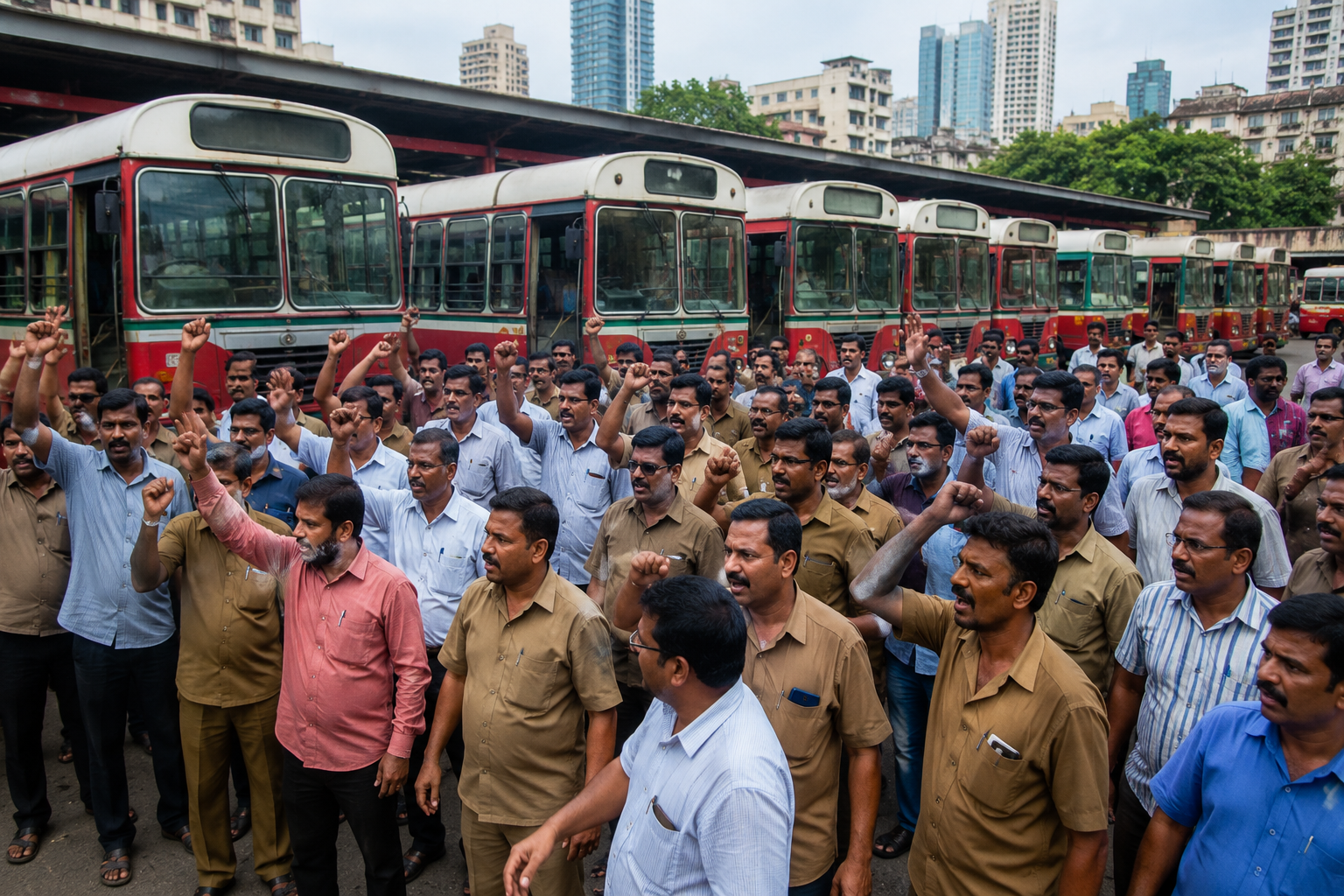
Public Transport Services Hit Across City as Unions Press for Pay Revision, Pension Benefits and Workforce Regularisation
Mumbai's public transport network faced major disruption on Friday after employees of the Brihanmumbai Electric Supply and Transport (BEST) undertaking launched an indefinite strike over salary-related demands, pending retirement dues and employment concerns. The agitation affected bus operations across the city, leaving lakhs of daily commuters scrambling for alternative transport options during peak hours.
The strike has once again brought attention to the financial and operational challenges facing one of India's oldest and most important public transport systems.
Bus Services Severely Affected Across Mumbai
The industrial action had an immediate impact on daily life in Mumbai, with buses remaining parked at several depots across the city.
Thousands of commuters waiting at bus stops were forced to seek alternate modes of transport, including suburban trains, Metro services, taxis, autorickshaws and app-based cab services. The sudden increase in demand led to overcrowding at railway stations and transportation hubs across Mumbai.
BEST operates one of the largest urban bus networks in the country and plays a vital role in connecting residential areas, commercial districts and industrial zones throughout the metropolitan region.
Why Are BEST Employees Protesting?
The strike has been called by the BEST Sanyukt Kamgar Kruti Samiti, a joint action committee representing multiple employee unions.
Union leaders claim that workers and retired employees have been facing financial uncertainty for several years. According to employee representatives, retired personnel have not received certain legal and financial dues pending since 2022, while some workers continue to demand wage revisions in line with government norms.
The unions argue that repeated appeals to management and government authorities have not resulted in satisfactory solutions, prompting the decision to launch an indefinite agitation.
Major Demands of the Employees
The protesting workers have submitted a broad charter of demands aimed at improving employee welfare and financial security.
Key demands include:
- Implementation of the Seventh Pay Commission recommendations for the 2016-2026 period
- Settlement of pending dues and retirement benefits
- Merger of the BEST budget with the Brihanmumbai Municipal Corporation (BMC) budget
- Abolition of contractual employment arrangements
- Regularisation of transport and electricity department workers
- Absorption of wet-lease bus employees into the permanent workforce
- Enhanced pension and employee welfare benefits
Union representatives maintain that these measures are necessary to ensure long-term sustainability and improve morale among workers.
Strike Continues Despite Government Restrictions
The protest has taken place despite legal and administrative efforts to prevent disruptions.
The Maharashtra government invoked the Maharashtra Essential Services Maintenance Act (MESMA), which prohibits strikes in essential public services. In addition, an industrial court issued an interim order restraining employees from proceeding with the strike.
However, employee organizations chose to continue the agitation, arguing that unresolved issues left them with no alternative.
The situation has created a complex legal and administrative challenge for authorities attempting to restore normal operations.
BEST’s Critical Role in Mumbai’s Economy
The disruption highlights the immense importance of BEST to Mumbai's transportation ecosystem.
Every day, approximately 25 lakh passengers rely on BEST buses for affordable and convenient mobility across the city. In addition to transportation services, the undertaking also supplies electricity to more than 10 lakh consumers in south and central Mumbai.
Given Mumbai's status as India's financial capital, any prolonged disruption to public transport services can have wider economic implications, affecting workforce movement, productivity and business operations.
Financial Stress Continues to Trouble BEST
The strike has also renewed focus on the financial difficulties faced by the BEST undertaking.
Over the years, rising operational costs, employee expenses and declining profitability have forced the organization to adopt various cost-saving measures. One such strategy has been the increasing use of wet-lease buses operated by private contractors.
While management views the model as financially efficient, employee unions argue that it reduces job security and weakens the role of the permanent workforce.
Industry experts believe that addressing these structural challenges will be crucial for the long-term viability of the transport utility.
Police Warn Against Disruption and Damage
Mumbai Police have issued strict warnings against any attempts to obstruct public services or damage public property.
Authorities have stated that legal action will be taken against individuals found preventing willing employees from reporting for duty or interfering with transport operations.
Additional security personnel have been deployed at major bus depots and transportation facilities to maintain law and order and minimize inconvenience to the public.
Divisions Among Employee Unions
Interestingly, not all employee organizations have supported the strike.
Some unions have distanced themselves from the agitation and indicated that discussions with the BEST administration and state government remain ongoing. These groups have expressed optimism that a negotiated settlement can be reached without extending disruptions to commuters.
The differing approaches within the workforce suggest that dialogue channels remain open despite the current standoff.
Impact on Commuters and Businesses
The strike has already begun affecting daily commuters, particularly lower-income workers and students who depend heavily on affordable bus transportation.
Businesses are also monitoring the situation closely, as prolonged disruptions could affect employee attendance, logistics and overall productivity.
Experts warn that if the strike continues for an extended period, traffic congestion could worsen significantly as more commuters shift to private vehicles and alternative transport modes.
Outlook: Negotiations Will Determine the Next Steps
The coming days will be crucial as discussions between employee representatives, BEST management, the Brihanmumbai Municipal Corporation and the Maharashtra government continue.
While workers remain firm on their demands, authorities are under pressure to restore normal transport services quickly and avoid prolonged inconvenience to millions of Mumbai residents.
A negotiated compromise remains the most likely solution, but until a breakthrough is achieved, Mumbai's public transport network may continue to face uncertainty and operational challenges.
The outcome of the dispute could also influence future labour negotiations in public transport utilities across India, where issues related to wages, pensions and contractual employment are becoming increasingly prominent.