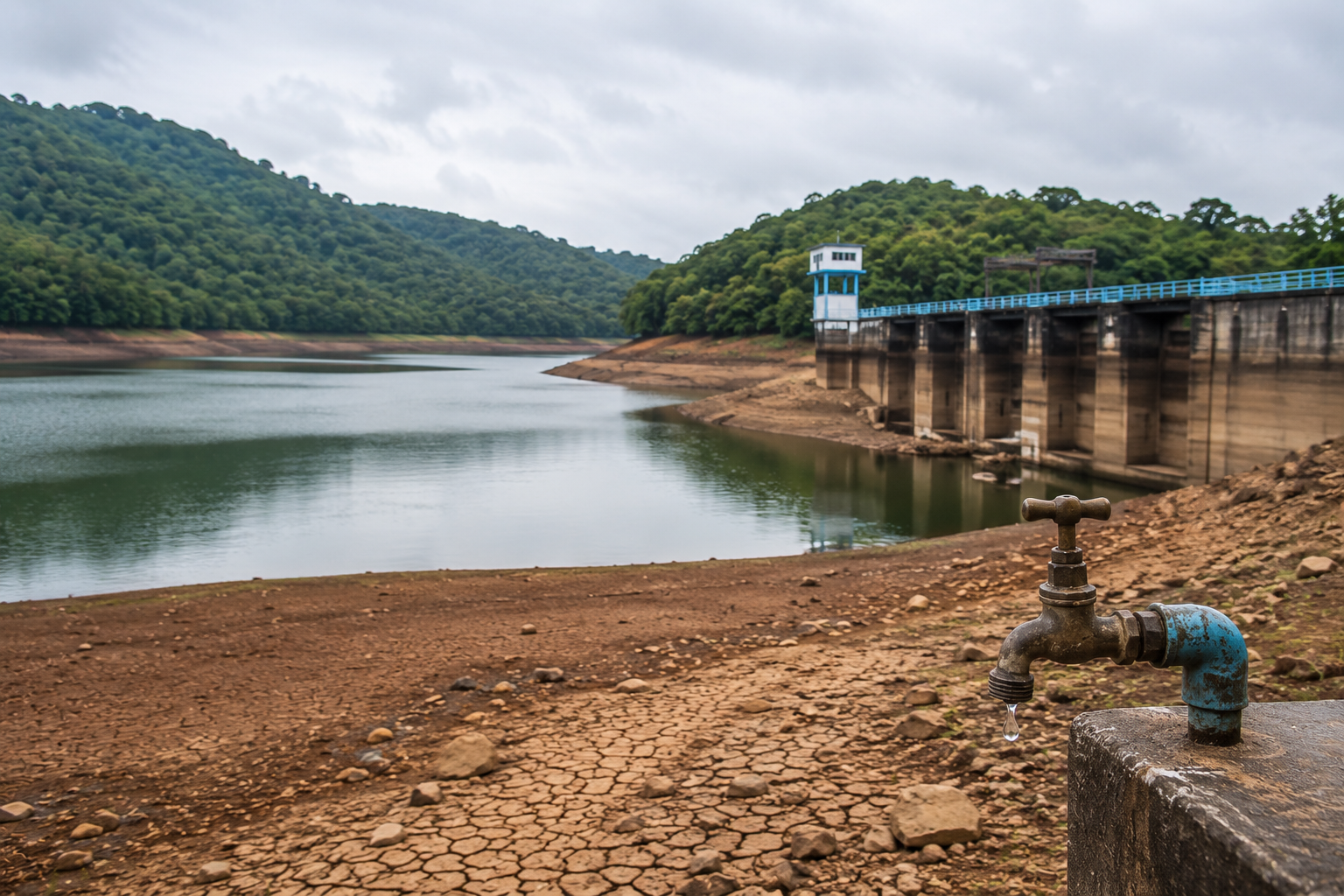
Delayed Monsoon Puts Pressure on Key Dams, Government Urges Conservation While Awaiting Rainfall Revival
Goa is facing an emerging water challenge as delayed monsoon rains have significantly reduced water levels in several major reservoirs across the state. Authorities have indicated that existing drinking water reserves may be sufficient for only about one month if rainfall does not improve soon, prompting officials to closely monitor the situation and prepare conservation measures.
The development comes amid a broader slowdown in the southwest monsoon across several parts of India, where rainfall deficits have raised concerns about water security, agriculture and reservoir replenishment.
Despite assurances from the state government that there is no immediate cause for alarm, officials have warned that prudent water management will be essential until monsoon activity regains momentum.
Delayed Monsoon Impacts Reservoir Storage
The southwest monsoon initially arrived over Goa with encouraging rainfall, raising hopes for adequate reservoir replenishment. However, a prolonged pause in monsoon activity has disrupted those expectations.
Several parts of the state have witnessed below-normal rainfall during recent weeks, resulting in a sharp decline in water storage levels across critical reservoirs.
Water resource experts note that reservoir replenishment during June is crucial because it determines the state's water availability for the remainder of the year, particularly during periods of lower rainfall.
The current shortfall has therefore become a significant concern for policymakers and utility managers.
Key Dams Witness Significant Drop in Water Levels
Among the most important reservoirs affected is the Selaulim Dam, which serves as a primary source of drinking water for South Goa and several adjoining regions.
The reservoir currently holds considerably lower water levels than expected for this stage of the monsoon season, raising concerns about future supply if rainfall remains inadequate.
Similarly, the Anjunem Dam in North Goa has reported one of the sharpest declines in storage levels. The reservoir plays a vital role in supplying water to several treatment plants and surrounding communities.
The Mhaisal Dam has also experienced declining reserves, further highlighting the pressure being placed on the state's water infrastructure.
Officials are conducting regular reviews of reservoir conditions to assess evolving risks and formulate appropriate response strategies.
Government Prepares Water Conservation Measures
Recognizing the potential challenges ahead, the Goa government is preparing a series of conservation measures aimed at preserving available water resources.
Authorities are expected to issue advisories encouraging responsible water usage among households, businesses and industries.
Commercial establishments and large-scale consumers may be asked to adopt stricter water-saving practices until reservoir levels improve.
Government departments are also evaluating contingency plans to ensure uninterrupted drinking water supply should the dry spell continue longer than anticipated.
Officials emphasize that proactive conservation now can help prevent more stringent restrictions later.
Industrial Sector Monitoring Water Availability
The uncertainty surrounding reservoir levels has prompted increased concern among industrial and commercial stakeholders.
Several businesses have reportedly sought clarification from authorities regarding the state's water availability outlook, particularly as manufacturing and tourism activities continue to expand.
Water-intensive industries are closely monitoring developments, as any future restrictions could affect operations and planning decisions.
The government has reassured businesses that efforts are being made to manage resources efficiently while prioritizing drinking water requirements.
Some Regions Better Positioned Than Others
While several major reservoirs are under pressure, not all parts of Goa face the same level of risk.
Certain water bodies continue to maintain relatively comfortable storage levels and are expected to meet local demand without difficulty.
Officials have indicated that regions supported by reservoirs with stronger reserves are currently less vulnerable to shortages, providing some relief amid broader concerns.
This uneven distribution of water resources highlights the importance of localized planning and efficient allocation across districts.
IMD Forecast Offers Hope for Relief
Meteorologists remain cautiously optimistic that rainfall activity could revive in the coming days.
The India Meteorological Department (IMD) has forecast a gradual return of monsoon rains over Goa by the coming weekend, which could significantly improve reservoir inflows and ease pressure on water supplies.
Weather experts suggest that a sustained period of moderate to heavy rainfall would be sufficient to stabilize water levels and restore confidence in the state's water security outlook.
However, forecasts remain subject to changing atmospheric conditions, and authorities continue to monitor developments closely.
Broader Monsoon Slowdown Adds to Concerns
Goa's situation is part of a wider weather pattern affecting multiple states across India.
After a strong onset, the southwest monsoon has slowed considerably due to weak moisture flow, dry-air intrusions and unfavorable global weather conditions.
Several states have reported rainfall deficits, delayed sowing activities and concerns regarding reservoir replenishment.
Meteorologists are also watching evolving Pacific Ocean conditions, including the possibility of El Niño influences, which could impact rainfall distribution during the remainder of the monsoon season.
Economic and Social Implications
Water availability remains critical not only for households but also for agriculture, tourism, industry and public infrastructure.
Any prolonged shortfall in rainfall could affect crop production, increase water management costs and place additional pressure on local administrations.
For Goa, where tourism and hospitality form major pillars of the economy, maintaining reliable water supplies is especially important during peak visitor periods.
The situation underscores the growing importance of sustainable water management practices and climate resilience planning.
Outlook: Critical Weeks Ahead for Goa
The next few weeks are expected to be crucial for Goa's water situation.
If the monsoon regains strength as forecast, reservoir levels could recover rapidly and alleviate concerns over drinking water availability. However, any further delay in widespread rainfall may require stricter conservation measures and closer monitoring of consumption patterns.
For now, state authorities remain focused on balancing available resources while hoping for a timely revival of monsoon activity that can replenish reservoirs and secure water supplies for the months ahead.