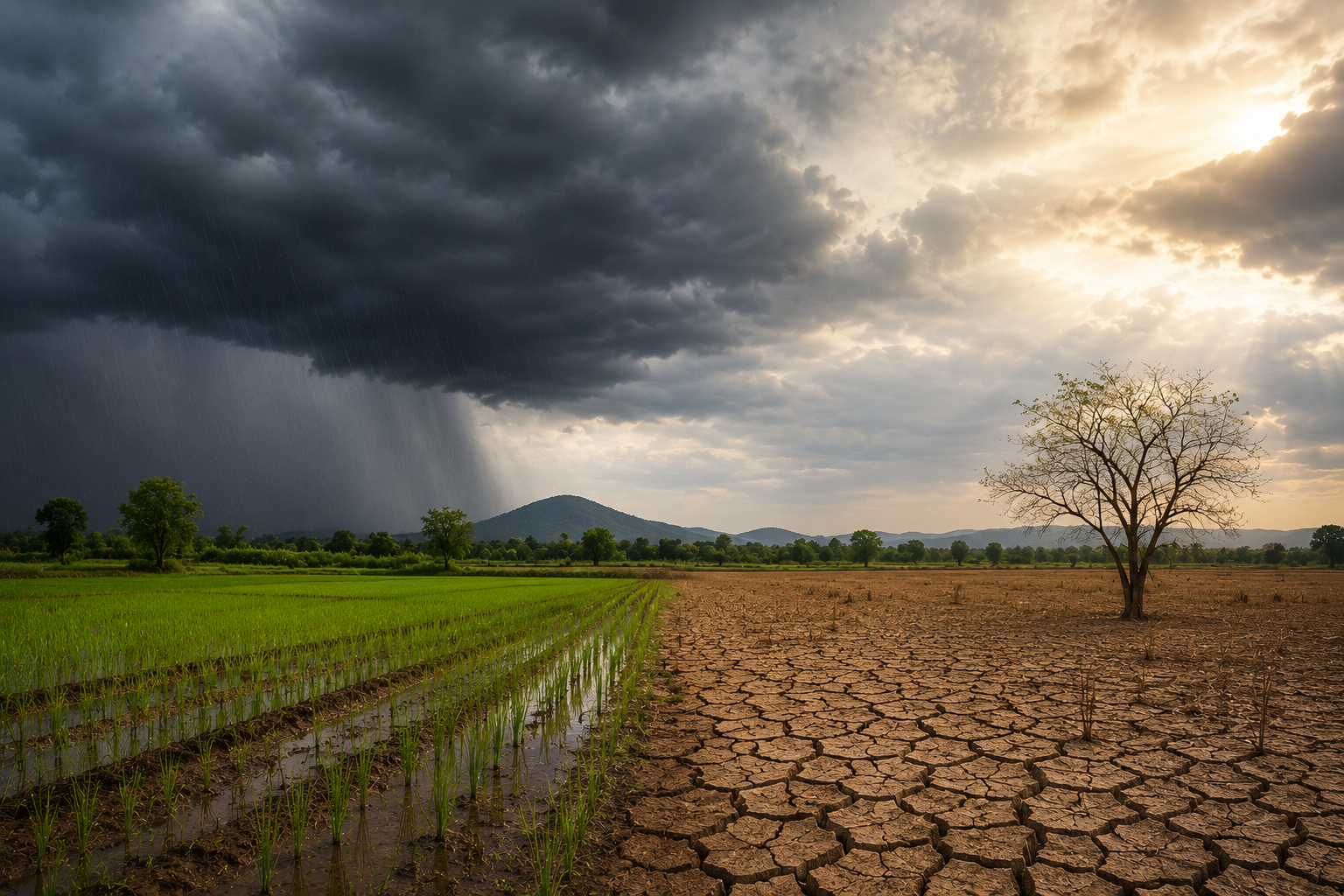
Weak Atmospheric Conditions, Dry Air Intrusions and El Niño Risks Slow Monsoon Advance Across Key Agricultural Regions
India's southwest monsoon, which began the season with a promising and early advance, has unexpectedly lost momentum across several parts of the country, triggering concerns among farmers, policymakers and weather experts. The slowdown has resulted in significant rainfall deficits across central, western and northwestern India, even as the country enters a critical phase for agricultural sowing and water reservoir replenishment.
After months of severe heatwave conditions, the delayed arrival of widespread rainfall is creating fresh challenges for crop planning, water management and rural economic activity.
Strong Start Raises Hopes for a Healthy Monsoon
The southwest monsoon made its onset over Kerala in early June and advanced rapidly during its initial phase. Within a few days, monsoon winds covered Kerala, coastal Karnataka, Goa, Tamil Nadu, Lakshadweep and large parts of northeastern India.
The early progress encouraged optimism among farmers and meteorologists alike. Several southern states recorded above-normal rainfall during the first week of June, supporting early sowing activities and improving soil moisture conditions.
However, the initial burst of activity soon weakened, with the monsoon entering a prolonged pause phase across large parts of the country.
Rainfall Deficit Widens Across Major Regions
Latest weather data indicates that India has received significantly lower rainfall than normal during the first half of the monsoon season.
The deficit has been particularly severe across central India, including Maharashtra, Madhya Pradesh and adjoining regions. Several districts have reported rainfall shortages exceeding 50 to 60 per cent, placing them in the "large deficient" category.
The shortfall is becoming increasingly concerning as June is traditionally one of the most important months for kharif crop sowing.
Agricultural experts warn that prolonged delays in rainfall could affect planting schedules for key crops such as rice, soybean, cotton, pulses and sugarcane.
Dry Air Intrusions Disrupt Monsoon Activity
One of the major reasons behind the stalled monsoon is the repeated intrusion of dry air masses into western and central India.
Meteorologists explain that dry air suppresses cloud formation and weakens the atmospheric instability required for sustained rainfall. As these dry conditions persisted through much of June, monsoon clouds struggled to develop and spread inland.
The result has been clear skies, rising temperatures and limited rainfall activity across regions that would normally be experiencing active monsoon conditions by this time of the year.
This unusual weather pattern has also intensified concerns over heat stress and evaporation losses from reservoirs and water bodies.
Weak Somali Jet Reduces Moisture Supply
Another crucial factor impacting monsoon performance is the weakness of the Somali Jet, an important low-level wind system over the western Indian Ocean.
The Somali Jet typically transports large quantities of moisture from the equatorial Indian Ocean toward the Indian subcontinent. A strong jet stream helps fuel the Arabian Sea branch of the monsoon and supports its inland progression.
This year, however, the wind system has remained weaker than normal, restricting moisture transport and slowing the advancement of rain-bearing clouds.
The weaker moisture flow has particularly affected western and central India, where the Arabian Sea branch plays a critical role in delivering seasonal rainfall.
El Niño Threat Looms Over Monsoon Season
Weather agencies are also closely monitoring the possible development of El Niño conditions in the Pacific Ocean.
Historically, El Niño events have been associated with below-normal monsoon rainfall in India. The phenomenon alters global atmospheric circulation patterns and often reduces moisture transport toward the Indian subcontinent.
Although the full impact remains uncertain, meteorologists warn that strengthening El Niño conditions during the June-September period could further disrupt rainfall distribution.
The concern is amplified by forecasts suggesting that the Indian Ocean Dipole (IOD), another important climate driver, is likely to remain neutral this year and may not provide significant support to offset El Niño-related effects.
Madden-Julian Oscillation Not Supporting Rainfall
The current position of the Madden-Julian Oscillation (MJO) is also contributing to the slowdown.
The MJO is a moving system of clouds, rainfall and atmospheric circulation that travels around the tropics. When positioned favorably over the Indian Ocean, it can significantly enhance monsoon rainfall.
At present, however, the oscillation remains in an unfavorable phase, offering limited support for cloud formation and monsoon revival across India.
Meteorologists are closely monitoring its movement as a shift into a favorable phase could help revive rainfall activity in the coming weeks.
Maharashtra Faces Growing Water Concerns
Among the most affected states, Maharashtra has emerged as a major area of concern.
The delayed arrival of widespread rainfall has started impacting water storage levels and reservoir replenishment. Authorities have already begun implementing precautionary measures to manage available water resources.
Urban centers, including Mumbai and surrounding regions, are closely monitoring reservoir levels as rainfall deficits persist.
Water supply restrictions for certain commercial and industrial users have already been introduced in some areas as a precautionary measure.
If rainfall remains below normal for an extended period, additional conservation measures may become necessary.
Economic Implications of a Delayed Monsoon
The southwest monsoon remains one of the most important drivers of India's economy.
Nearly half of India's agricultural land depends directly on seasonal rainfall for irrigation. A weak or delayed monsoon can affect crop production, rural incomes, food prices and overall economic growth.
Lower agricultural output could also increase inflationary pressures, particularly in food commodities such as rice, vegetables, pulses and sugar.
Additionally, inadequate rainfall may affect hydroelectric power generation and increase demand for groundwater extraction, creating further challenges for resource management.
Signs of Revival Emerging
Despite current concerns, meteorologists are observing early indications that monsoon activity may gradually strengthen over the coming days.
Weather models suggest that the monsoon could advance into additional parts of eastern and central India, including Telangana, Odisha, Bihar, Jharkhand and Chhattisgarh.
Improved moisture flow from the Bay of Bengal and favorable atmospheric adjustments could help revive rainfall activity and reduce deficits in some regions.
However, experts caution that sustained improvement will depend on several evolving global and regional weather factors.
Outlook: Critical Weeks Ahead for Agriculture and Water Resources
The next two to three weeks are expected to be crucial for India's monsoon season. A timely revival could support agricultural sowing, improve reservoir levels and ease concerns about water availability.
Conversely, continued weakness may increase pressure on farmers, state governments and policymakers as they navigate the challenges of managing rainfall deficits during one of the country's most important weather seasons.
For now, all eyes remain on the skies as meteorologists track evolving weather patterns that will determine the fate of India's 2026 monsoon.