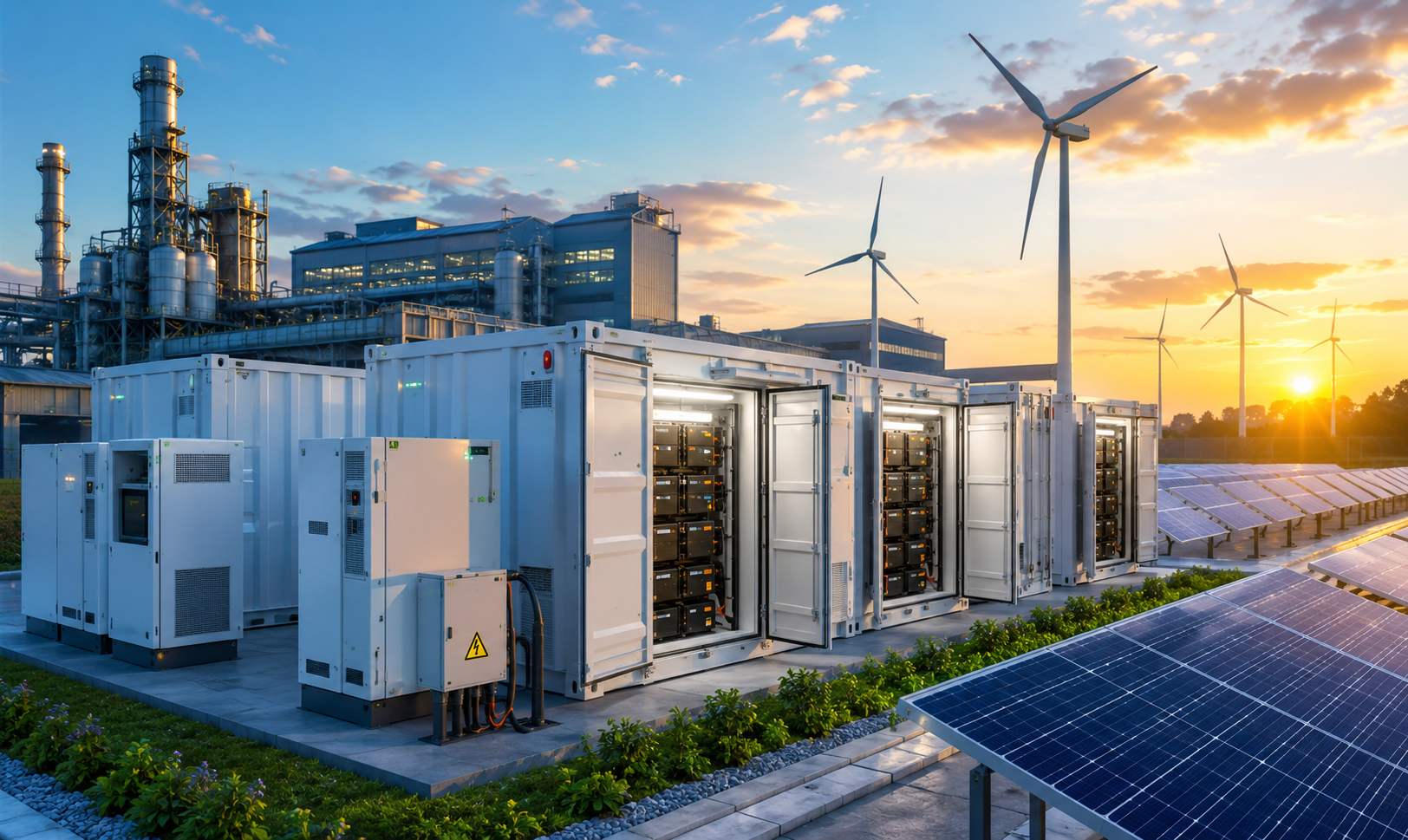
Rising Power Costs, Renewable Energy Expansion and Sustainability Goals to Drive Massive Investment Wave
India's commercial and industrial (C&I) energy storage sector is on the verge of a transformational growth phase, with industry estimates projecting an unprecedented rise in energy storage capacity over the next decade. According to a recent industry study, the country's C&I energy storage market could expand from less than 1 GWh in 2025 to as much as 2,231 GWh by 2032, highlighting the increasing importance of battery storage solutions in India's evolving energy landscape.
The projected growth reflects a combination of rising electricity costs, accelerating renewable energy adoption, growing concerns about energy reliability, and India's commitment to achieving ambitious climate and decarbonisation targets.
As industries focus on reducing energy expenses while improving sustainability, energy storage systems are rapidly transitioning from backup solutions to critical strategic assets.
Energy Storage Becomes a Core Business Necessity
For years, energy storage systems were primarily deployed as emergency backup power sources. However, the role of storage technology is evolving significantly.
Modern commercial and industrial consumers are increasingly using battery energy storage systems (BESS) for:
-
Peak demand management
-
Energy cost optimisation
-
Renewable energy integration
-
Grid independence
-
Operational continuity
-
Carbon footprint reduction
This shift is creating a large and rapidly expanding market for advanced energy storage technologies across manufacturing, infrastructure, commercial real estate, data centers, logistics parks, and industrial facilities.
Industry experts believe that energy storage will become a standard component of future industrial power infrastructure.
Why Demand for Energy Storage Is Rising
Several structural factors are driving adoption across India's commercial and industrial sectors.
Rising Electricity Tariffs
Industrial consumers continue to face increasing electricity costs, making energy optimisation a top priority.
Battery storage enables businesses to store electricity during off-peak periods and use it during expensive peak-demand hours, significantly reducing energy expenses.
Renewable Energy Integration
India's rapid expansion of solar and wind energy is creating demand for storage solutions that can balance intermittent power generation.
Energy storage allows organizations to maximize the utilization of renewable energy assets while ensuring a reliable power supply.
Energy Security and Reliability
Many industries require uninterrupted power for critical operations.
Storage systems improve resilience by providing instant backup power and reducing dependence on grid fluctuations and outages.
Sustainability Commitments
Corporates are increasingly adopting Environmental, Social and Governance (ESG) frameworks and net-zero targets.
Energy storage helps organizations achieve sustainability objectives while simultaneously reducing operating costs.
Market Growth Scenarios Highlight Massive Opportunity
The study outlines two possible growth trajectories for India's C&I energy storage sector.
Business-As-Usual Scenario
Under the Business-As-Usual (BAU) scenario, the market is expected to reach approximately 22-23 GWh by 2032.
This outlook assumes:
-
5-6 per cent annual growth in commercial and industrial electricity demand
-
Continued renewable energy growth
-
Stable policy support
-
Gradual reduction in battery costs
Rapid Adoption Scenario
A more aggressive growth scenario projects energy storage installations reaching nearly 31 GWh by 2032.
This scenario is based on:
-
Faster renewable energy deployment
-
Accelerated technology adoption
-
Stronger policy incentives
-
Significant battery cost reductions
-
Greater awareness among industrial consumers
Industry observers believe falling battery prices and supportive regulations could make the rapid adoption scenario increasingly achievable.
Battery Storage Technologies Evolving Rapidly
The sector is witnessing intense innovation across multiple energy storage technologies.
Lithium-Ion Batteries
Lithium-ion remains the dominant technology due to its declining costs, high efficiency, and scalability.
Lithium Iron Phosphate (LFP) batteries are particularly gaining popularity due to enhanced safety and longer life cycles.
Sodium-Ion Batteries
Sodium-ion technology is emerging as a promising alternative, offering lower costs and reduced dependence on critical minerals.
Vanadium Redox Flow Batteries
Flow batteries are attracting interest for long-duration storage applications where operational life and scalability are key requirements.
Pumped Hydro Storage
Large-scale pumped hydro projects continue to play an important role in supporting long-duration energy storage requirements.
The diversification of technologies is expected to improve competitiveness and accelerate market adoption.
Solar Plus Storage: The Next Growth Engine
One of the fastest-growing applications is the integration of battery storage with rooftop solar installations.
Commercial and industrial consumers are increasingly deploying solar-plus-storage systems to maximize energy savings and improve energy independence.
Benefits include:
-
Higher renewable energy utilization
-
Lower grid dependence
-
Improved return on investment
-
Reduced carbon emissions
-
Enhanced energy security
Industry experts expect solar-plus-storage solutions to become a mainstream investment for large commercial facilities over the next decade.
Diesel Generator Replacement Market Expands
Another major opportunity lies in replacing traditional diesel generator systems.
Many businesses continue to rely on diesel generators for backup power, resulting in high fuel costs and environmental concerns.
Battery storage systems offer several advantages:
-
Lower operating expenses
-
Reduced emissions
-
Minimal maintenance requirements
-
Better energy efficiency
-
Improved sustainability performance
As storage technology becomes more affordable, businesses are increasingly shifting away from diesel-based backup systems.
Manufacturing Sector Expected to Lead Adoption
Energy-intensive industries are likely to be among the largest adopters of storage technologies.
Key sectors include:
Manufacturing
Factories require stable and cost-efficient power for continuous operations.
Data Centers
Rapidly growing data center infrastructure requires reliable and uninterrupted energy supply.
Commercial Real Estate
Office parks, shopping malls, and business campuses are adopting storage solutions to improve energy efficiency.
Logistics and Warehousing
Large logistics facilities are integrating storage with solar systems to optimize energy costs.
Healthcare and Infrastructure
Critical infrastructure operators are increasingly investing in advanced energy resilience solutions.
Government Policies Supporting Growth
India's clean energy transition policies continue to create favorable conditions for energy storage investments.
Government initiatives focused on:
-
Renewable energy deployment
-
Grid modernization
-
Energy efficiency
-
Battery manufacturing
-
Electric mobility
-
Green hydrogen development
are expected to strengthen the long-term outlook for the storage industry.
Policy support combined with falling technology costs could significantly accelerate market growth over the coming years.
Investment Opportunities Across the Value Chain
The rapid expansion of the energy storage market presents opportunities for multiple industries.
Potential beneficiaries include:
-
Battery manufacturers
-
Renewable energy developers
-
Power electronics companies
-
Energy management software providers
-
Grid infrastructure firms
-
Industrial automation companies
-
Electrical equipment manufacturers
Investors are increasingly viewing energy storage as one of the most promising themes within India's clean energy ecosystem.
Industry Leaders to Discuss Future Outlook at IESW 2026
The findings will be showcased during the 12th India Energy Storage Week (IESW) 2026, scheduled to take place in New Delhi from July 8 to July 10.
The event is expected to bring together:
-
More than 200 exhibitors
-
Over 10,000 industry professionals
-
Delegates from over 30 countries
The conference will serve as a platform for discussing policy developments, technological innovations, investment opportunities, and future growth strategies.
Smart Investment View
India's commercial and industrial energy storage market is entering a period of accelerated expansion driven by economic, technological, and environmental factors. As businesses increasingly prioritize cost efficiency, energy security, and sustainability, battery storage systems are becoming an essential component of modern industrial infrastructure.
The convergence of rising electricity prices, rapid renewable energy deployment, supportive government policies, and declining battery costs creates a compelling long-term growth opportunity. Companies operating in battery manufacturing, renewable energy integration, power management, and energy technology solutions are likely to be among the key beneficiaries.
For investors, the energy storage sector represents one of the most attractive long-term themes within India's clean energy transition, offering substantial growth potential as the country moves toward a more resilient, sustainable, and technology-driven energy future.