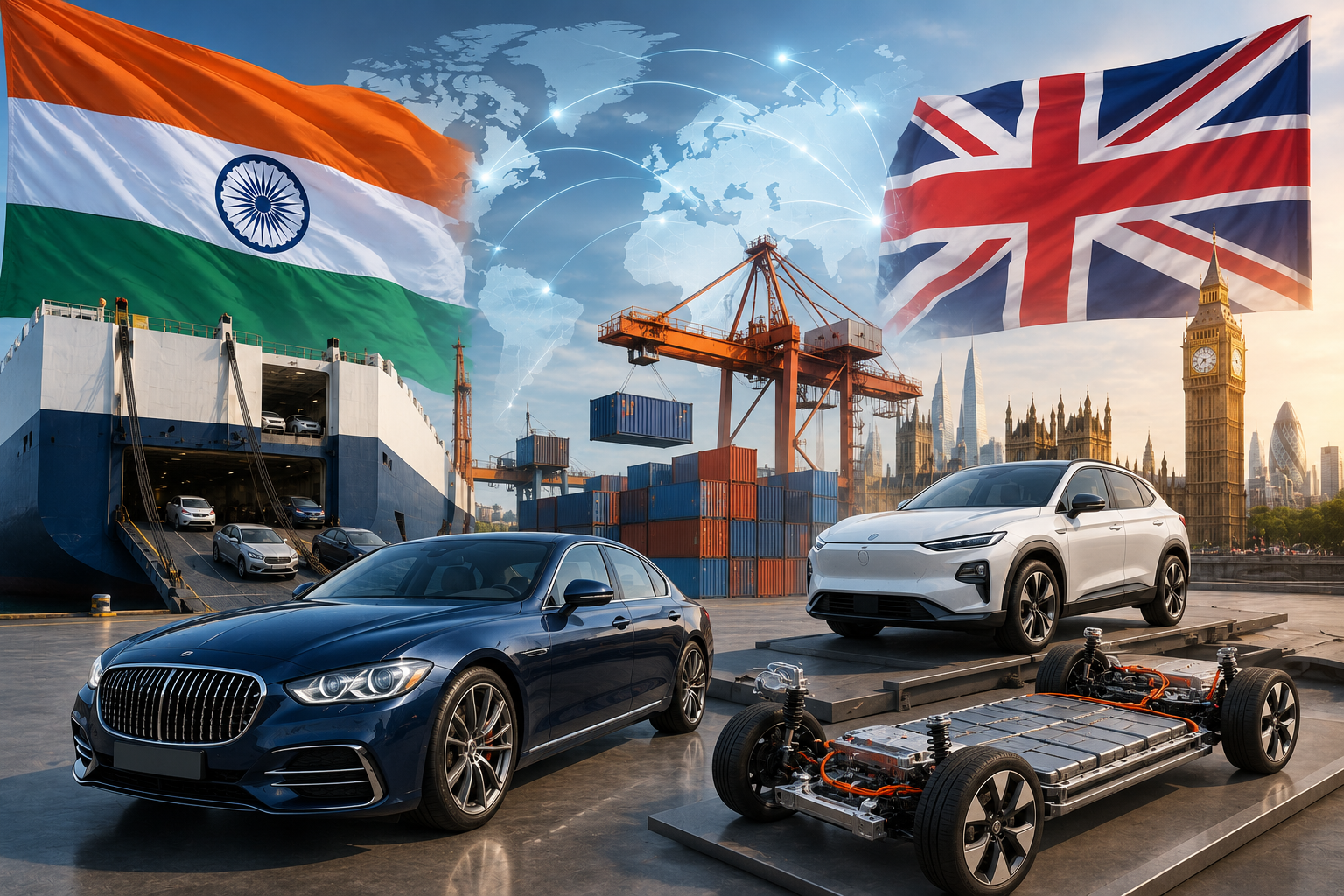
Landmark Trade Agreement to Reshape Automotive Trade Between India and the United Kingdom
India's automobile sector is set for a major transformation as the Comprehensive Economic and Trade Agreement (CETA) between India and the United Kingdom comes into effect on July 15, 2026. Under the landmark trade pact, India will allow the import of up to 3.78 lakh conventional-engine passenger vehicles from the UK at significantly reduced customs duties over the first 15 years of the agreement.
The move marks one of the most substantial market-opening measures in India's automotive sector and reflects the deepening economic partnership between the two countries.
The agreement is expected to create new opportunities for automakers, consumers, exporters, and investors while strengthening bilateral trade relations.
Import Duty on UK Vehicles to Drop Sharply
One of the most significant features of the trade agreement is the reduction in import duties on automotive products.
Currently, imported passenger vehicles attract customs duties of around 110 per cent. Under the new framework, duties on eligible vehicles imported from the UK will gradually decline to just 10 per cent within the agreed quota limits.
This reduction is expected to make several British automotive brands more competitively priced in the Indian market, potentially increasing consumer choice across premium and luxury vehicle segments.
Industry experts believe the lower duty structure could significantly boost automobile trade between the two countries over the coming decade.
Quota-Based Access to Protect Domestic Industry
While duties are being reduced, India has adopted a quota-based system to ensure a balanced opening of the market.
The agreement permits imports of up to 3.78 lakh conventional-engine passenger vehicles over a phased period of 15 years. This approach allows India to provide greater market access while also protecting domestic manufacturers from sudden disruptions.
Automobile industry observers note that the quota mechanism offers a measured pathway for trade liberalization, balancing consumer interests with the growth objectives of India's automotive manufacturing sector.
Opportunities for British Automakers
The agreement is expected to benefit several UK-based automobile manufacturers that have traditionally faced high import duties in India.
Lower tariffs could improve the competitiveness of British brands in categories such as:
-
Luxury passenger vehicles
-
Premium SUVs
-
Performance vehicles
-
Specialty automotive products
-
High-end hybrid models
The Indian market, which remains one of the fastest-growing automobile markets globally, presents significant long-term growth opportunities for international manufacturers.
With rising disposable incomes and growing demand for premium mobility solutions, British automakers could witness stronger sales growth under the new trade framework.
India Secures Major Gains in Electric Vehicle Exports
While the agreement provides greater access to the Indian market for UK automobiles, India has secured important benefits for its own automotive industry.
Under the CETA framework, India will gain preferential access to the UK's electric vehicle, hybrid vehicle, and hydrogen-powered vehicle segments.
From the sixth year of implementation, Indian manufacturers will be able to export eligible vehicles to the UK duty-free within specified quota limits.
This provision is being viewed as a significant opportunity for India's emerging electric vehicle ecosystem.
EV Export Quota to Reach 88,000 Units
According to the agreement, India's quota for duty-free exports of electric, hybrid, and hydrogen-powered passenger vehicles to the UK will gradually increase over time.
The quota will eventually reach 88,000 vehicles annually by the fifteenth year of the agreement and continue at that level in subsequent years.
The export eligibility covers vehicles priced between GBP 20,000 and GBP 80,000, creating opportunities for Indian manufacturers to participate in higher-value automotive segments.
Industry analysts believe this could encourage Indian companies to invest further in advanced electric mobility technologies and export-oriented manufacturing facilities.
Boost for India's EV Manufacturing Ambitions
The agreement arrives at a time when India is aggressively promoting electric mobility and clean transportation technologies.
The government's focus on EV adoption, battery manufacturing, green hydrogen, and sustainable mobility solutions has already attracted substantial investments from domestic and international companies.
Access to the UK market could further strengthen India's ambition of becoming a global manufacturing hub for electric vehicles and next-generation automotive technologies.
Several Indian manufacturers have already announced plans to expand EV production capacities and develop export-focused product portfolios.
Impact on Consumers
For Indian consumers, the agreement could translate into a wider range of vehicle choices and more competitive pricing in select categories.
Lower import duties may lead to:
Increased Product Availability
More vehicle models from UK-based manufacturers could become available in India.
Greater Competition
Higher competition may encourage innovation and improved offerings across the industry.
Premium Segment Expansion
Luxury and premium vehicle buyers could benefit from improved affordability.
Technology Transfer
Increased international participation may accelerate the introduction of advanced automotive technologies.
However, industry experts believe the overall impact on mass-market vehicle pricing may remain limited as domestic manufacturers continue to dominate the volume segment.
What It Means for India's Auto Industry
The trade agreement is expected to encourage Indian automakers to improve competitiveness, invest in innovation, and strengthen export capabilities.
India's automobile industry remains one of the largest globally and has established itself as a major manufacturing hub for passenger vehicles, commercial vehicles, and auto components.
The agreement could accelerate:
-
Technology collaboration
-
Joint ventures
-
Component exports
-
EV investments
-
Advanced manufacturing capabilities
-
Global supply chain integration
Many industry participants view the pact as an opportunity rather than a threat, particularly given the phased implementation and quota-based structure.
Economic Significance of the India-UK Trade Pact
The automotive provisions form part of the broader India-UK Comprehensive Economic and Trade Agreement, which aims to increase bilateral trade, investment, and economic cooperation.
The agreement covers multiple sectors, including:
-
Manufacturing
-
Financial services
-
Technology
-
Pharmaceuticals
-
Textiles
-
Agriculture
-
Renewable energy
Both countries expect the pact to significantly enhance trade volumes and create new business opportunities over the coming years.
Smart Investment View
The India-UK trade agreement represents a strategic step toward deeper economic integration between two major economies. While the reduction in automobile import duties will attract attention, the long-term significance lies in the opportunities it creates for India's automotive industry, particularly in electric vehicles and advanced mobility technologies.
The phased opening of the market, combined with export opportunities for Indian EV manufacturers, creates a balanced framework that supports both consumer choice and domestic industry growth.
For investors, the agreement could benefit automobile manufacturers, auto component suppliers, EV ecosystem companies, logistics providers, and export-oriented businesses. As India positions itself as a global automotive and electric mobility hub, the trade pact may become an important catalyst for long-term sector growth.