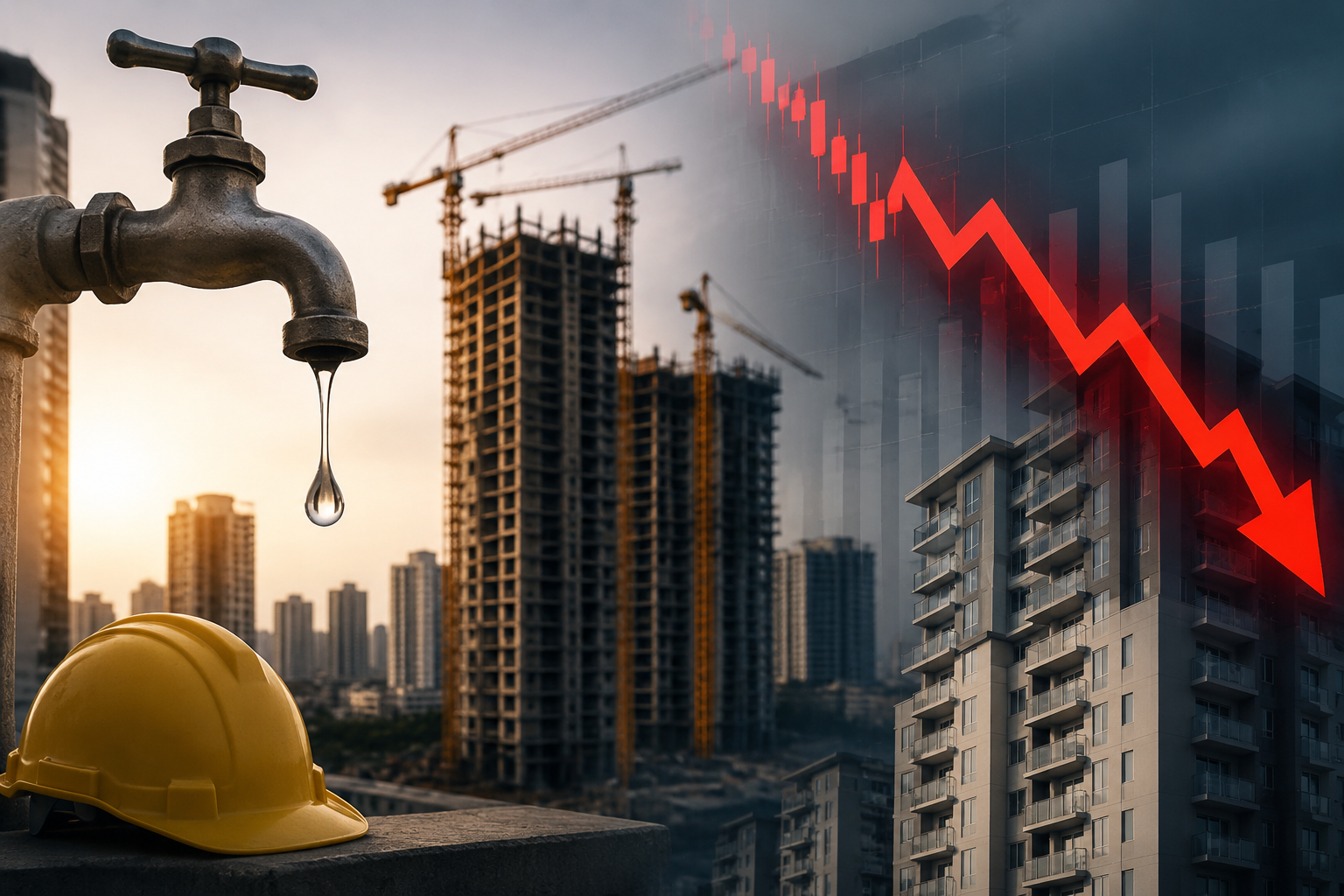
📉 Lodha, Oberoi Realty Lead Declines as Nifty Realty Index Turns Top Sectoral Loser
Indian real estate stocks witnessed selling pressure in Wednesday’s trading session, with key developers such as Lodha Developers, Oberoi Realty, and Godrej Properties falling up to 4% during intraday trade. The weakness dragged the Nifty Realty index down nearly 1%, making it the worst-performing sector, even as the broader Nifty 50 posted modest gains of around 0.2%.
The decline comes after a strong rally in recent sessions, where the realty index had surged nearly 10% in just three days, significantly outperforming the broader market. This sharp move triggered profit booking, while fresh concerns around construction activity added further pressure.
🚰 BMC Water Supply Cut Raises Execution Risk for Developers
The immediate trigger for the sector’s weakness was the Brihanmumbai Municipal Corporation (BMC) announcement to:
- Suspend water supply to construction sites and swimming pools
- Impose a 20% reduction in water supply to industrial and commercial users
Market participants believe this decision could directly impact ongoing construction timelines, especially in Mumbai’s high-density real estate zones where large-scale projects depend heavily on consistent utility access.
Developers now face concerns over:
- Potential delays in project execution
- Higher operational inefficiencies at sites
- Short-term cost escalation due to alternative water sourcing
📊 Stock-Wise Impact Across Realty Space
Heavyweights in the sector saw broad-based selling:
- Lodha Developers: down ~4%
- Oberoi Realty: down ~3%
- Prestige Estates Projects: down 1–2%
- Aditya Birla Real Estate and Anant Raj also traded lower
The correction highlights sensitivity of realty stocks to local regulatory and infrastructure constraints, particularly in Mumbai, India’s most expensive and active property market.
🏗️ Rising Costs and Execution Bottlenecks Add to Sentiment Pressure
Beyond the immediate trigger, the sector continues to grapple with structural concerns:
📌 Input Cost Pressure
Volatility in steel, cement, and construction materials continues to weigh on developer margins, although companies report manageable impact so far.
📌 Project Execution Challenges
Timely delivery remains dependent on:
- Labour availability
- Regulatory approvals
- Utility access (water and electricity)
- Weather disruptions and litigation risks
These factors collectively create intermittent pressure on earnings visibility.
🏙️ Long-Term Outlook Still Constructive Despite Near-Term Volatility
Despite short-term weakness, analysts remain optimistic about the sector’s medium-term trajectory. Demand for premium and luxury housing remains strong, supported by:
- Infrastructure expansion in Mumbai (metro, coastal road, trans-harbour links)
- Healthy end-user demand across major metros
- Strong pre-sales pipeline for FY27
- Continued urbanisation-led housing demand
Brokerages note that developers with strong balance sheets and premium positioning are better placed to navigate near-term disruptions.
📌 Conclusion
The correction in realty stocks appears to be a combination of profit booking after a sharp rally and concerns over construction disruptions due to BMC’s water supply restrictions. While near-term volatility may persist, the structural demand story for India’s real estate sector remains intact, supported by infrastructure growth and strong housing absorption trends.