Fragile Diplomatic Breakthrough Raises Questions Over Long-Term Stability, Energy Security, and Regional Order
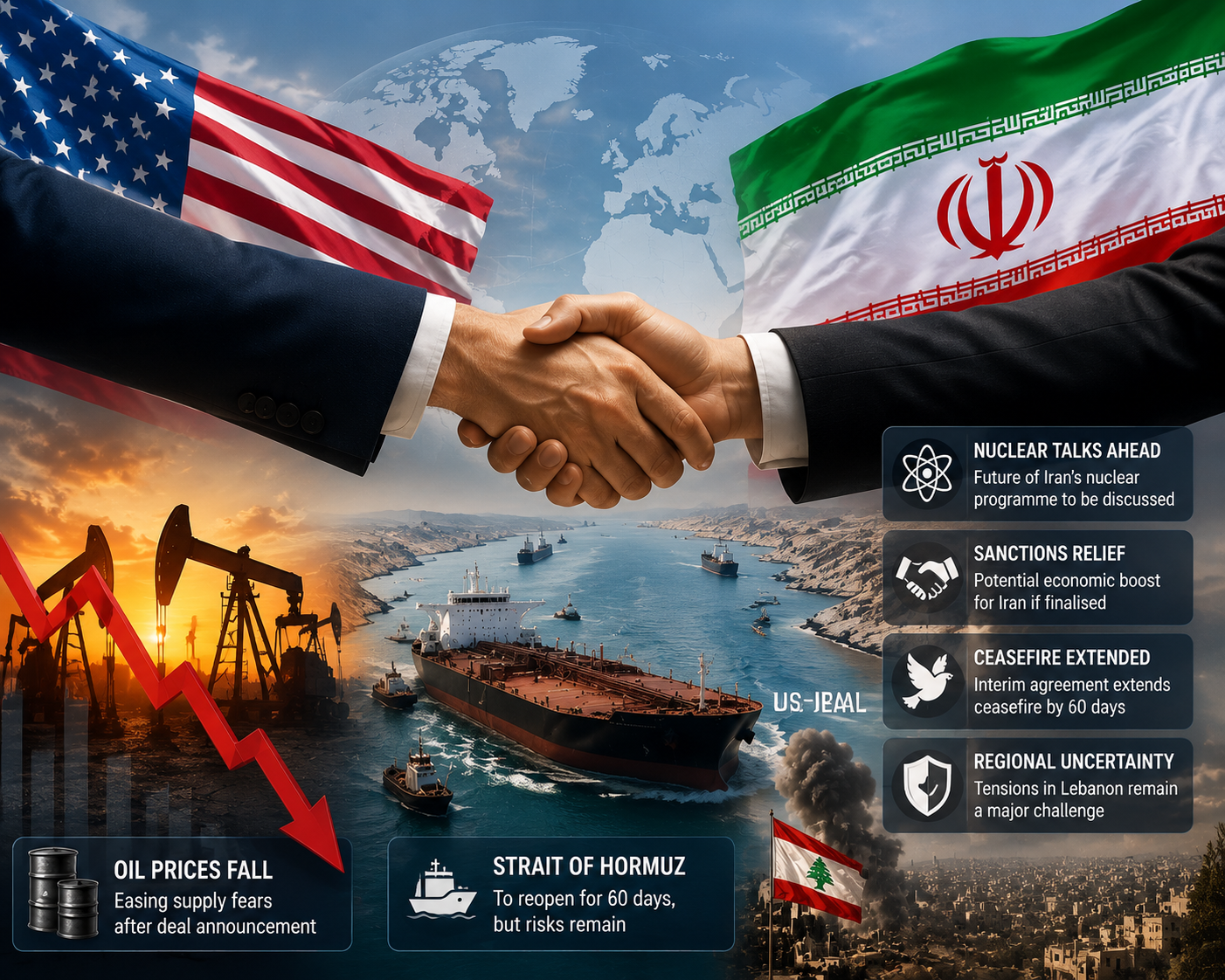
Global financial markets reacted cautiously to news of a preliminary US–Iran agreement aimed at ending months of conflict in the Middle East. While the deal has eased immediate geopolitical tensions and triggered a sharp fall in crude oil prices, analysts warn that major structural issues remain unresolved, leaving investors exposed to ongoing volatility.
The interim agreement, described by officials as a “framework for further negotiation,” includes a temporary extension of ceasefire arrangements and provisions to reopen the strategically critical Strait of Hormuz. However, both sides have acknowledged that a final, comprehensive peace settlement is still far from complete.
Markets React to Falling Oil Prices and Easing Risk Premium
Global equity markets and commodities reacted positively to the announcement, with crude oil sliding to multi-month lows as fears of supply disruption eased.
The Strait of Hormuz, through which nearly one-fifth of global oil and LNG flows, had been partially disrupted during the conflict. Its potential reopening has been viewed as a major relief for energy-importing economies such as India, Japan, and parts of Europe.
Key Market Impacts:
- Crude oil prices decline sharply on easing supply fears
- Equity markets in Asia and Europe show risk-on sentiment
- Energy and airline stocks benefit from lower input costs
- Safe-haven assets such as gold come under pressure
Despite the positive reaction, analysts caution that shipping insurance premiums and freight volatility may remain elevated until full maritime security is restored.
Political Framework Still Lacks Final Agreement
U.S. President Donald Trump described the agreement as “done in principle,” but emphasized that it is only the first stage of a broader diplomatic process.
Iranian officials have similarly confirmed that the document represents an interim arrangement rather than a permanent peace treaty.
Key unresolved issues include:
- Long-term status of Iran’s nuclear enrichment programme
- Future sanctions framework and economic relief measures
- Regional security architecture involving proxy groups
- Verification mechanisms for compliance enforcement
A second round of negotiations is expected to begin in Geneva, where both sides will attempt to formalize the next phase of the agreement.
Strait of Hormuz: The World’s Most Critical Energy Chokepoint
A central feature of the deal is the proposed reopening of the Strait of Hormuz, a narrow maritime corridor responsible for a significant portion of global oil and gas shipments.
However, maritime experts warn that restoring full confidence in the route may take weeks or even months due to security concerns.
Ongoing Risks Include:
- Possible naval mines and unexploded ordnance
- Delays in resuming full shipping operations
- Insurance and freight rate uncertainty
- Geopolitical enforcement disputes over control of the strait
Even if the strait is reopened officially, commercial shipping may normalize only gradually as operators reassess risk levels.
Sanctions Relief Could Reshape Iran’s Economy
Reports suggest the framework includes a substantial sanctions relief package that could unlock frozen assets and revive Iran’s energy exports.
If fully implemented in a final agreement, the economic impact could be significant:
- Restoration of oil export capacity
- Potential inflows of foreign investment
- Stabilization of currency and inflation pressures
- Reconstruction funding for war-affected infrastructure
However, U.S. officials have indicated that sanctions relief would be conditional on Iran meeting strict requirements related to nuclear non-proliferation and regional militancy concerns.
Regional Flashpoints Remain Unresolved
Despite progress in US–Iran talks, broader regional tensions—particularly in Lebanon—continue to complicate the geopolitical outlook.
The ongoing conflict involving Israel and Hezbollah remains outside the scope of the current negotiations, raising concerns that instability could persist even if a US–Iran deal is finalized.
Key Concerns:
- Continued military presence in southern Lebanon
- Disagreements over ceasefire enforcement
- Risk of renewed escalation involving regional proxies
Analysts suggest that without broader regional de-escalation, markets may remain sensitive to sudden geopolitical shocks.
Investor Outlook: Relief Rally or Temporary Pause?
For investors, the agreement presents a classic “risk-on” catalyst—but with significant uncertainty attached.
Positive Factors:
- Lower crude oil prices improve inflation outlook
- Improved global risk sentiment supports equities
- Reduced immediate threat of energy supply shock
Key Risks:
- Lack of clarity on final agreement structure
- Fragile ceasefire conditions
- Potential breakdown in negotiations
- Persistent regional instability
Conclusion
The US–Iran interim agreement marks a notable diplomatic shift that has already influenced global markets, particularly in energy and equities. However, the absence of a finalized treaty and unresolved geopolitical challenges suggest that volatility is likely to persist.
For investors, the development offers short-term optimism but requires continued caution as negotiations move into a more complex and uncertain second phase.