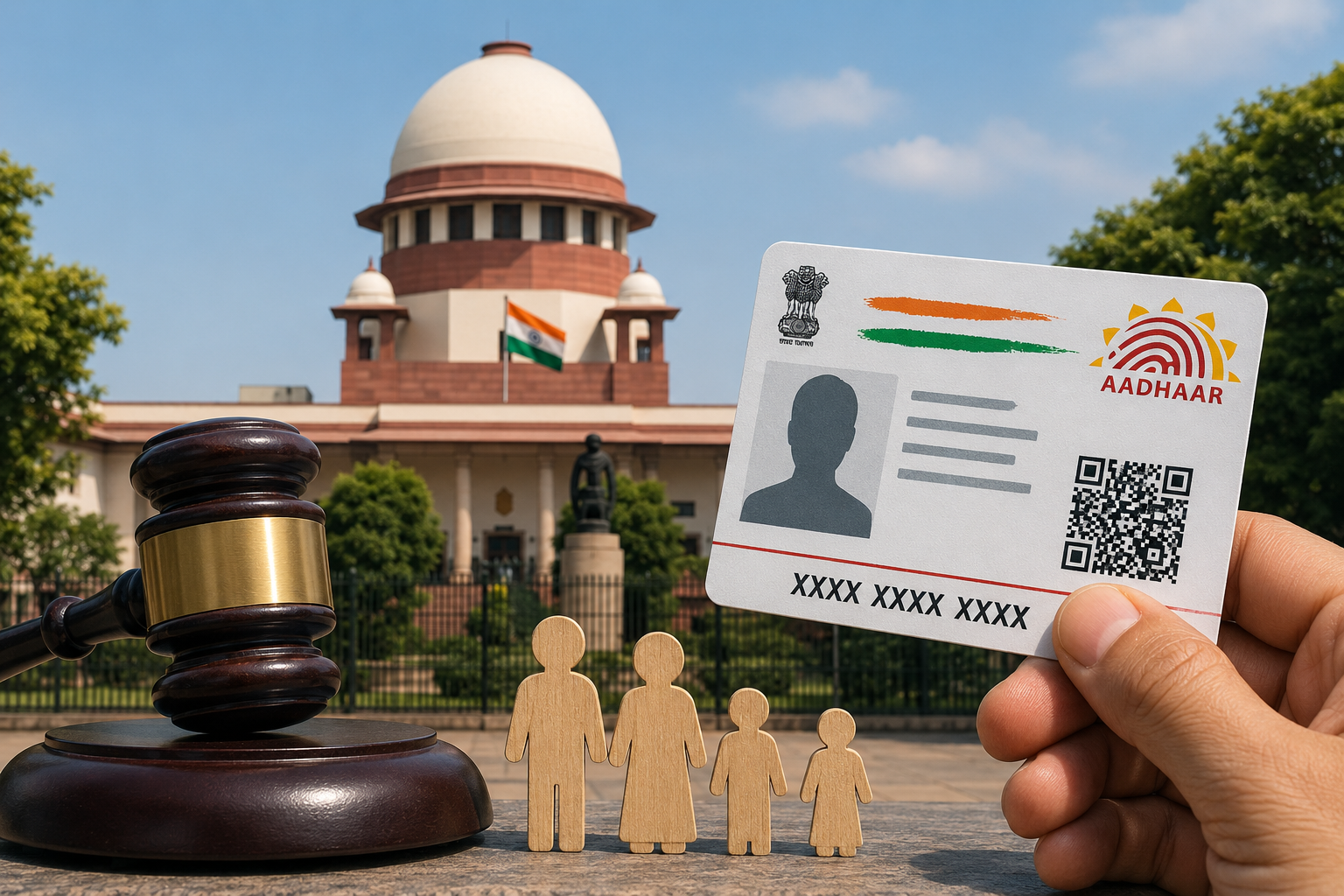
Petition Seeks Clear Separation Between Identity Verification and Proof of Citizenship, Domicile and Residence
The Supreme Court is set to hear a significant public interest litigation (PIL) that could have far-reaching implications for the use of Aadhaar in administrative and governance processes across India. The petition seeks stricter implementation of existing legal provisions by ensuring that Aadhaar is used solely as a proof of identity and not as evidence of citizenship, domicile, residential status or date of birth.
The case comes at a time when Aadhaar has become one of the most widely used identification documents in the country, playing a crucial role in welfare delivery, banking, taxation, telecommunications and numerous government services.
Legal experts believe the hearing could provide important clarity on the scope and legal status of Aadhaar within India's documentation framework.
Core Issue Before the Apex Court
The petition argues that Aadhaar was designed primarily as a unique identity verification system and should not be treated as proof of nationality or citizenship. The plea requests directions to the Central Government, state governments and the Election Commission to ensure that Aadhaar is used only for identity authentication purposes.
According to the petitioner, confusion regarding the legal scope of Aadhaar has led to its acceptance in situations where documents establishing citizenship, domicile or residency are required.
The petition seeks judicial intervention to ensure that government departments and public institutions follow uniform standards regarding document verification.
Understanding Aadhaar's Original Purpose
Introduced as a unique identification system, Aadhaar assigns a 12-digit number linked to an individual's biometric and demographic information. The objective was to create a reliable mechanism for identity verification and improve the delivery of public services and subsidies.
Over the years, Aadhaar has become deeply integrated into India's digital governance ecosystem, helping streamline welfare schemes, financial inclusion initiatives and public service delivery.
However, experts note that Aadhaar enrollment is based on residency criteria and not citizenship status. As a result, legal distinctions between identity verification and citizenship determination have remained an important aspect of policy discussions.
Identity Proof Versus Citizenship Proof
One of the central arguments in the case is the distinction between proving who a person is and proving their legal citizenship status.
Identity documents are designed to establish an individual's identity, while citizenship-related documents serve the purpose of confirming nationality and legal eligibility for certain rights and benefits. Similarly, separate documents are often used to establish domicile, place of residence and date of birth.
The petition contends that blurring these distinctions can create administrative inconsistencies and legal ambiguities.
A clear judicial interpretation could help reinforce the separate roles of various official documents used across government systems.
Potential Impact on Government Procedures
The outcome of the hearing may influence how government departments, public institutions and regulatory bodies verify information related to identity, residence and citizenship.
Many administrative processes rely on document verification for eligibility assessments, service delivery and compliance requirements. A clarification from the Supreme Court could lead to updated guidelines regarding the documents acceptable for specific purposes.
Such a development may encourage greater standardization across departments and reduce confusion among citizens regarding documentation requirements.
Electoral Implications Under Scrutiny
The petition also raises concerns related to electoral processes. Voting eligibility in India is determined through a combination of legal requirements, including citizenship, age and residency criteria.
The plea argues that Aadhaar should not be treated as standalone proof of these requirements and that appropriate verification mechanisms should remain in place.
Election administrators and legal observers are expected to closely monitor the proceedings, as any clarification from the court could influence future documentation practices related to voter registration and electoral rolls.
Broader Debate on Documentation Standards
The case has reignited discussions regarding documentation standards in India's rapidly digitizing governance framework. As technology-driven systems become more integrated into public administration, ensuring clarity regarding the purpose of different documents has become increasingly important.
Experts argue that maintaining clear distinctions among identity, citizenship, residence and age-related documents strengthens administrative accuracy and legal certainty.
The hearing is expected to contribute to the broader debate on balancing efficiency in governance with adherence to legal and constitutional principles.
Aadhaar's Expanding Role in Digital Governance
Over the past decade, Aadhaar has evolved into one of the largest digital identity systems in the world. It has facilitated direct benefit transfers, reduced duplication in welfare programs and enhanced access to banking and financial services.
The platform has played a key role in India's digital transformation efforts by enabling secure identity verification across multiple sectors.
While its benefits are widely acknowledged, its expanding use has periodically prompted legal and policy discussions regarding privacy, authentication, documentation standards and the limits of its applicability.
Legal Significance of the Case
Constitutional experts believe the case could become an important reference point for future interpretations regarding the legal status of Aadhaar and its permissible applications.
The Supreme Court's observations may help establish clearer guidelines for administrative authorities, reducing inconsistencies in how Aadhaar is treated across different institutions.
A judgment or directive could also influence future policymaking related to digital identity systems and public documentation frameworks.
Stakeholders Closely Watching Proceedings
The hearing has attracted attention from policymakers, legal professionals, election officials, governance experts and civil society organizations. The outcome could affect multiple sectors that rely on Aadhaar-based verification systems.
Government departments may also review existing practices if the court provides specific guidance regarding the use of Aadhaar for citizenship, domicile or residence-related matters.
The proceedings are expected to be closely followed because of their potential impact on documentation policies affecting millions of citizens.
Outlook
As the Supreme Court prepares to hear the petition, the case highlights the growing importance of clear legal definitions within India's expanding digital governance framework. The central question is not whether Aadhaar remains a vital identification tool, but whether its use should be confined strictly to identity verification.
A judicial clarification could strengthen administrative consistency, improve documentation standards and provide greater certainty regarding the role of Aadhaar in public life. The outcome may ultimately shape how identity, citizenship and residency are distinguished within India's legal and governance systems for years to come.