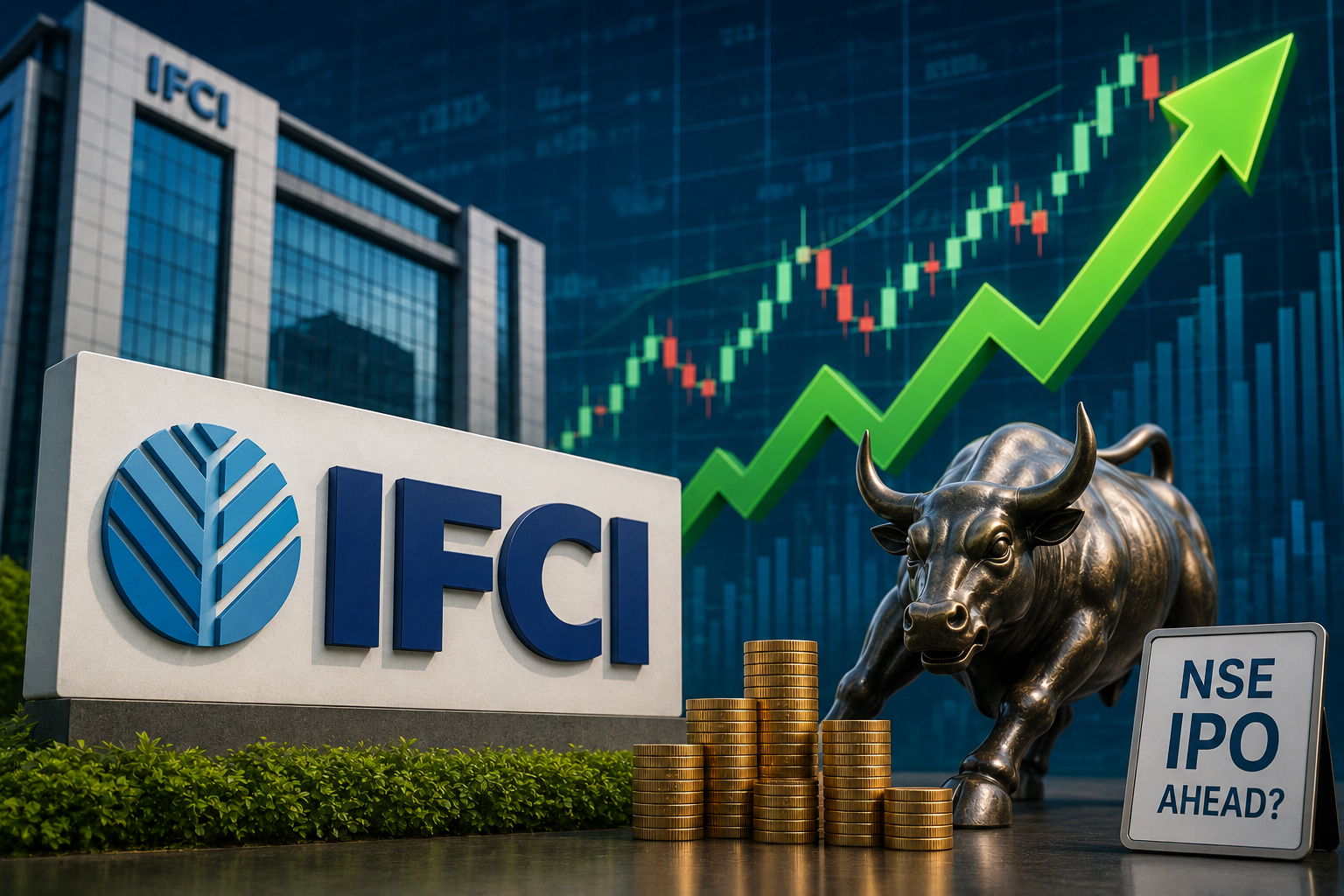
Investors Bet on Hidden Value in IFCI's Indirect Stake in National Stock Exchange
Shares of IFCI Ltd have witnessed a remarkable surge in 2026, significantly outperforming the broader market as investors increasingly focus on the company's indirect exposure to the proposed initial public offering (IPO) of the National Stock Exchange (NSE). The sharp rally reflects growing optimism that the long-awaited listing of India's largest stock exchange could unlock substantial value for shareholders linked to the exchange.
The state-owned financial institution has emerged as one of the strongest-performing public sector stocks this year, attracting renewed investor interest amid expectations of a major value-unlocking event within India's capital markets ecosystem.
NSE IPO Moves Closer to Reality
Market sentiment received a major boost following reports that the National Stock Exchange is preparing to advance its IPO process. The anticipated public listing is considered one of the most significant developments in India's financial sector, given NSE's dominant position in equity derivatives, cash market trading and overall market infrastructure.
The proposed IPO is expected to be structured as an offer-for-sale, enabling existing shareholders to monetize part of their holdings while providing greater transparency and market-based valuation for the exchange.
For investors, the prospect of NSE's listing has triggered renewed interest in companies that hold direct or indirect stakes in the exchange.
IFCI's Strategic Connection to NSE
A key factor driving IFCI's rally is its controlling stake in Stock Holding Corporation of India Limited (SHCIL), a financial services company that owns a stake in the National Stock Exchange.
Through its majority ownership in SHCIL, IFCI effectively gains indirect exposure to the value embedded in NSE. As market participants attempt to estimate the potential valuation of the exchange post-listing, attention has increasingly shifted toward shareholders that could benefit from this value realization.
Analysts believe that the market is beginning to factor in the possibility that a successful NSE listing could enhance the perceived value of IFCI's investment portfolio and strengthen its asset base.
Massive Outperformance Against Benchmark Indices
The rally in IFCI shares has been significantly stronger than the broader equity market. While benchmark indices have faced periods of volatility in 2026 due to global uncertainties and foreign investor outflows, IFCI has delivered exceptional returns driven by company-specific catalysts.
The stock's strong performance demonstrates how value-unlocking opportunities can generate substantial investor interest even when broader market conditions remain mixed.
Trading volumes have also increased considerably, reflecting heightened participation from retail investors, traders and institutional market participants seeking exposure to the NSE IPO theme.
Why Investors Are Looking Beyond Traditional Fundamentals
The recent momentum in IFCI highlights a broader market trend where investors are identifying hidden asset values within holding companies and financial institutions.
Rather than focusing solely on operational earnings, market participants are increasingly evaluating the underlying worth of strategic investments, subsidiaries and equity stakes held by listed companies.
In IFCI's case, the spotlight has shifted toward its indirect ownership structure and the potential valuation benefits that may emerge if NSE's market capitalization receives a strong response following its public listing.
Broader Impact on Capital Market Stocks
The excitement surrounding the NSE IPO has not been limited to IFCI alone. Investors have also shown increased interest in several financial institutions and organizations that hold stakes in the exchange.
The listing could potentially unlock value across a wide network of shareholders, including insurance companies, banks, investment institutions and foreign investors that have maintained long-term positions in NSE over the years.
As a result, the broader financial services sector may continue to attract investor attention as the IPO process progresses.
Strong Outlook for India's Capital Markets
The anticipated listing of NSE comes at a time when India's capital markets continue to witness growing participation from retail and institutional investors. Rising demat account openings, increased trading activity and expanding mutual fund investments have strengthened the long-term outlook for market infrastructure companies.
A successful IPO could further enhance investor confidence in India's financial ecosystem while providing greater visibility into the valuation of one of the country's most strategically important financial institutions.
The development also reflects the increasing maturity and depth of India's capital markets, which continue to attract domestic and global investment interest.
Risks Investors Should Monitor
Despite the strong optimism, market experts caution that investors should remain aware of potential risks. Regulatory approvals, IPO timelines, market conditions and final valuation expectations will all play an important role in determining the ultimate impact on shareholder value.
Additionally, stocks that rally sharply on anticipated events can experience periods of volatility as investors reassess expectations and book profits.
Therefore, while the NSE IPO theme remains a powerful catalyst, investors are advised to focus on long-term fundamentals and valuation considerations.
Market Outlook
With the NSE IPO gaining momentum, IFCI is likely to remain firmly on investors' radar in the coming months. The company's indirect exposure to one of India's most valuable financial institutions has created a compelling investment narrative that continues to attract market attention.
If the listing process advances smoothly and investor demand remains strong, the value-unlocking story surrounding IFCI could continue to support positive sentiment. However, market participants will closely monitor regulatory developments, valuation benchmarks and broader market conditions before determining the full impact of the IPO on the company's future prospects.