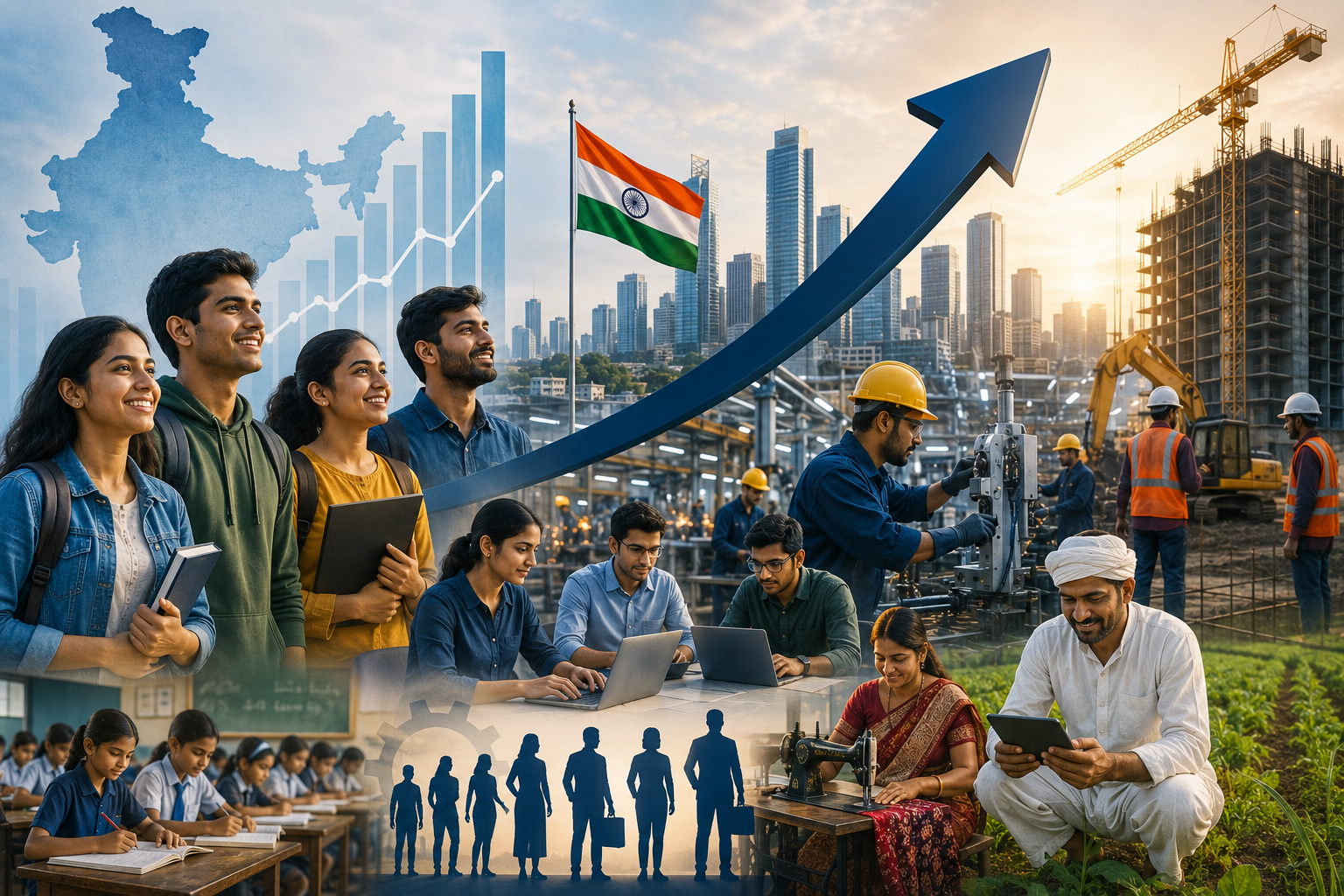
Falling fertility rates are not India's biggest challenge anymore; creating productive employment and boosting workforce productivity now hold the key to long-term growth
India's demographic story is entering a decisive new chapter. While the country's fertility rate has fallen below the replacement level of 2.1 children per woman, experts believe the more important question is no longer about population growth but about economic opportunity.
India still possesses one of the world's largest and youngest workforces, providing a significant demographic advantage over many developed economies facing labour shortages and ageing populations. However, economists warn that this opportunity will only translate into sustained prosperity if the country can generate sufficient jobs, improve workforce participation and enhance productivity over the next two decades.
The coming years are expected to determine whether India can fully capitalize on its demographic dividend before demographic ageing gradually begins to reshape the economy.
India Remains One of the World's Youngest Major Economies
Despite declining fertility rates, India continues to benefit from a favourable age structure. More than two-thirds of the country's population remains within the working-age bracket, creating a large labour pool capable of supporting economic expansion.
Unlike many developed economies where shrinking workforces have become a structural challenge, India still enjoys a growing labour force supported by population momentum. Millions of young people continue to enter the workforce every year, ensuring that labour supply remains robust well into the 2030s.
This demographic advantage provides India with a unique opportunity to accelerate industrialisation, increase consumption and strengthen its position in global manufacturing and services markets.
Fertility Decline Reflects Economic and Social Progress
India's fertility rate has fallen dramatically over the past five decades, dropping from nearly five children per woman in the early 1970s to below replacement levels today.
The decline has been driven by a combination of factors, including improved education, urbanisation, rising incomes, better healthcare access and greater participation of women in education and employment.
Smaller family sizes are increasingly becoming the norm as households prioritise education, healthcare and quality of life over larger numbers of children.
This demographic transition is consistent with patterns observed across many rapidly developing economies around the world.
Population Momentum Keeps Growth Intact
A common misconception is that a fertility rate below replacement level automatically leads to immediate population decline.
In reality, India's population will continue growing for several decades because of population momentum. The country still has a massive young population entering reproductive and working ages, ensuring that total births remain substantial even as individual families become smaller.
As a result, India's demographic dividend remains intact, although the window is gradually narrowing.
Experts estimate that India could continue benefiting from a favourable age structure through the 2030s and potentially into the early 2040s before ageing becomes a more significant economic factor.
Employment Generation Becomes the Defining Challenge
While India has no shortage of workers, the critical challenge is creating enough productive jobs.
Economic growth alone does not guarantee employment generation. Policymakers increasingly face the task of ensuring that millions of new labour market entrants find meaningful and productive work.
Several sectors have the potential to absorb large numbers of workers, including manufacturing, logistics, tourism, healthcare, construction, retail and modern services.
The success of initiatives such as Make in India, Production Linked Incentive (PLI) schemes and infrastructure expansion will be closely linked to their ability to generate large-scale employment opportunities.
Without adequate job creation, demographic advantages can quickly turn into economic and social challenges.
Female Workforce Participation Holds Untapped Potential
One of the largest opportunities for India lies in increasing female labour force participation.
Although educational attainment among women has improved significantly, workforce participation rates remain below those of many comparable economies.
Greater inclusion of women in formal employment could substantially expand India's effective workforce, increase household incomes and improve economic productivity.
Experts believe that investments in childcare infrastructure, workplace flexibility, safety measures and skill development programs could play a crucial role in unlocking this untapped potential.
Productivity Must Become the Next Growth Driver
As fertility declines and workforce growth gradually slows, India's economic success will increasingly depend on productivity gains rather than population expansion.
Future growth will require workers to produce more value through better skills, technology adoption and innovation.
Manufacturing industries are becoming more automated and technology-intensive, while service sectors increasingly demand advanced digital and analytical capabilities.
This shift means that simply expanding workforce numbers will no longer be sufficient. Enhancing worker productivity will become equally important.
Countries that successfully transitioned from middle-income to high-income status typically achieved sustained productivity growth through investments in education, technology and innovation.
Skill Development Will Determine Competitiveness
India's ability to compete in a rapidly evolving global economy depends heavily on workforce readiness.
While millions of workers receive training every year, businesses continue to report skill gaps in areas such as advanced manufacturing, artificial intelligence, data analytics, automation and digital technologies.
Industry leaders argue that future skilling initiatives must focus not only on certifications but also on practical workplace capabilities.
Stronger collaboration between educational institutions, industry and government could help bridge the gap between training and employment outcomes.
Vocational education, apprenticeships and continuous reskilling programs are expected to become increasingly important as technology reshapes labour markets.
Ageing Population Will Create New Policy Priorities
Although India remains young today, demographic ageing is inevitable.
Over the coming decades, the share of elderly citizens is expected to rise significantly, increasing demand for healthcare, pensions, social security and elder-care services.
Preparing for this transition requires long-term planning while the demographic dividend remains favourable.
Countries that failed to prepare for ageing often faced rising fiscal pressures and slower economic growth. India has the opportunity to build stronger healthcare systems, retirement frameworks and social safety nets before ageing becomes a major challenge.
Can India Get Rich Before It Gets Old?
The central question facing policymakers is whether India can achieve broad-based prosperity before demographic ageing begins to weigh on growth.
The country enters this phase with several advantages, including rapid digitisation, strong infrastructure investment, expanding manufacturing capabilities and growing global economic influence.
However, per-capita income levels remain significantly below those of countries that achieved high-income status before ageing accelerated.
The success of India's next growth phase will therefore depend less on population size and more on the quality of jobs, productivity improvements, human capital development and institutional strength.
Outlook: Demographics Alone Are No Longer Enough
India's demographic arithmetic remains favourable, but the nature of the opportunity is changing. The next stage of growth will not be determined by how many people enter the workforce, but by how effectively they are employed, trained and integrated into a modern economy.
The demographic dividend remains one of India's greatest strengths, but it is not guaranteed. Turning that advantage into long-term prosperity will require sustained focus on job creation, skills development, productivity enhancement and inclusive economic growth.
The coming decade may ultimately determine whether India successfully transforms its demographic potential into lasting economic success.